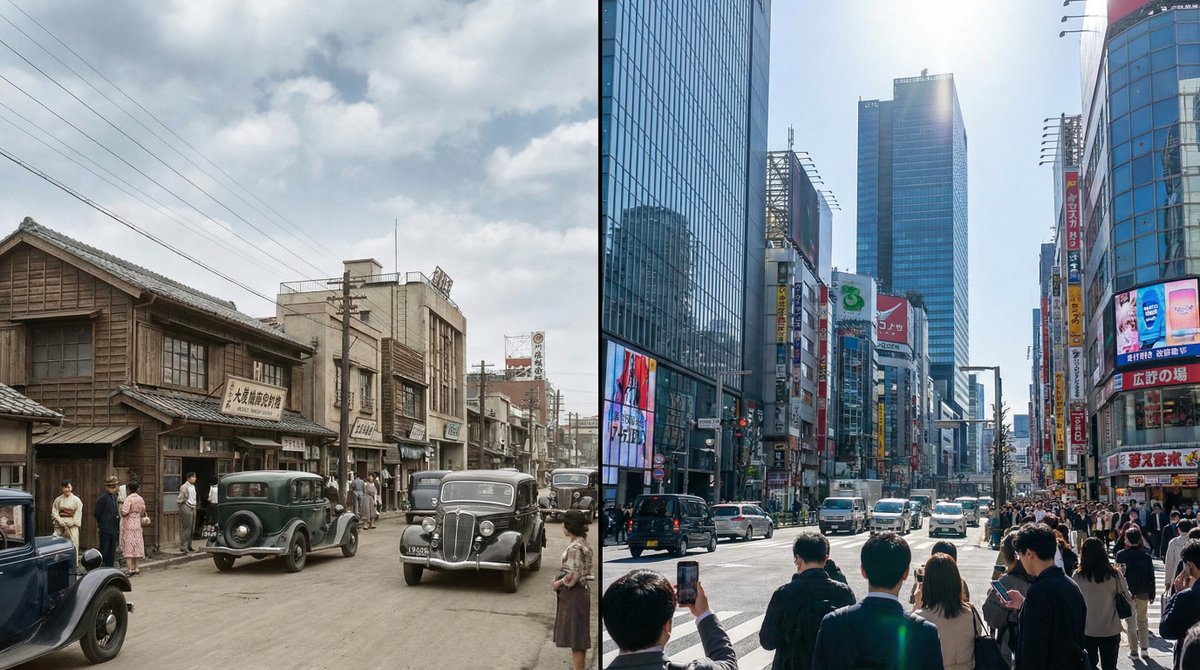
Split-screen time-lapse of same location by coordinates
Full prompt
Generate a single photorealistic 16:9 image and split its composition into left and right halves. On each side, depict the same place,
[LOCATION_NAME: {argument name="location_name_en" default="(any location)"}],
at different eras.
Left side: {argument name="left_year_en" default="(any year)"} · {argument name="left_time_en" default="(time)"}
Right side: {argument name="right_year_en" default="(any year)"} · {argument name="right_time_en" default="(time)"}
Keep the camera position exactly the same and use the following coordinates:
[LATITUDE,LONGITUDE: {argument name="coordinates_en" default="(latitude and longitude of any place)"}]
Do not include any text in the image (years, labels, watermarks, etc.). Do not specify detailed visuals.
Leave all aspects such as architecture, light, cars, people, signs, materials, atmosphere, and composition up to Nano Banana Pro.
Each era should feel natural and together form a side-by-side time comparison image within a single 16:9 frame.
--ar 16:9 --stylize 800 --v 6
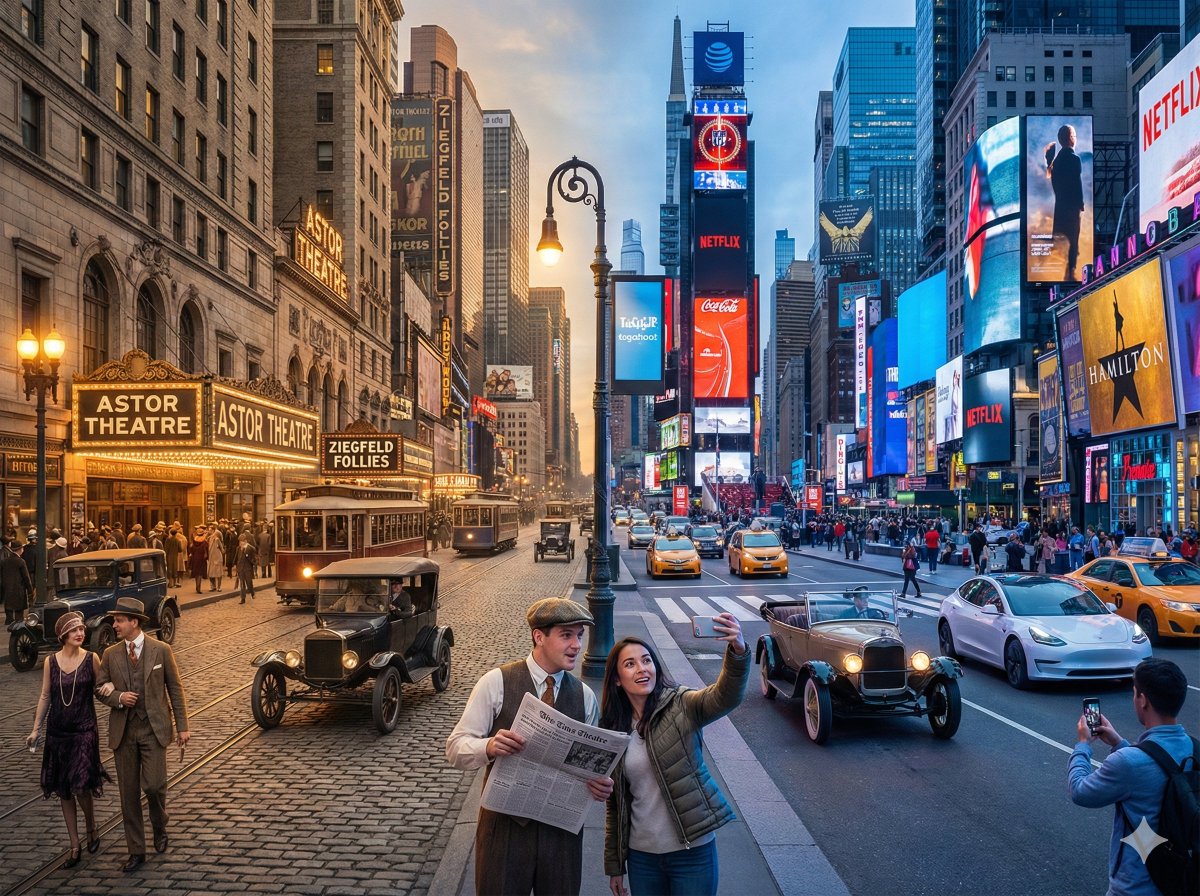
A horizontal split-screen cinematic shot of {argument name="scene" default="{Scene}"}, seamlessly blending two different eras: {argument name="era A" default="{Era_A}"} on the left and {argument name="era B" default="{Era_B}"} on the right (default: about 100 years ago vs. present day).
On the left side ({argument name="era A" default="{Era_A}"}): show era-appropriate architecture, interior or environment design, materials, vehicles, and props that clearly belong to that historical period. People wear authentic clothing from {argument name="era A" default="{Era_A}"}, including hairstyles, accessories, and typical items in their hands (such as books, umbrellas, instruments, letters, newspapers, etc.). The overall mood feels nostalgic and historically accurate.
On the right side ({argument name="era B" default="{Era_B}"}): show the same {argument name="scene" default="{Scene}"} in the modern era, with updated architecture or renovated structures, contemporary materials (glass, steel, LED screens, modern furniture), modern vehicles or equipment, and current technology (smartphones, laptops, cameras, etc.). People wear contemporary fashion that matches today’s style in this setting.
In the center: the two eras merge and overlap organically, without a hard dividing line. Elements from {argument name="era A" default="{Era_A}"} and {argument name="era B" default="{Era_B}"} visually interact: people from different times look at each other, walk through each other’s space, or seem surprised by the other era’s technology and objects. Architecture and environment smoothly morph from old to new (for example, stone gates turning into modern campus gates, classical concert hall décor fading into a futuristic stage, old street shops transforming into neon-lit storefronts).
Make sure the scene is not just a simple left/right comparison but a dynamic time-travel interaction where buildings, clothing, props, and human gestures clearly emphasize the contrast and fusion between the two eras. Photorealistic, 8k resolution, cinematic lighting, wide angle, highly detailed textures, rich sense of time-travel storytelling.
SCENE: {argument name="scene example" default="Times Square, New York"}
Era Comparison: {argument name="era comparison example" default="1920s and present day"}
Aspect Ratio: {argument name="aspect ratio" default="4:3"}
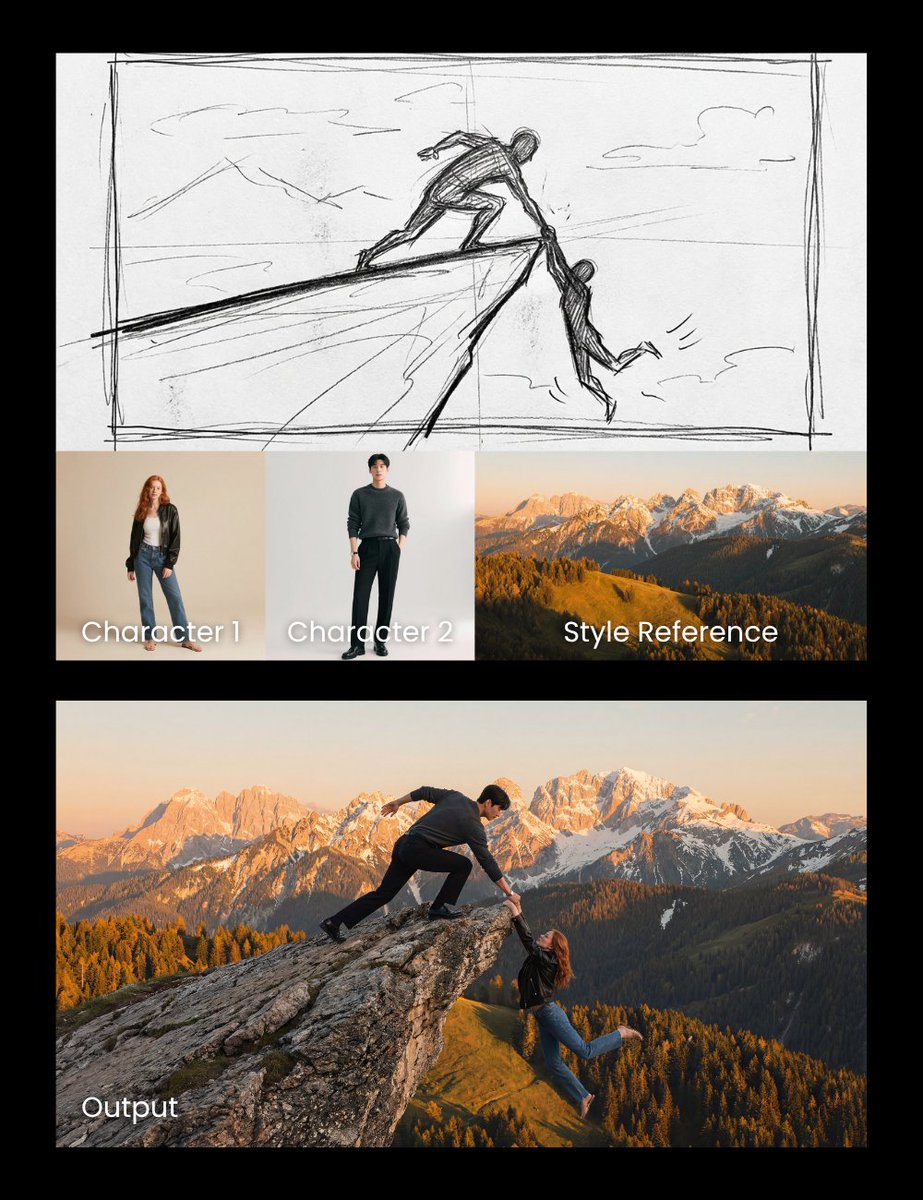
Realistic cliff rescue. Use the man photo as the hero and the woman photo as the one slipping. Match the sketch side pose and composition precisely, and use the mountain photo as a style reference for the background.