Editorial / Poster
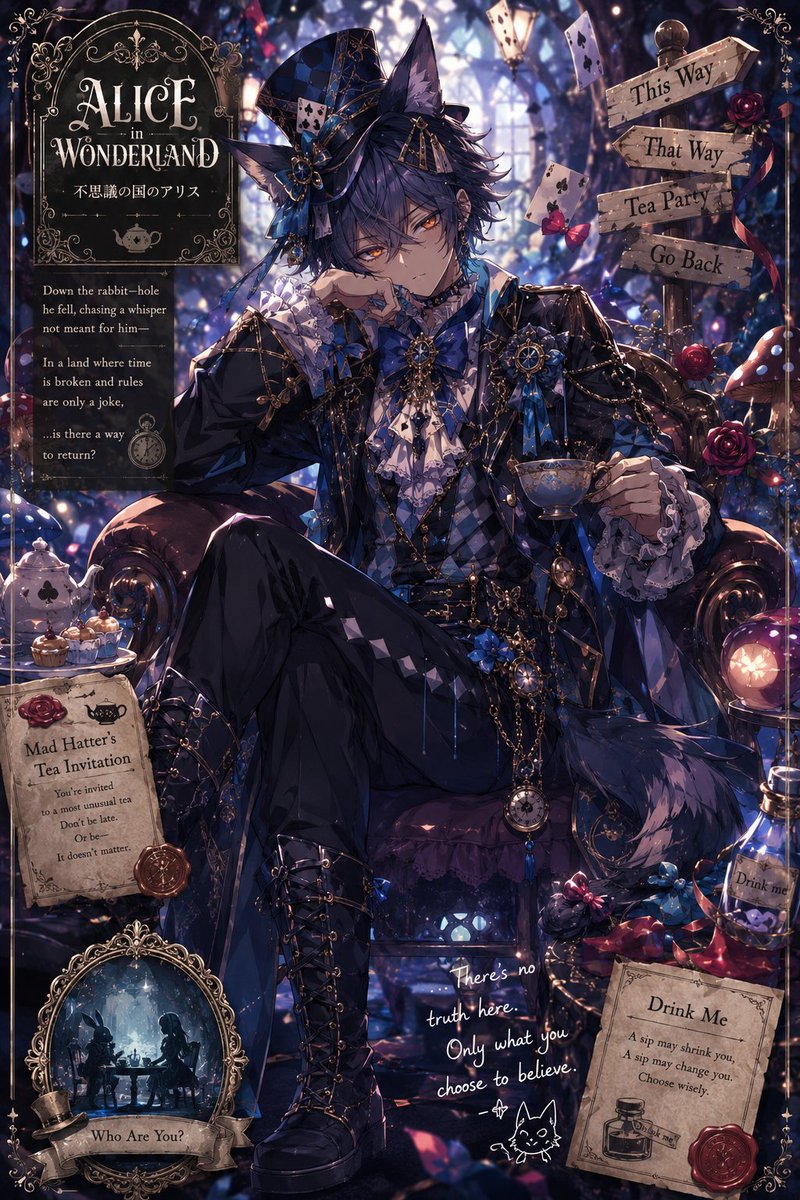
Gothic Alice Tea Party Poster
Goal: Create a richly detailed vertical dark-fantasy anime poster for Alice in Wonderland, reimagined as an elegant gothic tea-party character illustration.
Fields you can change: story title, center quote.
Full prompt
Goal: Create a richly detailed vertical dark-fantasy anime poster for {argument name="story title" default="Alice in Wonderland"}, reimagined as an elegant gothic tea-party character illustration.
Canvas: Tall 2:3 portrait poster, dense decorative composition, cinematic lighting, deep navy, violet, black, antique gold, muted cream, and ruby-red accents. Use ornate Victorian borders, filigree corners, glowing bokeh, floating cards, and magical dust throughout.
Main subject: A beautiful androgynous young male anime character seated in a plush vintage armchair at the center, looking tired, aloof, and melancholic. He has messy dark blue-purple hair, golden amber eyes, pale skin, and black cat ears, with a dark fluffy cat tail visible near the lower right. He wears an extravagant Mad Hatter-inspired gothic aristocrat outfit: oversized checkerboard top hat decorated with playing cards, blue roses, chains, gears, ribbons, and small charms; layered black and navy tailcoat with gold trim; ruffled white lace shirt; blue bow at the neck; ornate brooches; shoulder epaulettes; dangling chains; pocket watches; belts; gloves or lace cuffs; fitted dark trousers; and tall black lace-up platform boots. Pose him lounging with one leg crossed forward, one elbow resting on the chair arm, one hand near his face, and the other holding a delicate teacup.
Environment: A surreal enchanted Wonderland forest or tea-party room with blurred glowing lanterns, blue stained-glass-like lights, mushrooms, roses, antique bottles, tea sets, cakes, clocks, playing cards, ribbons, and magical floating fragments. The mood should feel mysterious, decadent, dreamlike, and slightly ominous.
Layout and text elements: Include exactly 6 distinct readable graphic text panels/signs:
1. Upper-left ornate arched title plaque with the large title “ALICE in WONDERLAND”, a smaller Japanese subtitle “不思議の国のアリス”, a tiny teapot icon, and story text: “Down the rabbit-hole he fell, chasing a whisper not meant for him— In a land where time is broken and rules are only a joke, ...is there a way to return?”
2. Upper-right wooden signpost with 4 arrow signs labeled exactly: “This Way”, “That Way”, “Tea Party”, and “Go Back”.
3. Lower-left parchment invitation card titled “Mad Hatter’s Tea Invitation” with smaller text: “You’re invited to a most unusual tea. Don’t be late. Or be. It doesn’t matter.”
4. Bottom-left ornate oval cameo frame showing a tiny silhouette tea-party scene with two seated figures, labeled “Who Are You?”
5. Lower-center handwritten chalk-like quote: {argument name="center quote" default="There’s no truth here. Only what you choose to believe."} with a small doodle cat face and sparkle marks.
6. Lower-right parchment tag titled “Drink Me” with smaller text: “A sip may shrink you, A sip may change you, Choose wisely.” plus a small potion-bottle illustration.
Additional visible objects: Include floating playing cards with suits, at least 3 red roses, at least 2 pocket watches, a teapot and cupcake tea set near the lower left, a glowing potion bottle labeled “Drink me” on the lower right, a crystal orb or glowing glass lamp, wax seals on parchment notes, ribbons, chains, and blue flowers.
Visual style: Ultra-detailed Japanese anime key visual, ornate gothic lolita / ouji fashion, Victorian fantasy poster design, high-contrast rim lighting, soft painterly rendering, crisp character details, luminous particles, intricate accessories, dramatic depth of field, premium collectible illustration quality.
Constraints: Keep the main character recognizable as the central focus, do not crop off the hat or boots, preserve all 6 text panels/signs, avoid modern objects, avoid minimalism, avoid flat colors, and make the typography decorative but legible.