Editorial / Poster
Chinese Editorial Photography Lesson Page
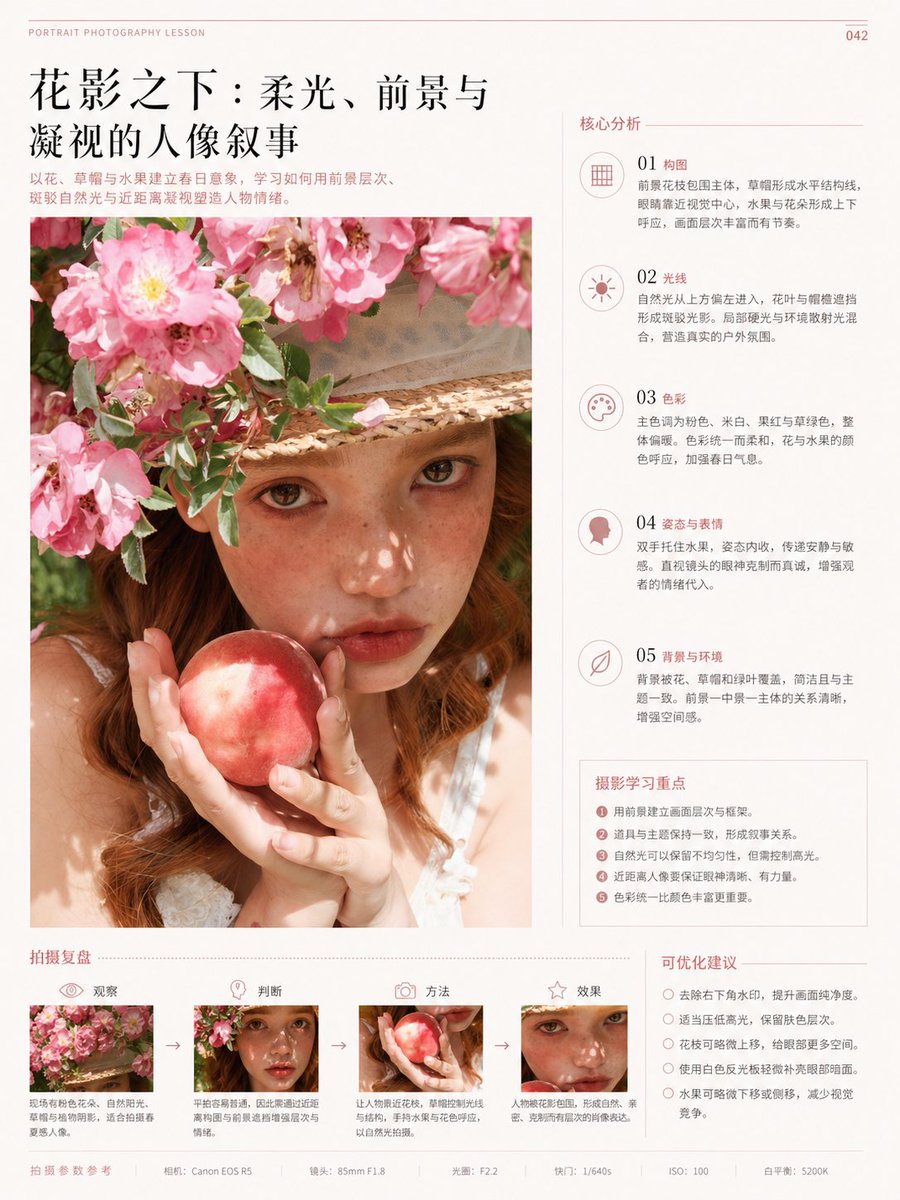
portrait photography lesson. 花影之下:柔光、前景与凝视的人像叙事. 以花、草帽与水果建立春日意象,学习如何用前景层次、斑驳自然光与近距离凝视塑造人物情绪。.
Full prompt
{"type":"editorial book page layout","theme":"portrait photography lesson","page":{"number":"042","orientation":"vertical","background":"warm off-white paper with very light pink-gray rules and dividers"},"header":{"left":"PORTRAIT PHOTOGRAPHY LESSON","right":"042"},"main":{"title":"花影之下:柔光、前景与凝视的人像叙事","subtitle":"以花、草帽与水果建立春日意象,学习如何用前景层次、斑驳自然光与近距离凝视塑造人物情绪。","hero_image":{"position":"left large column","subject":"soft romantic portrait of a young woman under blooming pink flowers, long wavy auburn hair, white lace or embroidered sleeveless dress, holding a pink peach near her lips with both hands, warm sunlight, shallow depth of field, floral foreground framing from above, gentle spring mood","style":"high-end lifestyle photography, pastel tones, airy natural light","censorship_block":{"present":true,"shape":"vertical rectangle centered over the face","color":"muted tan-brown"}},"sidebar":{"position":"right column","title":"核心分析","count":5,"items":[{"number":"01","label":"构图","icon":"grid in a circle","text":"前景花枝包围主体,草帽形成水平结构线。眼睛靠近视觉中心,水果与花朵形成上下呼应,画面层次丰富而有节奏。"},{"number":"02","label":"光线","icon":"sun in a circle","text":"自然光从上方斜左进入,花叶与帽檐遮挡形成斑驳光影。局部硬光与环境散射光混合,营造真实的户外氛围。"},{"number":"03","label":"色彩","icon":"palette in a circle","text":"主色调为粉色、米白、果红与草绿色,整体偏暖。色彩统一而柔和,花与水果的颜色呼应,加强春日气息。"},{"number":"04","label":"姿态与表情","icon":"profile silhouette in a circle","text":"双手托住水果,姿态内收,传递安静与敏感。直视镜头的眼神克制而真诚,增强观者的情绪代入。"},{"number":"05","label":"背景与环境","icon":"leaf in a circle","text":"背景被花、草帽和绿叶覆盖,简洁且与主题一致。前景—中景—主体的关系清晰,增强空间感。"}]},"tips_box":{"position":"right lower-middle","title":"摄影学习重点","count":5,"items":["用前景建立画面层次与框架。","道具与主题保持一致,形成叙事关系。","自然光可以保留不均匀性,但需控制高光。","近距离人像要保证眼神清晰、有力量。","色彩统一比颜色丰富更重要。"]},"bottom_section":{"title":"拍摄复盘","position":"bottom full width","workflow":{"count":4,"steps":[{"label":"观察","thumbnail":"cluster of pink flowers and leaves in sunlight","caption":"现场有粉色花朵、自然阳光,草帽与场景呼应,适合拍摄春夏感人像。"},{"label":"构图","thumbnail":"portrait with floral top framing and face partially blocked","caption":"平拍容易普通,因此靠近拍摄并利用花草与帽檐营造前景层次与情绪。"},{"label":"方法","thumbnail":"close crop of hands holding peach near face","caption":"让人物靠近花枝,嘴唇轻贴桃子边缘,手持水果与花呼应,以自然光拍摄。"},{"label":"","thumbnail":"soft blurred peach-beige color swatch or heavily blurred crop","caption":"总:光线所有层次的呼吸表达。"}],"connectors":"thin arrows between the 4 thumbnails"}},"improvement_box":{"position":"bottom right","title":"可优化建议","count":5,"items":["去除右下角水印,提升画面纯净度。","适当压低高光,保留肤色层次。","花枝可略微上扬,给眼部更多空间。","使用白色反光板轻微补亮眼部暗面。","水果可略微下移或侧移,减少视觉竞争。"]},"footer":{"camera_info_count":6,"items":["拍摄参数参考","相机:Canon EOS R5","镜头:85mm F1.8","光圈:F2.2","快门:1/640s","ISO:100","白平衡:5200K"]},"design":{"typography":"modern Chinese editorial typography with large serif-like headline and clean sans-serif body text","palette":"dusty pink, muted rose, warm beige, light gray, black","graphic_elements":"thin divider lines, circular line icons, spacious margins, magazine/book design, premium photography course aesthetic"}}



