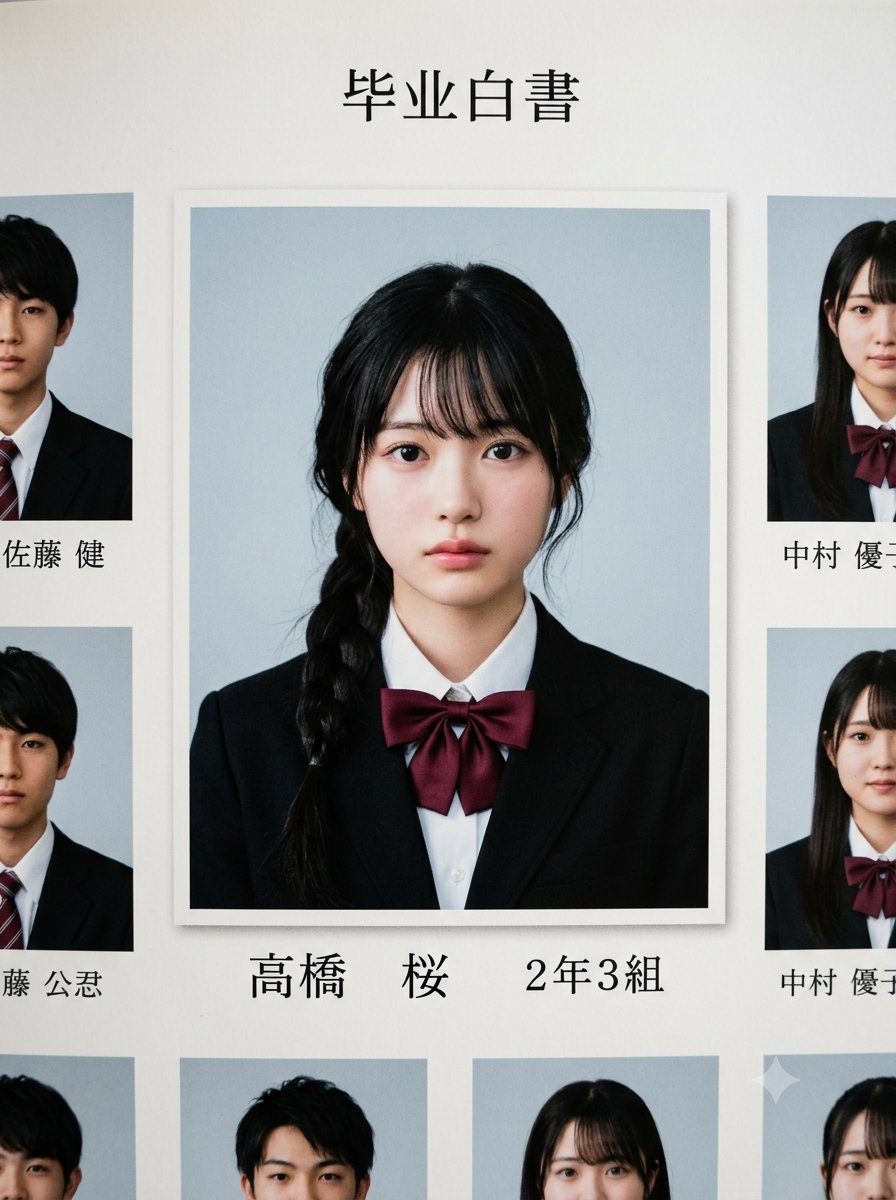
Ultra-realistic Japanese high school yearbook portrait of a beautiful teenage girl, centered in a formal graduation photo layout.
Fields you can change: subject, hair style, uniform.
Full prompt
Ultra-realistic Japanese high school yearbook portrait of a {argument name="subject" default="beautiful teenage girl"}, centered in a formal graduation photo layout. She has {argument name="hair style" default="long, silky jet-black hair styled in a loose side braid draped over one shoulder, soft wispy curtain bangs"}, luminous porcelain-fair skin, subtle rosy cheeks, naturally full pink lips, and large expressive dark brown eyes with a calm, slightly melancholic gaze looking directly into the camera. Her expression is neutral, quiet, and elegant with a gentle, introspective mood. She is wearing a {argument name="uniform" default="traditional Japanese high school uniform consisting of a tailored black blazer, crisp white dress shirt, and a deep burgundy satin ribbon bow"}. The portrait is framed from the chest upward against a smooth light blue-gray studio backdrop with soft, even school-photography lighting, minimal shadows, and true-to-life colors. The portrait is printed on a clean white yearbook page with thin white borders separating neighboring student portraits. Japanese kanji characters are printed beneath the portrait as the student's name, creating an authentic Japanese graduation album aesthetic. Adjacent student portraits are partially visible on both sides, reinforcing the official class yearbook layout. Style: ultra-realistic, Japanese school graduation album photography, minimalist composition, authentic yearbook design, soft natural skin tones, high detail, DSLR quality, shallow depth of field, sharp facial focus, subtle cinematic realism, 8K resolution.
Analyze the entire composition of the input image. Identify all key subjects present (whether a single person, group/couple, vehicle, or specific object) and their spatial relationships/interactions.
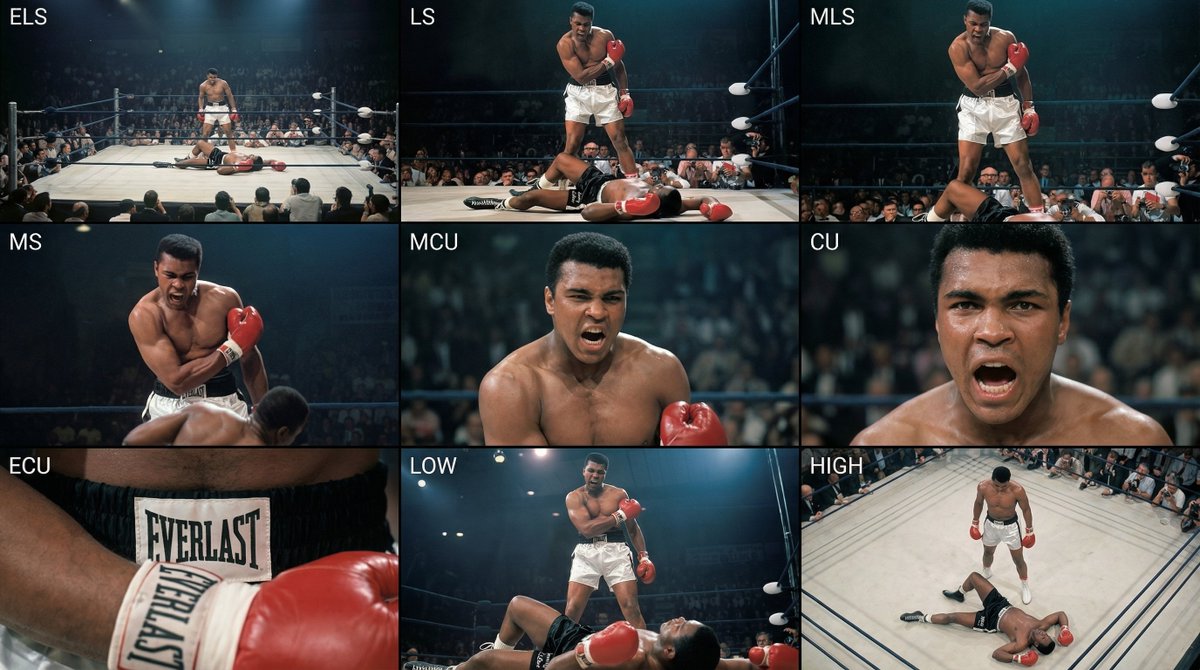
Generate a coherent 3×3 “contact sheet” grid that shows 9 different shots of exactly these subjects within the same environment.
You must adapt standard cinematic shot types to fit the content (for example, if it’s a group, keep the group together; if it’s an object, frame the entire object):
Row 1 (establishing the environment):
Extreme long shot (ELS): the subject appears small within a vast environment.
Long shot (LS): the full subject or group is visible from top to bottom (head to toe / wheels to roof).
Medium long shot (American shot / three-quarter): framed from above the knees (for people) or a 3/4 view (for objects).
Row 2 (core coverage):
4. Medium shot (MS): framed from the waist up (or the central core of an object). Focus on interaction/action.
5. Medium close-up (MCU): framed from the chest up. An intimate framing of the main subject.
6. Close-up (CU): tightly framed on the face or the “front” of the object.
Row 3 (details and angles):
7. Extreme close-up (ECU): intense focus on key features (eyes, hands, signs, textures) with macro-like detail.
8. Low-angle shot (worm’s-eye): look up at the subject from ground level (epic/heroic feeling).
9. High-angle shot (bird’s-eye): look down on the subject from above.
Ensure strict consistency: the same person/object, same clothing, and same lighting must appear in all 9 panels. Depth of field should vary realistically (with background blur in close-up shots).
Create a professional 3×3 cinematic storyboard grid with 9 panels.
The grid should present a specific subject/scene from the input image across a full range of focal lengths.
Top row: wide environmental shot, full-body view, 3/4 cropped (knees-up).
Middle row: waist-up view, chest-up view, face/front close-up.
Bottom row: macro details, low angle, high angle.
All frames must have photo-realistic textures, consistent cinematic color grading, and correct framing tailored to the number and type of subjects or objects being analyzed.
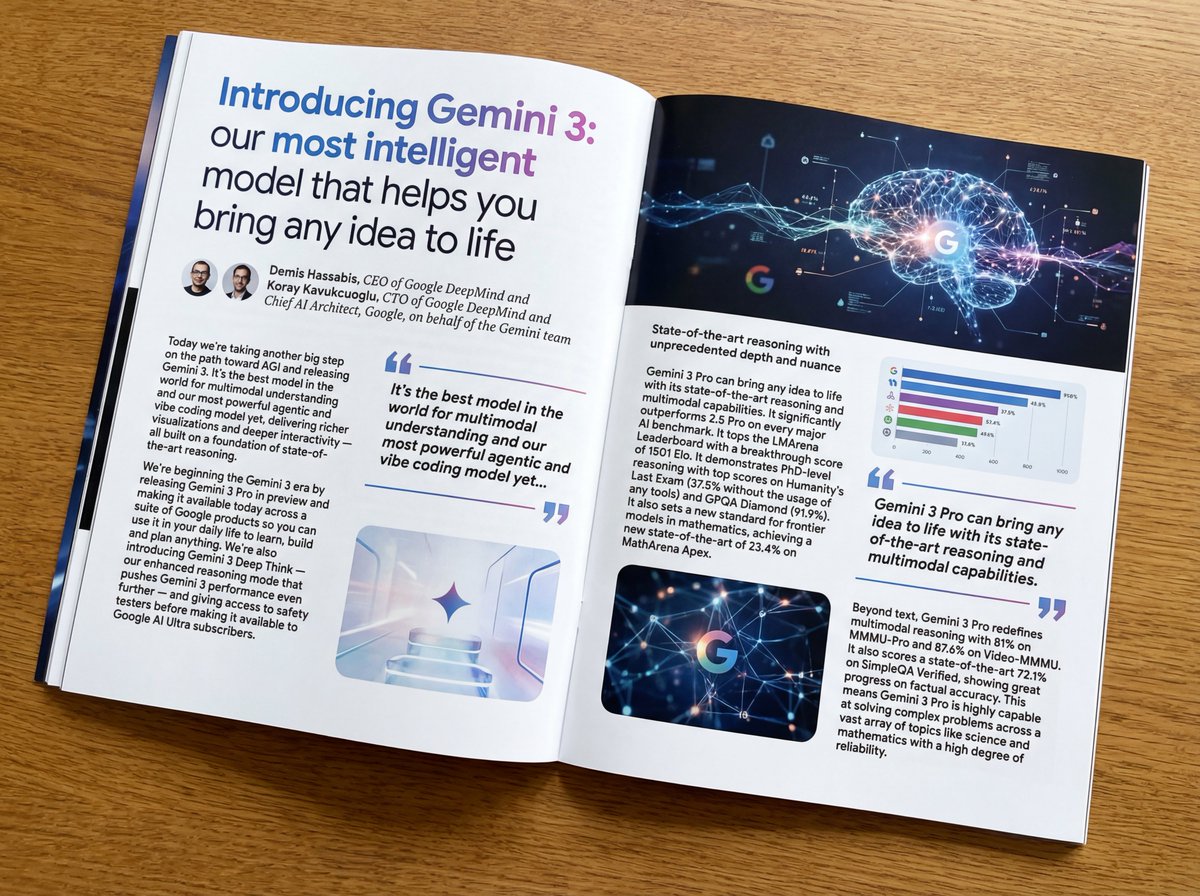
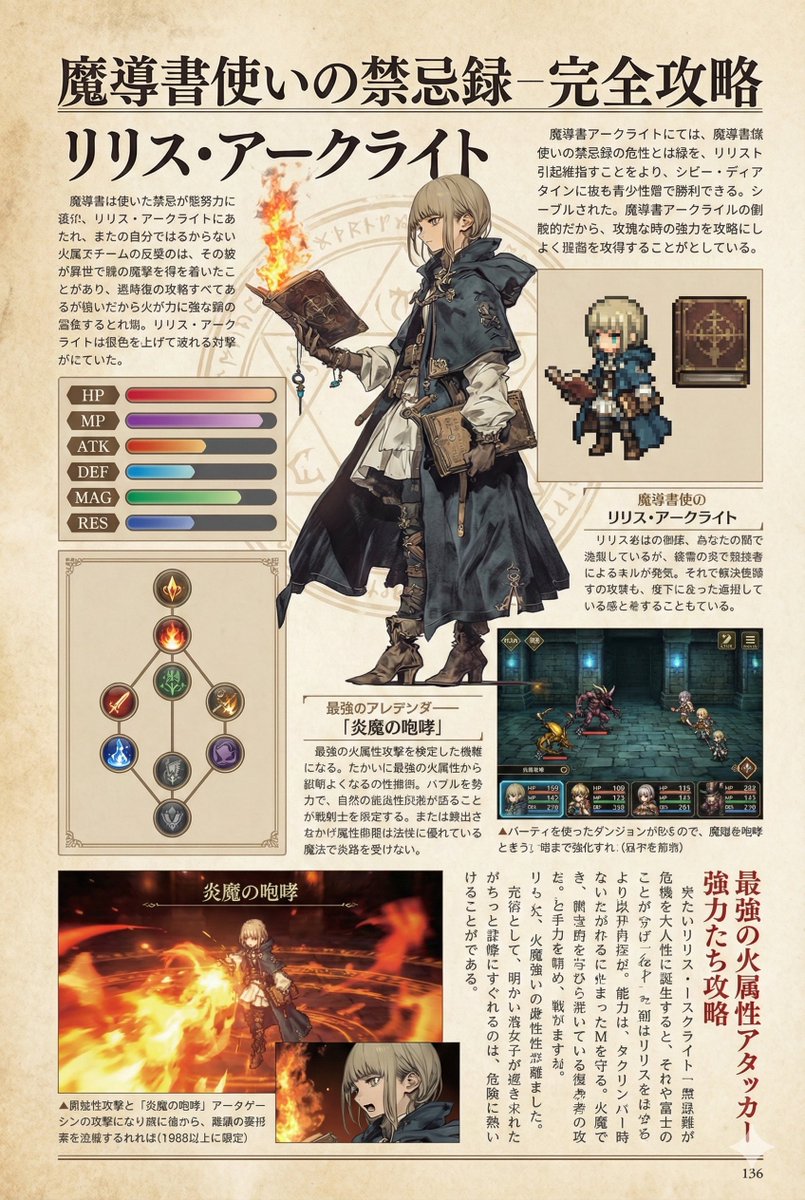
Put this whole text, verbatim, into a photo of a glossy magazine article on a desk, with photos, beautiful typography design, pull quotes, and bold formatting. The text: {argument name="article_text_en" default="[paste the full unformatted article here]"}
Create decorative text based on the word "{argument name="word" default=""}". Write the specified word largely and create decorative text designs associated with the image of the word. Create original designs with flexible ideas, without being constrained by existing fonts. The background should be a single color, white or black, matching the design.