Editorial / Poster
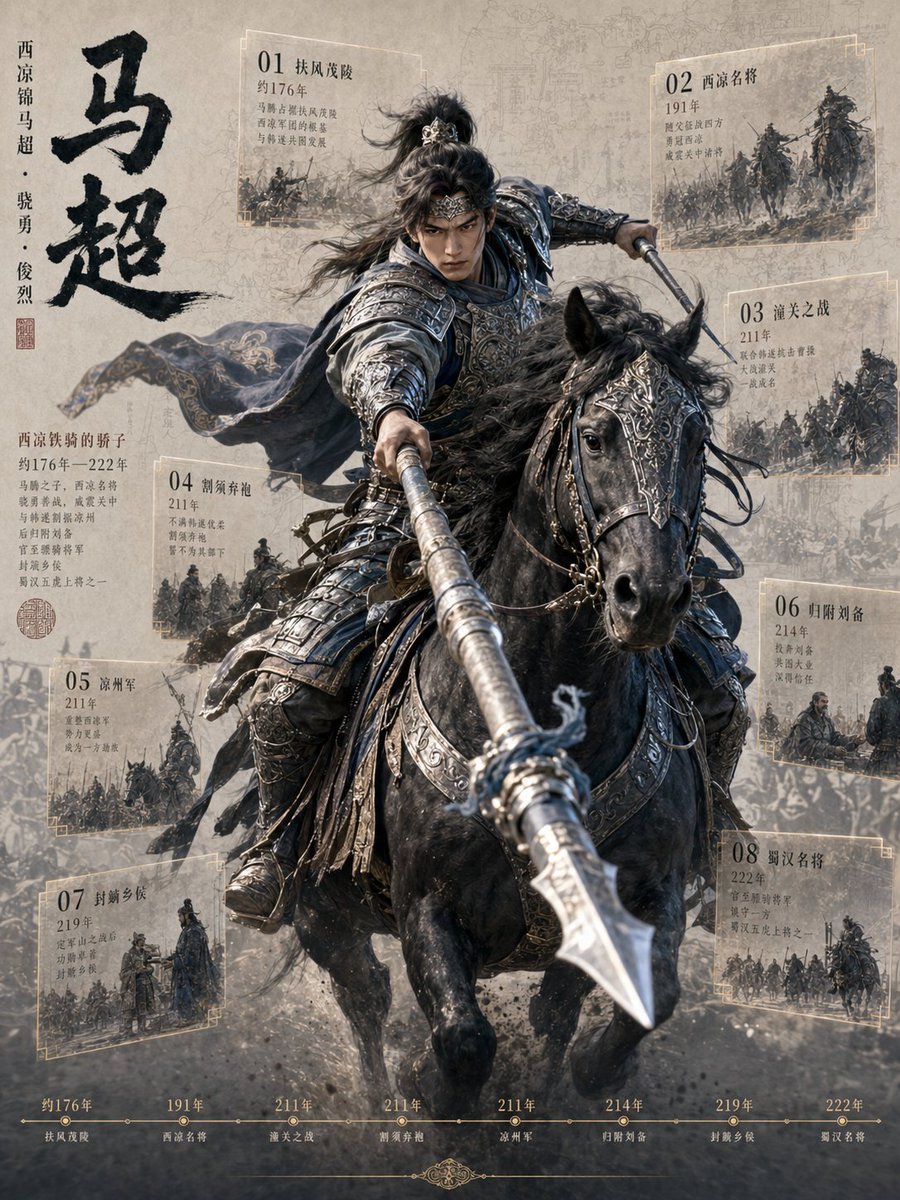
Ma Chao Historical Cavalry Timeline Poster
Goal: Create a vertical historical hero infographic poster about 马超, a fierce ancient Chinese cavalry general, combining cinematic fantasy realism with an antique manuscript timeline design.
Fields you can change: character name, main calligraphy title.
Full prompt
Goal: Create a vertical historical hero infographic poster about {argument name="character name" default="马超"}, a fierce ancient Chinese cavalry general, combining cinematic fantasy realism with an antique manuscript timeline design.
Canvas: Portrait 3:4 poster, aged beige parchment background with faint map lines, battle sketches, dust, ink wash texture, and subtle sepia-gray atmosphere. High-detail digital painting / cinematic historical concept art, dramatic depth of field, gritty battlefield energy.
Main subject: Center composition shows {argument name="character name" default="马超"} charging forward on a powerful black warhorse. The rider wears ornate dark silver lamellar armor with engraved patterns, layered pauldrons, leather straps, flowing dark cloak, and a high tied topknot with loose windblown hair. His face is partially covered by a centered dark rectangular censor/blur block. He thrusts a long silver spear directly toward the viewer, creating strong foreshortening; the spear tip dominates the lower-right foreground. The black horse has elaborate metal head armor, reins, ornamental tack, flared nostrils, and galloping motion with dust and debris underfoot.
Left title area: Large vertical black Chinese calligraphy reading {argument name="main calligraphy title" default="马超"} along the upper-left side. Beside it, smaller vertical text reads “西凉锦马超 · 骁勇 · 俊烈” with a small red seal stamp beneath. Below, add a short Chinese biography block in small serif-style text beginning with “西凉铁骑的骄子” and mentioning “约176年—222年”; keep it visually authentic, compact, and slightly faded.
Timeline/event cards: Add exactly 8 translucent parchment cards around the rider, each with a thin pale-gold border, a large two-digit number, a Chinese title, a year, several tiny Chinese annotation lines, and a small monochrome ink-battle illustration. The 8 cards are:
1. “01 扶风茂陵”, year “约176年”, upper left of rider.
2. “02 西凉名将”, year “191年”, upper right.
3. “03 潼关之战”, year “211年”, mid right.
4. “04 割须弃袍”, year “211年”, lower left-center.
5. “05 凉州军”, year “211年”, lower left.
6. “06 归附刘备”, year “214年”, lower right-center.
7. “07 射鹤乡侯”, year “219年”, bottom left-center.
8. “08 蜀汉名将”, year “222年”, bottom right.
Bottom timeline: Along the bottom edge, create a thin horizontal gold timeline with exactly 8 marked dots and labels matching the same sequence and years: “约176年 扶风茂陵”, “191年 西凉名将”, “211年 潼关之战”, “211年 割须弃袍”, “211年 凉州军”, “214年 归附刘备”, “219年 射鹤乡侯”, “222年 蜀汉名将”. Add a small ornamental flourish centered below the line.
Visual style: Realistic Chinese historical war epic, antique museum-poster layout, muted beige, charcoal, steel blue, black, and pale gold palette. Use dust, torn-paper translucency, faint battlefield silhouettes, and ink-wash overlays. The central rider and horse should be sharp and dramatic, while background cards and maps are slightly faded.
Constraints: Use exactly 8 event cards and 8 bottom timeline markers. Keep all visible typography Chinese-style and integrated into the poster. No modern objects, no watermark, no logo, no extra characters in the foreground, no bright saturated colors.