Editorial / Poster
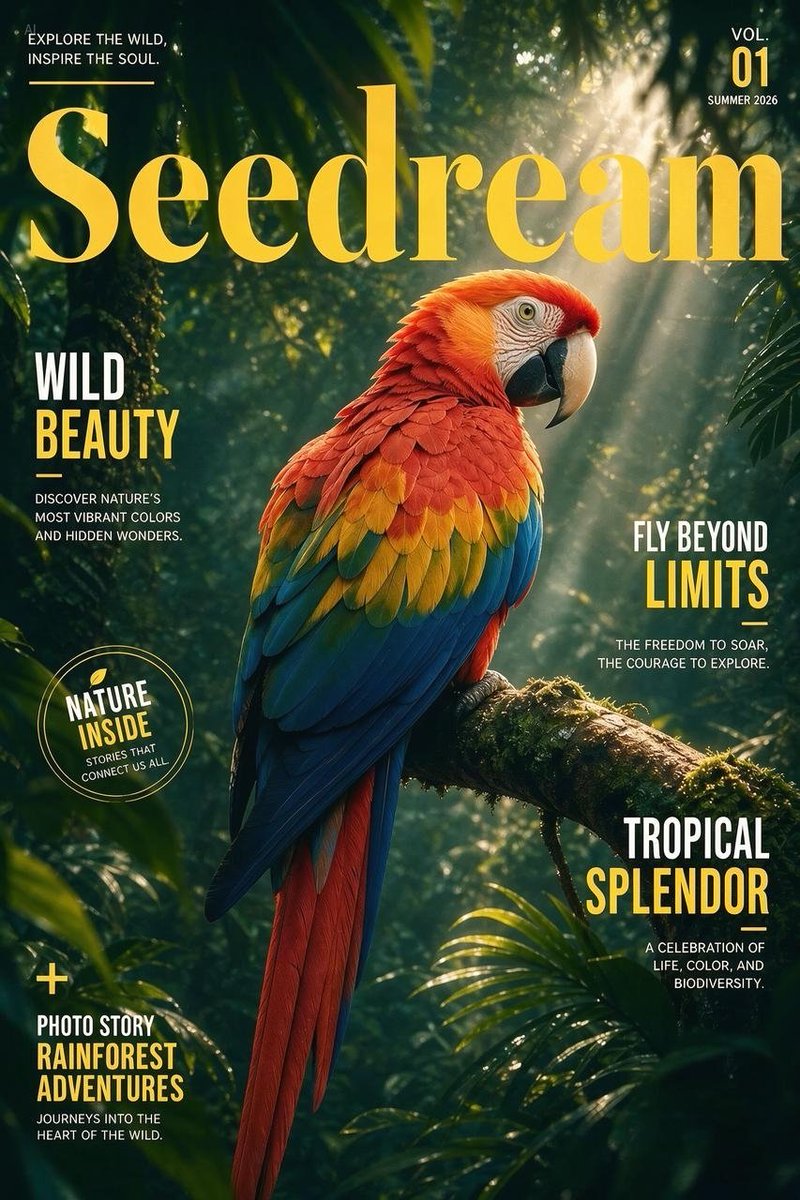
Tropical Macaw Magazine Cover
Goal: Create a vertical tropical wildlife magazine cover featuring a vivid scarlet macaw in a rainforest, with bold editorial typography and a premium adventure-nature aesthetic. Canvas: Portrait magazine cover, 2:3 aspect ratio.
Fields you can change: magazine title.
Full prompt
Goal: Create a vertical tropical wildlife magazine cover featuring a vivid scarlet macaw in a rainforest, with bold editorial typography and a premium adventure-nature aesthetic.
Canvas: Portrait magazine cover, 2:3 aspect ratio. Dark lush jungle background with dense green leaves, palm fronds, mossy branches, atmospheric haze, and warm sunbeams streaming diagonally from the upper right. High-contrast cinematic lighting, realistic photography style, sharp bird detail, soft depth of field in the background.
Main subject: One large scarlet macaw perched on a moss-covered branch angled from lower right toward center. The parrot faces right in three-quarter profile, with a pale curved beak, detailed eye rings, red head and chest feathers, orange-yellow wing transitions, green accents, deep blue wing feathers, and long red tail feathers extending downward. The bird occupies the center and lower center, overlapping the title slightly.
Masthead and issue text: Place a huge elegant serif masthead reading {argument name="magazine title" default="Seedream"} across the upper third in warm golden yellow, spanning nearly the full width. In the top left, small white uppercase tagline: “EXPLORE THE WILD, INSPIRE THE SOUL.” with a thin yellow horizontal line beneath. In the top right, compact issue block: “VOL.” above large yellow “01”, with “SUMMER 2026” below in white.
Cover lines: Include exactly 5 editorial cover-line groups plus 1 circular badge and 1 plus sign feature marker. Use condensed bold uppercase sans-serif typography, mostly white with key words in golden yellow.
1. Left middle cover line: “WILD” in white, “BEAUTY” in yellow, short yellow underline, then small white text: “DISCOVER NATURE’S MOST VIBRANT COLORS AND HIDDEN WONDERS.”
2. Right middle cover line: “FLY BEYOND” in white, “LIMITS” in yellow, short yellow underline, then small white text: “THE FREEDOM TO SOAR, THE COURAGE TO EXPLORE.”
3. Lower right cover line: “TROPICAL” in white, “SPLENDOR” in yellow, short yellow underline, then small white text: “A CELEBRATION OF LIFE, COLOR, AND BIODIVERSITY.”
4. Lower left feature line beneath a yellow plus sign: “PHOTO STORY” in white, “RAINFOREST ADVENTURES” in yellow, then small white text: “JOURNEYS INTO THE HEART OF THE WILD.”
5. Circular badge on left lower-middle: thin double-line yellow circle containing a small leaf icon, “NATURE” in white, “INSIDE” in yellow, and tiny curved/supporting white text: “STORIES THAT CONNECT US ALL.”
Visual style: Editorial wildlife magazine cover, realistic luxury travel photography, deep forest greens, golden-yellow typography, crisp print design, balanced asymmetrical layout, dramatic backlight, subtle lens glow, mist, and high detail in feathers and leaves.
Constraints: Keep all text legible and correctly spelled. Do not add barcodes, pricing, QR codes, watermarks, extra birds, people, or additional cover lines. Maintain a polished professional magazine-cover composition.