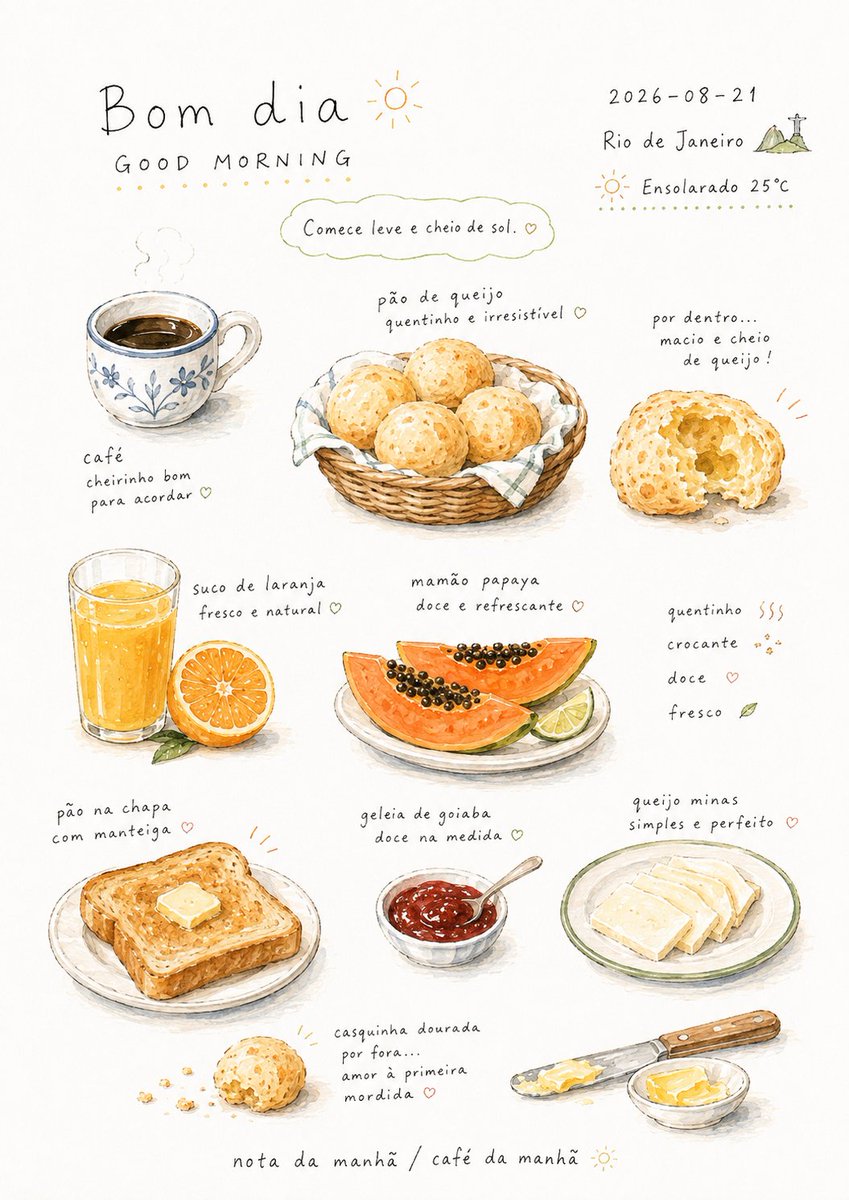
Editorial / Poster
Hand-drawn Breakfast Journal Aesthetic Poster
Full prompt
Create a relaxed, hand-drawn observation map around any subject: a large area of clean white paper serves as the main space, with the theme content broken down into several small object-like graphics, cross-sections, small connected pieces, short repetitive items, and close-ups, scattered across the upper and middle sections of the paper. Instead of a formal table, they are connected by loose line spacing, staggered white space, and handwritten phrases that simulate horizontal reading, forming an intimate rhythm as if taste, touch, sound, or movement were recorded casually. Small graphics use theme-derived materials and colors, maintaining small scales, rounded outlines, slight perspective, and hand-painted traces, with local preservation of grain, burnt edges, crumbs, textures, or section details; do not let them become unified icons, they should look like physical notes between picture book food illustrations and journal stickers. Text is the skeleton of the picture: use thin black lines with a sense of handwritten kana or childish handwriting, loose spacing, slightly jumping baselines, short words interspersed around the graphics, some strings close to the edges of the graphics, and some floating independently in the blank space, with a line of small signature-style explanation at the bottom. The color is derived from the theme itself, with white paper occupying the largest area and fine black characters carrying information; the main color remains warm, clean, and slightly high-brightness; a small amount of high-saturation warm colors or dark colors are only used for the focal points, shadows, and textures of the graphics, with dots of green, brown, or other thematic auxiliary colors as minimal rhythm. The overall image maintains a slight softening and natural compression feel of scanned paper, with hand-drawn unevenness and pigment absorption at the edges, without heavy shadows, decorative borders, or modern typography; the focus is to let the graphics and onomatopoeic handwriting together create a refreshing and childlike information page.
Theme: {argument name="theme" default="Good Morning + Greeting + GOOD MORNING + City + Quote + Weather + 2026-08-21"}
View original prompt
围绕任意主题对象呈现轻松的手写观察图谱:大面积洁白纸面作为主要空间,主题内容被拆成若干小块实物状图形、剖面小图、串联小件、短条重复物和局部特写,分散排在纸面中上部与中段,彼此不做严整表格,而是靠近似横向阅读的松散行距、错位留白和手写短语串联,形成像味觉、触感、声音或动作被随手记录下来的亲密节奏。小图形使用主题派生的材料和颜色,保持小尺幅、圆钝外轮廓、轻微透视和手绘上色痕迹,局部保留颗粒、焦边、碎屑、纹理或剖面细节;不要让它们变成统一图标,应像绘本食物插图和手账贴纸之间的实物笔记。文字是画面骨架:使用细黑色手写假名感或童稚手写感线条,字距松、基线轻微跳动,短词围绕图形左右穿插,部分字串贴近图形边缘,部分独立漂浮在空白中,底部可放一行较小署名式说明。色彩由主题自身推导,白纸占最大面积,黑色细字承担信息,主体色保持温暖、清洁、略高明度;少量高饱和暖色或深色只用于图形的焦点、阴影 and 纹理,点状绿色、褐色或其他主题辅色作为极小面积节奏。整体保持扫描纸张的轻微柔化和自然压缩感,边缘有手绘不齐与颜料吸收,不加厚重阴影、装饰边框或现代排版感;重点是让图形和拟声手写共同制造“边看边读”的清爽童趣信息页。 主题:{argument name="主题" default="早安+问候+GOOD MORNING+城市+金句+天气+2026-08-21"}