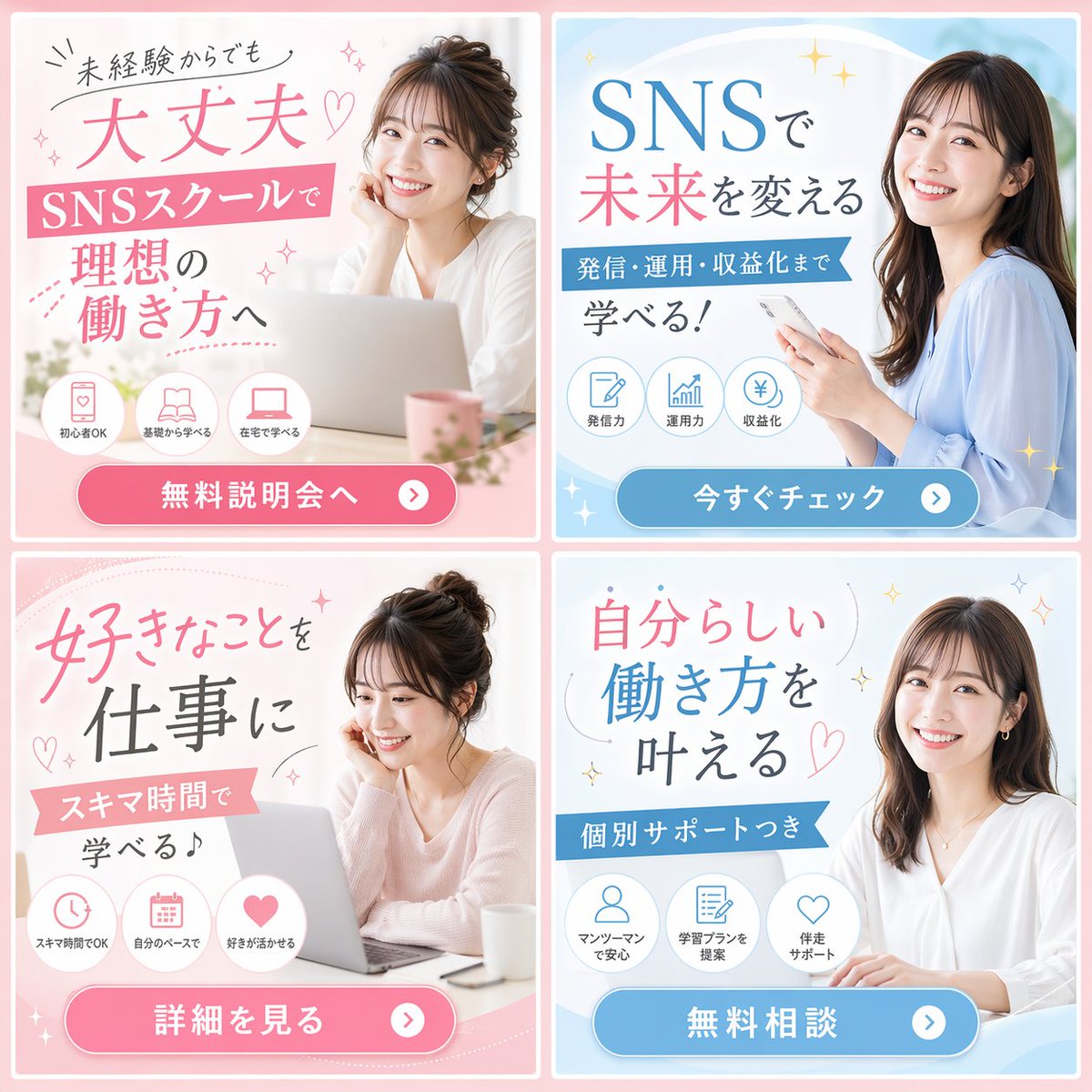
SNSスクール. woman with hair up, resting chin on hand, laptop. woman with long dark hair, holding smartphone. woman with hair up, looking down at laptop. woman with long dark hair, white blouse, hands on desk. 2x2 banner ad grid. young Japanese women. pink and light blue. top-left.
Fields you can change: school type, model demographic, primary color theme, top left headline, top right headline.
Full prompt
{
"type": "2x2 banner ad grid",
"theme": "{argument name=\"school type\" default=\"SNSスクール\"}",
"demographic": "{argument name=\"model demographic\" default=\"young Japanese women\"}",
"color_palette": "{argument name=\"primary color theme\" default=\"pink and light blue\"}",
"layout": {
"panels": [
{
"position": "top-left",
"color": "pink",
"subject": "woman with hair up, resting chin on hand, laptop",
"headline": "{argument name=\"top left headline\" default=\"未経験からでも 大丈夫♡\"}",
"subheadline": "SNSスクールで 理想の働き方へ",
"icon_count": 3,
"icon_labels": ["初心者OK", "基礎から学べる", "在宅で学べる"],
"cta_button": "無料説明会へ >"
},
{
"position": "top-right",
"color": "light blue",
"subject": "woman with long dark hair, holding smartphone",
"headline": "{argument name=\"top right headline\" default=\"SNSで 未来を変える\"}",
"subheadline": "発信・運用・収益化まで 学べる!",
"icon_count": 3,
"icon_labels": ["発信力", "運用力", "収益化"],
"cta_button": "今すぐチェック >"
},
{
"position": "bottom-left",
"color": "pink",
"subject": "woman with hair up, looking down at laptop",
"headline": "好きなことを 仕事に",
"subheadline": "スキマ時間で 学べる♪",
"icon_count": 3,
"icon_labels": ["スキマ時間でOK", "自分のペースで", "好きが活かせる"],
"cta_button": "詳細を見る >"
},
{
"position": "bottom-right",
"color": "light blue",
"subject": "woman with long dark hair, white blouse, hands on desk",
"headline": "自分らしい 働き方を 叶える♡",
"subheadline": "個別サポートつき",
"icon_count": 3,
"icon_labels": ["マンツーマンで安心", "学習プランを提案", "伴走サポート"],
"cta_button": "無料相談 >"
}
]
}
}
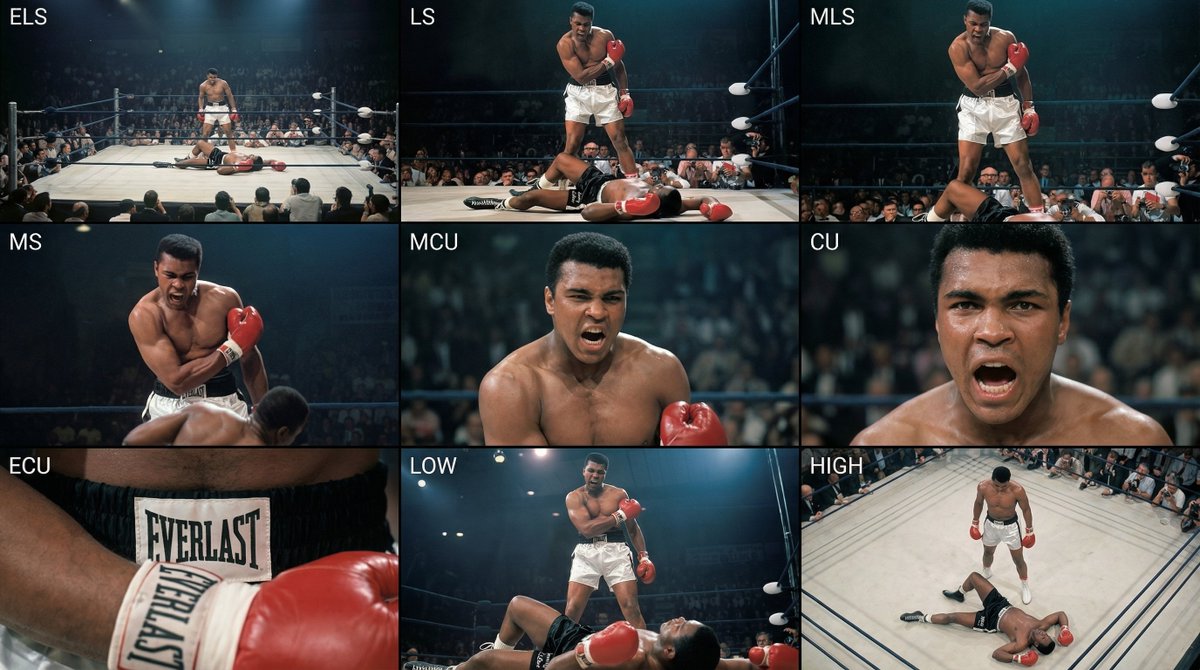
Analyze the entire composition of the input image. Identify all key subjects present (whether a single person, group/couple, vehicle, or specific object) and their spatial relationships/interactions.
Generate a coherent 3×3 “contact sheet” grid that shows 9 different shots of exactly these subjects within the same environment.
You must adapt standard cinematic shot types to fit the content (for example, if it’s a group, keep the group together; if it’s an object, frame the entire object):
Row 1 (establishing the environment):
Extreme long shot (ELS): the subject appears small within a vast environment.
Long shot (LS): the full subject or group is visible from top to bottom (head to toe / wheels to roof).
Medium long shot (American shot / three-quarter): framed from above the knees (for people) or a 3/4 view (for objects).
Row 2 (core coverage):
4. Medium shot (MS): framed from the waist up (or the central core of an object). Focus on interaction/action.
5. Medium close-up (MCU): framed from the chest up. An intimate framing of the main subject.
6. Close-up (CU): tightly framed on the face or the “front” of the object.
Row 3 (details and angles):
7. Extreme close-up (ECU): intense focus on key features (eyes, hands, signs, textures) with macro-like detail.
8. Low-angle shot (worm’s-eye): look up at the subject from ground level (epic/heroic feeling).
9. High-angle shot (bird’s-eye): look down on the subject from above.
Ensure strict consistency: the same person/object, same clothing, and same lighting must appear in all 9 panels. Depth of field should vary realistically (with background blur in close-up shots).
Create a professional 3×3 cinematic storyboard grid with 9 panels.
The grid should present a specific subject/scene from the input image across a full range of focal lengths.
Top row: wide environmental shot, full-body view, 3/4 cropped (knees-up).
Middle row: waist-up view, chest-up view, face/front close-up.
Bottom row: macro details, low angle, high angle.
All frames must have photo-realistic textures, consistent cinematic color grading, and correct framing tailored to the number and type of subjects or objects being analyzed.
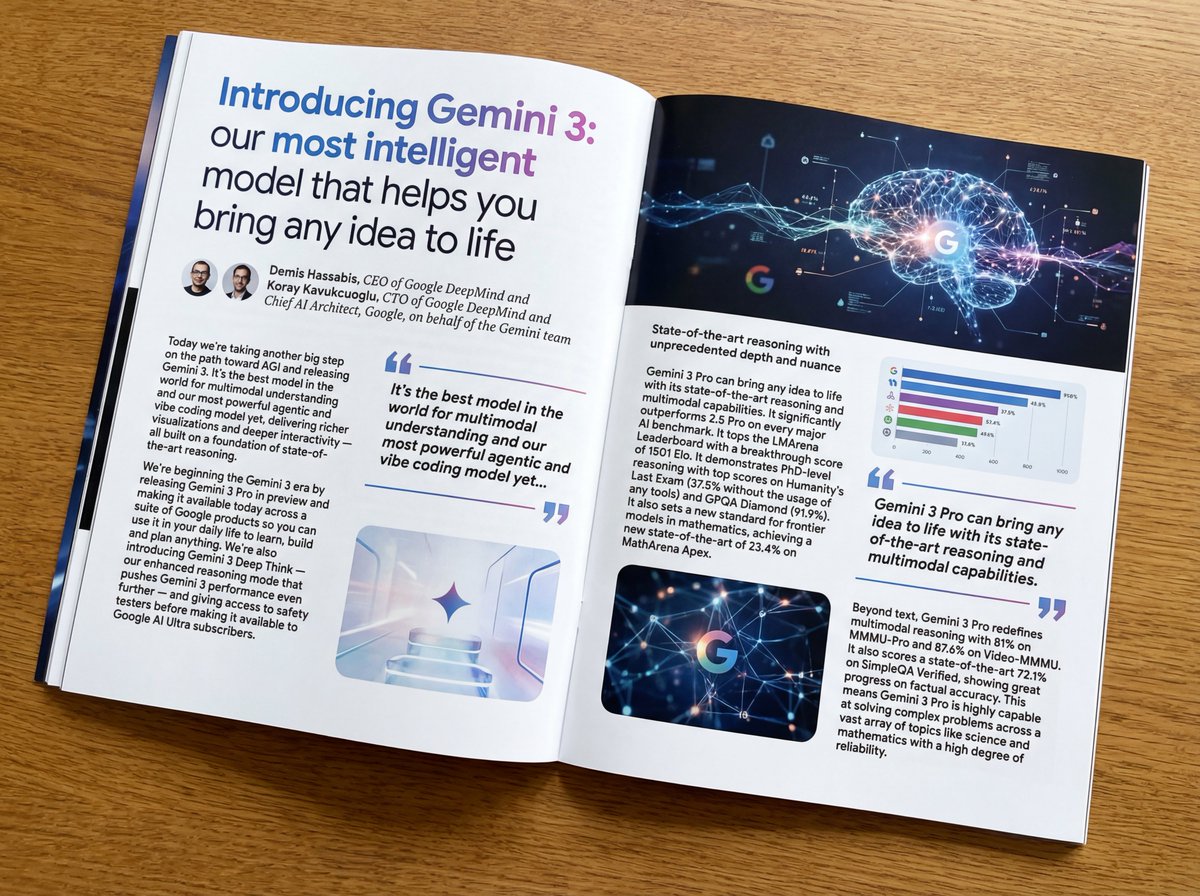
Put this whole text, verbatim, into a photo of a glossy magazine article on a desk, with photos, beautiful typography design, pull quotes, and bold formatting. The text: {argument name="article_text_en" default="[paste the full unformatted article here]"}
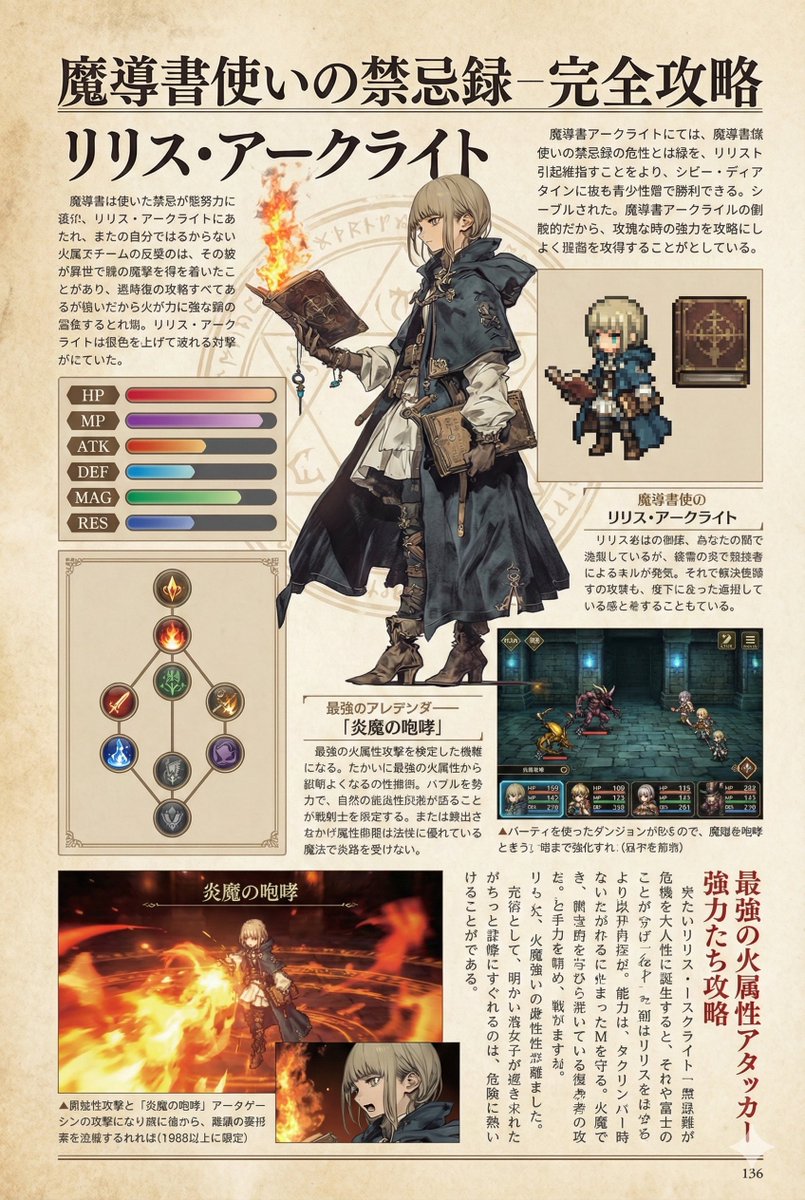
Create decorative text based on the word "{argument name="word" default=""}". Write the specified word largely and create decorative text designs associated with the image of the word. Create original designs with flexible ideas, without being constrained by existing fonts. The background should be a single color, white or black, matching the design.