Editorial / Poster
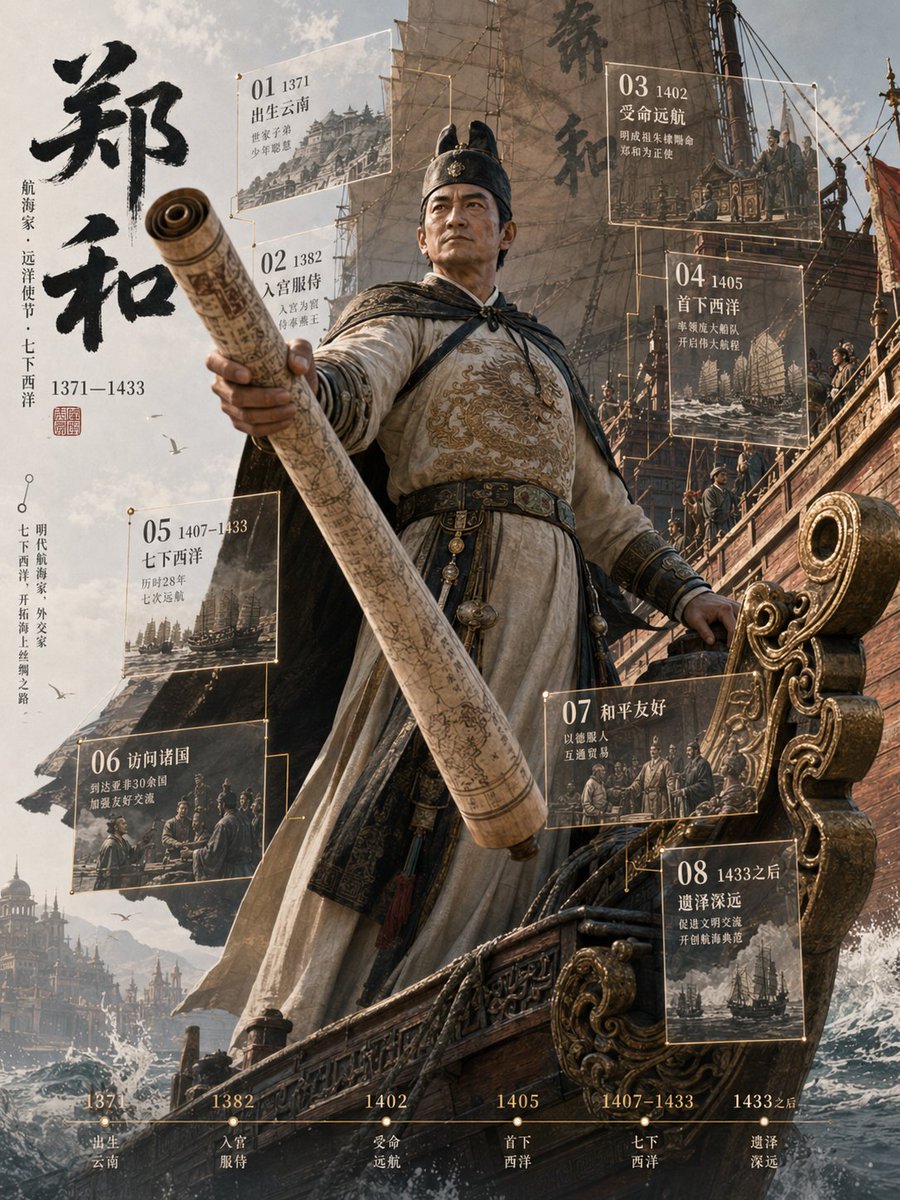
Zheng He 3D Historical Archive Poster
Goal: Create a vertical cinematic 3D historical figure archive poster about Zheng He, presenting him as a monumental explorer standing on the prow of a Ming dynasty treasure ship, with archival timeline panels floating around him.
Fields you can change: historical figure, main calligraphy.
Full prompt
Goal: Create a vertical cinematic 3D historical figure archive poster about {argument name="historical figure" default="Zheng He"}, presenting him as a monumental explorer standing on the prow of a Ming dynasty treasure ship, with archival timeline panels floating around him.
Canvas: Tall 3:4 poster, epic historical documentary style, warm sepia and ocean-blue palette, high detail, dramatic perspective from slightly below, realistic 3D render mixed with aged parchment infographic design.
Main subject: A full-body Ming dynasty admiral in ornate embroidered robes, cloak, belt ornaments, and official headwear stands heroically on the carved wooden bow of a large sailing ship. His right arm thrusts a long rolled nautical map directly toward the viewer, creating strong foreshortening. His left hand rests near the ship rail. Keep the face softly obscured or indistinct, while the costume, posture, and props remain sharp. The figure should feel powerful, statuesque, and breaking out of the poster space.
Background: Massive canvas sails and rigging rise behind him, with faint large Chinese calligraphy on the sail. Sailors and officials occupy the deck to the right. The ship cuts through rough waves, sea spray, and mist. A distant harbor city and fleet silhouettes appear low on the left horizon, with a few birds in the cloudy sky.
Left title area: Large bold black ink-brush Chinese calligraphy reading {argument name="main calligraphy" default="郑和"}. Beside it, add slim vertical Chinese subtitle text: “航海家 · 远洋使节 · 七下西洋”. Add the date range “1371—1433” and a small red seal stamp. Include a narrow vertical note about the Ming dynasty navigator and diplomat opening the maritime Silk Road.
Infographic overlay: Use thin glowing gold lines, corner brackets, small nodes, and translucent parchment-glass rectangles. Include exactly 8 numbered archival cards with small monochrome historical scene images and Chinese captions:
1. “01 1371 出生云南” showing a mountain town or old city.
2. “02 1382 入宫服侍” showing palace or court imagery.
3. “03 1402 受命远航” showing an imperial command or ship deck ceremony.
4. “04 1405 首下西洋” showing a fleet departing on the ocean.
5. “05 1407–1433 七下西洋” showing ships and sea routes.
6. “06 访问诸国” showing diplomatic exchange with foreign envoys.
7. “07 和平友好” showing meetings, gifts, and mutual trade.
8. “08 1433之后 选择深远” showing ships fading into distance and legacy imagery.
Bottom timeline: Add a thin horizontal gold timeline with exactly 6 labeled milestones: “1371 出生云南”, “1382 入宫服侍”, “1402 受命远航”, “1405 首下西洋”, “1407–1433 七下西洋”, “1433之后 选择深远”. Use small dots and delicate vertical tick marks.
Visual style: Ultra-detailed cinematic 3D, historical realism, museum-exhibit infographic, parchment texture, gold technical-line overlays, atmospheric haze, dramatic lighting, carved ship ornamentation, fabric embroidery, weathered nautical map texture, dynamic waves, no modern objects.
Constraints: Maintain the exact count of 8 floating cards and 6 bottom timeline milestones. Keep all visible poster text in Chinese as specified. Do not add logos, watermarks, extra panels, or unrelated characters.



