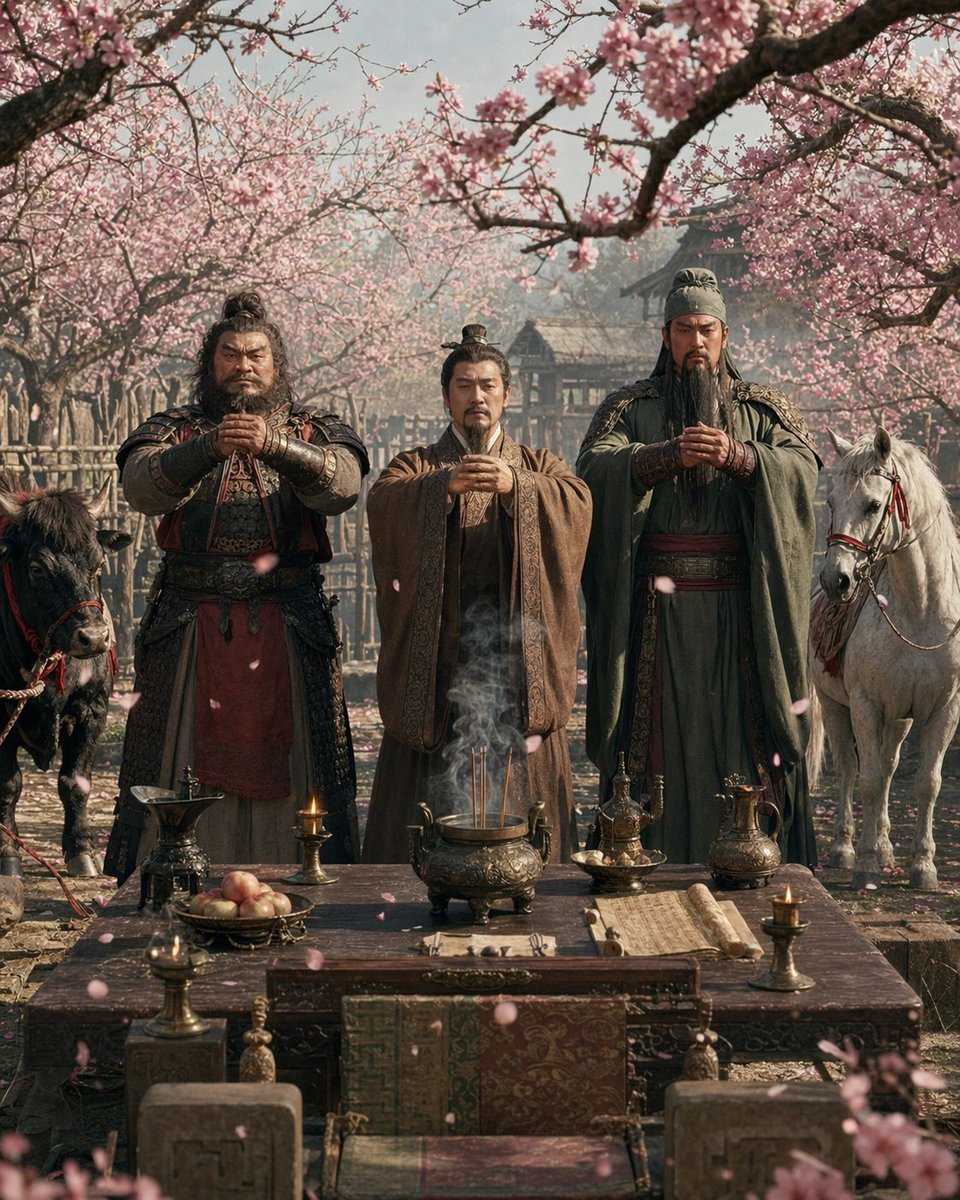
A cinematic historical scene from Romance of the Three Kingdoms showing the Peach Garden Oath.
Fields you can change: scene name.
Full prompt
A cinematic historical scene from Romance of the Three Kingdoms showing the {argument name="scene name" default="Peach Garden Oath"}. Three ancient Chinese men stand side by side behind a ceremonial altar table in a blooming orchard of pink peach blossoms, each holding a respectful fist-and-palm salute at chest height. The man on the left is broad and heavily built, wearing dark lamellar armor with a deep red robe panel and rugged warrior styling; the man in the center is shorter and slimmer, wearing layered brown scholar-official robes and a simple topknot; the man on the right is tall and imposing, wearing flowing dark green robes with armor details, a long black beard, and a noble commanding presence. In front of them is one large carved wooden altar table arranged with exactly 10 ritual elements: 1 bronze incense burner in the center with three lit incense sticks and visible curling smoke, 4 bronze candlesticks with small flames placed near the corners, 1 fruit plate with peaches, 1 ewer or wine vessel on the left, 2 bronze pouring vessels on the right, and 1 open scroll laid across the tabletop. Pink petals drift through the air and scatter on the ground. The orchard forms a tunnel of flowering branches overhead, with rustic wooden fencing and traditional buildings softly visible in the background through light spring haze. Include exactly 2 horses flanking the group: a dark horse on the far left and a white horse on the far right, both saddled and calm. Composition is symmetrical, eye-level, centered on the oath ritual, with rich period textures, realistic faces and fabrics, soft natural morning light, shallow atmospheric depth, and an epic, reverent, painterly-cinematic realism in the style of a prestige historical drama.

Analyze the entire composition of the input image. Identify all key subjects present (whether a single person, group/couple, vehicle, or specific object) and their spatial relationships/interactions.
Generate a coherent 3×3 “contact sheet” grid that shows 9 different shots of exactly these subjects within the same environment.
You must adapt standard cinematic shot types to fit the content (for example, if it’s a group, keep the group together; if it’s an object, frame the entire object):
Row 1 (establishing the environment):
Extreme long shot (ELS): the subject appears small within a vast environment.
Long shot (LS): the full subject or group is visible from top to bottom (head to toe / wheels to roof).
Medium long shot (American shot / three-quarter): framed from above the knees (for people) or a 3/4 view (for objects).
Row 2 (core coverage):
4. Medium shot (MS): framed from the waist up (or the central core of an object). Focus on interaction/action.
5. Medium close-up (MCU): framed from the chest up. An intimate framing of the main subject.
6. Close-up (CU): tightly framed on the face or the “front” of the object.
Row 3 (details and angles):
7. Extreme close-up (ECU): intense focus on key features (eyes, hands, signs, textures) with macro-like detail.
8. Low-angle shot (worm’s-eye): look up at the subject from ground level (epic/heroic feeling).
9. High-angle shot (bird’s-eye): look down on the subject from above.
Ensure strict consistency: the same person/object, same clothing, and same lighting must appear in all 9 panels. Depth of field should vary realistically (with background blur in close-up shots).
Create a professional 3×3 cinematic storyboard grid with 9 panels.
The grid should present a specific subject/scene from the input image across a full range of focal lengths.
Top row: wide environmental shot, full-body view, 3/4 cropped (knees-up).
Middle row: waist-up view, chest-up view, face/front close-up.
Bottom row: macro details, low angle, high angle.
All frames must have photo-realistic textures, consistent cinematic color grading, and correct framing tailored to the number and type of subjects or objects being analyzed.
Put this whole text, verbatim, into a photo of a glossy magazine article on a desk, with photos, beautiful typography design, pull quotes, and bold formatting. The text: {argument name="article_text_en" default="[paste the full unformatted article here]"}
Create decorative text based on the word "{argument name="word" default=""}". Write the specified word largely and create decorative text designs associated with the image of the word. Create original designs with flexible ideas, without being constrained by existing fonts. The background should be a single color, white or black, matching the design.


