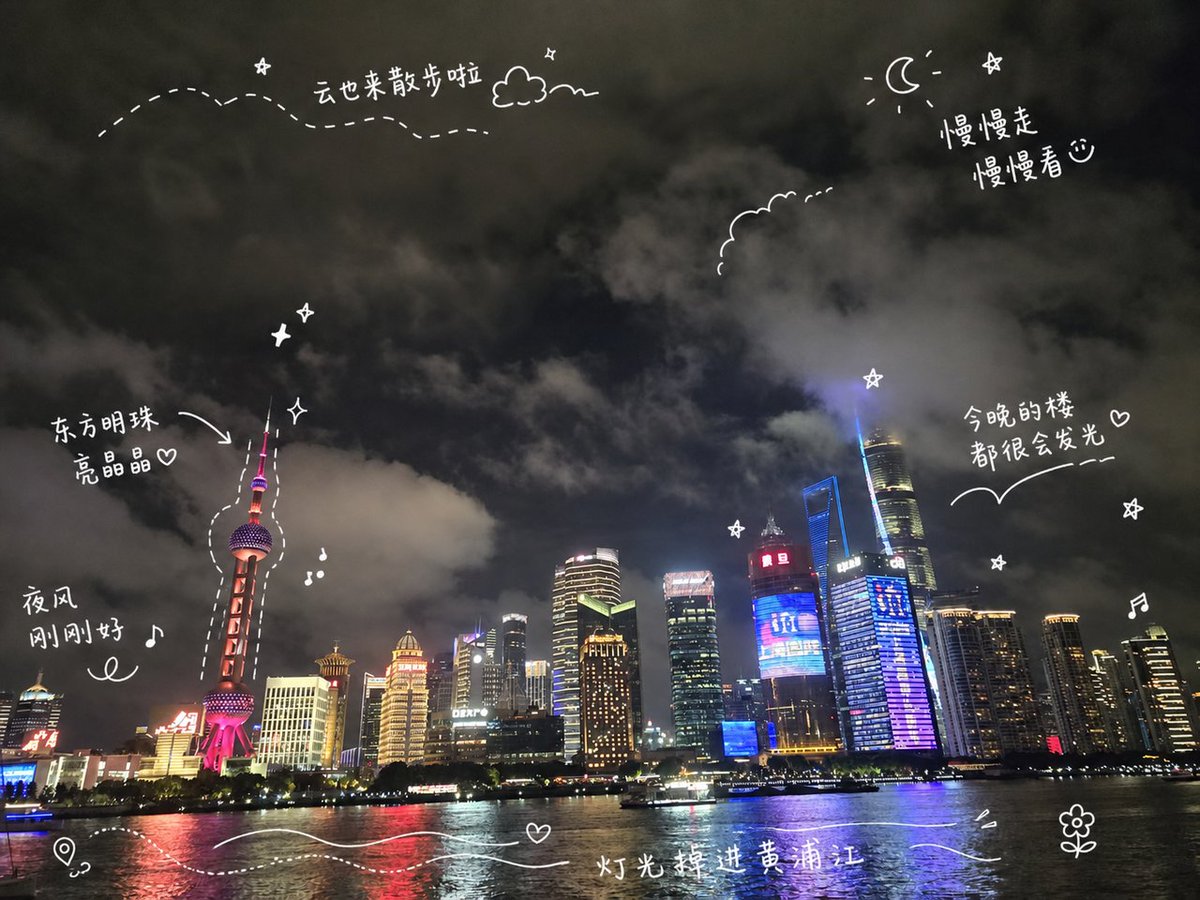
Create a travel-journal style night cityscape poster of Shanghai Pudong skyline along the Huangpu River.
Fields you can change: city skyline.
Full prompt
Create a travel-journal style night cityscape poster of {argument name="city skyline" default="Shanghai Pudong skyline along the Huangpu River"}. Use a wide 4:3 canvas showing a realistic nighttime waterfront photo look: dark cloudy sky filling the top two thirds, illuminated skyscrapers along the horizon, the Oriental Pearl Tower on the left glowing pink-red, Shanghai Tower and other high-rises on the right with blue, purple, gold, and white lights, and reflective river water across the bottom with a small sightseeing boat. Add playful white hand-drawn diary doodles and handwritten Chinese annotations directly over the scene, like a social media travel note. Include exactly 6 handwritten text notes: “云也来散步啦” near the upper left with a dotted wandering path and small cloud, “慢慢走 慢慢看♡” near the upper right beside a crescent moon and star, “东方明珠 亮晶晶♡” pointing with an arrow to the Oriental Pearl Tower, “夜风 刚刚好♪” on the left above the river, “今晚的楼 都很会发光♡” on the right above the skyline with a curved underline, and “灯光掉进黄浦江” centered near the bottom over the water. Include exactly 15 white doodle elements: a dotted flight path across the upper left, one small outlined cloud near the top, one crescent moon at the upper right, one scalloped cloud outline near the upper center-right, one arrow pointing to the Oriental Pearl Tower, one dashed outline tracing around the Oriental Pearl Tower, three small sparkle/star icons, two music-note icons, one map-pin icon at the bottom left, two flowing wave lines across the bottom water, and one small flower doodle at the bottom right. Keep all doodles thin, casual, hand-drawn, slightly imperfect, and bright white, with no borders or watermark. The mood should be dreamy, cozy, romantic, and spontaneous, like a handwritten travel memory shared on social media.

Analyze the entire composition of the input image. Identify all key subjects present (whether a single person, group/couple, vehicle, or specific object) and their spatial relationships/interactions.
Generate a coherent 3×3 “contact sheet” grid that shows 9 different shots of exactly these subjects within the same environment.
You must adapt standard cinematic shot types to fit the content (for example, if it’s a group, keep the group together; if it’s an object, frame the entire object):
Row 1 (establishing the environment):
Extreme long shot (ELS): the subject appears small within a vast environment.
Long shot (LS): the full subject or group is visible from top to bottom (head to toe / wheels to roof).
Medium long shot (American shot / three-quarter): framed from above the knees (for people) or a 3/4 view (for objects).
Row 2 (core coverage):
4. Medium shot (MS): framed from the waist up (or the central core of an object). Focus on interaction/action.
5. Medium close-up (MCU): framed from the chest up. An intimate framing of the main subject.
6. Close-up (CU): tightly framed on the face or the “front” of the object.
Row 3 (details and angles):
7. Extreme close-up (ECU): intense focus on key features (eyes, hands, signs, textures) with macro-like detail.
8. Low-angle shot (worm’s-eye): look up at the subject from ground level (epic/heroic feeling).
9. High-angle shot (bird’s-eye): look down on the subject from above.
Ensure strict consistency: the same person/object, same clothing, and same lighting must appear in all 9 panels. Depth of field should vary realistically (with background blur in close-up shots).
Create a professional 3×3 cinematic storyboard grid with 9 panels.
The grid should present a specific subject/scene from the input image across a full range of focal lengths.
Top row: wide environmental shot, full-body view, 3/4 cropped (knees-up).
Middle row: waist-up view, chest-up view, face/front close-up.
Bottom row: macro details, low angle, high angle.
All frames must have photo-realistic textures, consistent cinematic color grading, and correct framing tailored to the number and type of subjects or objects being analyzed.
Put this whole text, verbatim, into a photo of a glossy magazine article on a desk, with photos, beautiful typography design, pull quotes, and bold formatting. The text: {argument name="article_text_en" default="[paste the full unformatted article here]"}
Create decorative text based on the word "{argument name="word" default=""}". Write the specified word largely and create decorative text designs associated with the image of the word. Create original designs with flexible ideas, without being constrained by existing fonts. The background should be a single color, white or black, matching the design.


