Editorial / Poster
Blueberry Courseware Cover Slide
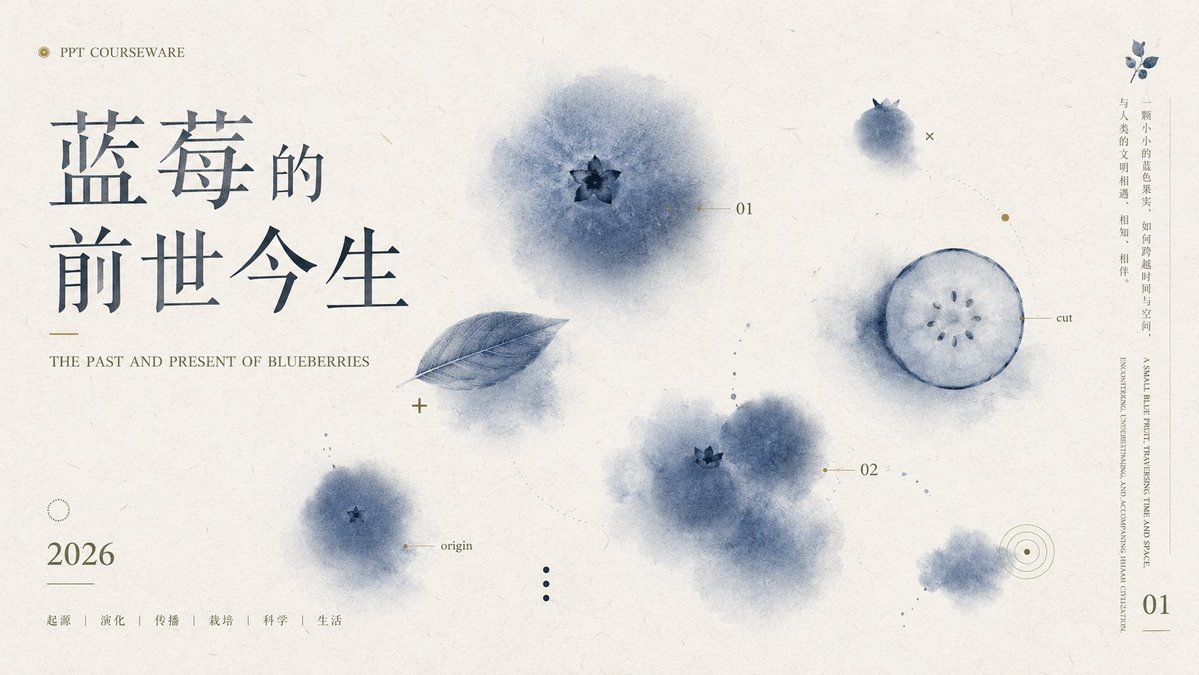
Goal: Create an elegant widescreen PPT courseware cover slide about the past and present of blueberries, blending Chinese editorial typography with soft watercolor botanical illustration.
Fields you can change: topic, Chinese title, English subtitle, year, vertical quote.
Full prompt
Goal: Create an elegant widescreen PPT courseware cover slide about {argument name="topic" default="the past and present of blueberries"}, blending Chinese editorial typography with soft watercolor botanical illustration.
Canvas: 16:9 landscape presentation slide, warm off-white handmade paper texture background with subtle fibers, faint stains, and minimal ink speckles.
Layout: Left third is dominated by a large Chinese title in dark blue-gray: {argument name="Chinese title" default="蓝莓的\n前世今生"}. Place the title in two stacked lines with generous spacing, using a refined Song/Ming-style serif font. Above it, small uppercase text reads “PPT COURSEWARE” preceded by a tiny gold circular icon. Under the title, add a short thin gold line and the English subtitle in small serif capitals: {argument name="English subtitle" default="THE PAST AND PRESENT OF BLUEBERRIES"}. Bottom left shows the year {argument name="year" default="2026"} in large serif numerals, with a thin horizontal line beneath, then five small Chinese category labels separated by vertical dividers: “起源 | 演化 | 传播 | 栽培 | 科学 | 生活”.
Main imagery: Use exactly 6 visible blueberry-related watercolor elements across the slide: 1 large soft blue blueberry bloom near the upper center with a dark star-shaped calyx, 1 translucent blue leaf angled diagonally below-left of it, 1 small blueberry bloom near lower left labeled “origin”, 1 clustered pair of blurry blueberries near lower middle-right with one visible calyx, 1 circular blueberry cross-section on the right labeled “cut” with pale pulp and small seed dots, and 1 small fuzzy blueberry wash near the lower right. Keep all fruit elements desaturated indigo, smoky blue, and gray-blue, with feathered watercolor edges.
Technical annotation details: Add fine gold and blue-gray diagram marks: tiny crosses, dotted guide lines, small circles, target rings, and thin leader lines. Include exactly 3 small numeric labels: “01” near the upper-center blueberry, “02” near the middle-right cluster, and “01” as a page number at the bottom right. Add the labels “origin” and “cut” in very small serif text.
Right margin: Add a narrow vertical text column on the far right with small Chinese copy: {argument name="vertical quote" default="一颗小小的蓝色果实,如何跨越时间与空间,与人类的文明相遇、相知、相伴。"}. Beside or below it, add very small vertical English text in uppercase, decorative and partially editorial, about blueberries traversing time and space.
Visual style: Minimal premium academic presentation design, Chinese new-literati aesthetic, botanical science notes, high negative space, soft ink-wash watercolor, muted navy-blue and gray palette with restrained antique-gold accents, crisp typography but organic painted fruit. No people, no photorealistic fruit, no bright colors, no watermark.