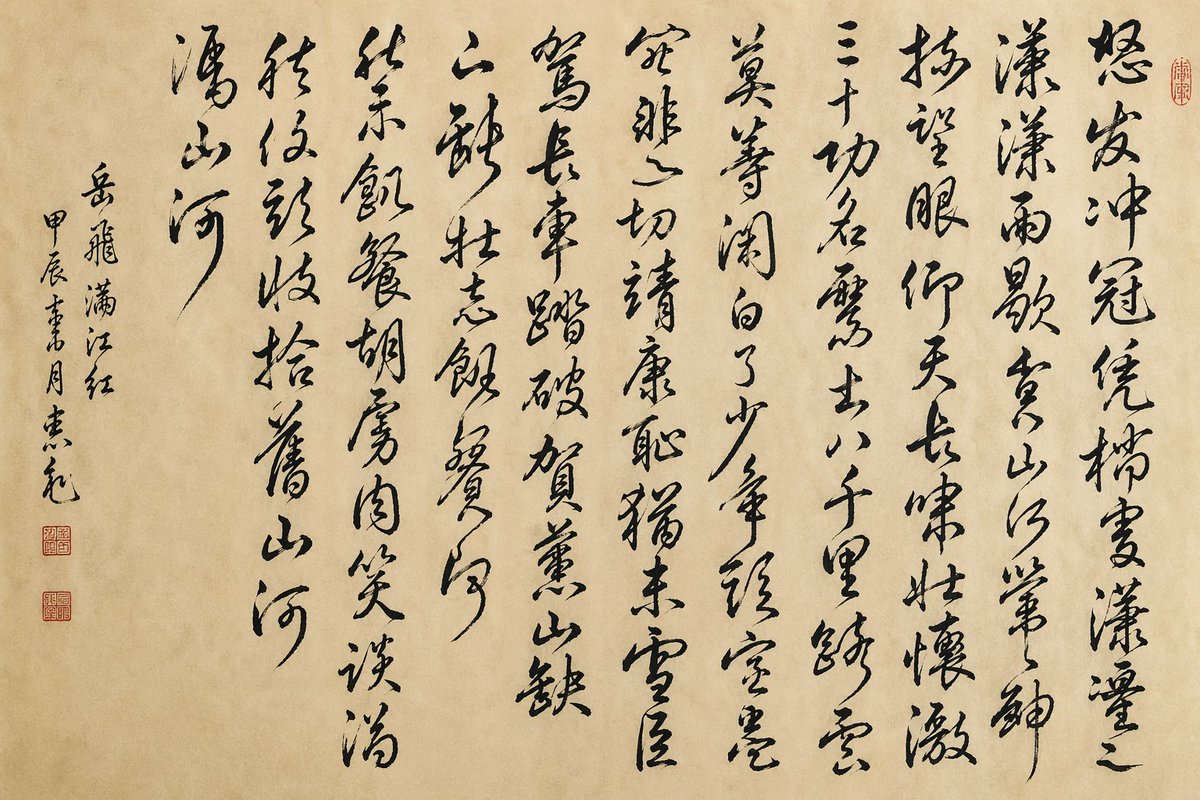
A traditional Chinese ink calligraphy artwork on aged beige xuan paper, presented as a clean flat scan or photograph of a single hanging scroll page with no frame.
Fields you can change: poem text, inscription text.
Full prompt
A traditional Chinese ink calligraphy artwork on aged beige xuan paper, presented as a clean flat scan or photograph of a single hanging scroll page with no frame. The composition is entirely vertical Chinese cursive script, bold expressive grass-script brushwork in deep black ink with dynamic stroke variation, flying-white texture, dry-brush breaks, and elegant rhythm. Write the full poem {argument name="poem text" default="怒发冲冠,凭栏处、潇潇雨歇。抬望眼,仰天长啸,壮怀激烈。三十功名尘与土,八千里路云和月。莫等闲,白了少年头,空悲切。\n靖康耻,犹未雪;臣子恨,何时灭!驾长车,踏破贺兰山缺。壮志饥餐胡虏肉,笑谈渴饮匈奴血。待从头,收拾旧山河,朝天阙。"} in large vertical columns arranged right to left, about 8 main poem columns across the page, each column flowing freely with slight variations in spacing and tilt. Leave a wide left margin containing a smaller vertical inscription with 3 narrow columns: the title and attribution reading {argument name="inscription text" default="岳飞 满江红 甲辰書月 某元"}, written in a more restrained but still cursive hand. Add exactly 3 small red seal stamps: 2 stacked square seals in the lower-left margin beneath the inscription, and 1 small oval seal near the upper-right edge beside the first main column. The paper should have subtle warm tan mottling, soft fibers, faint age marks, and natural uneven tone. Overall mood is heroic, scholarly, and museum-quality, with authentic Song-inspired Chinese calligraphy aesthetics, minimal background, high detail, and faithful brush texture.

Analyze the entire composition of the input image. Identify all key subjects present (whether a single person, group/couple, vehicle, or specific object) and their spatial relationships/interactions.
Generate a coherent 3×3 “contact sheet” grid that shows 9 different shots of exactly these subjects within the same environment.
You must adapt standard cinematic shot types to fit the content (for example, if it’s a group, keep the group together; if it’s an object, frame the entire object):
Row 1 (establishing the environment):
Extreme long shot (ELS): the subject appears small within a vast environment.
Long shot (LS): the full subject or group is visible from top to bottom (head to toe / wheels to roof).
Medium long shot (American shot / three-quarter): framed from above the knees (for people) or a 3/4 view (for objects).
Row 2 (core coverage):
4. Medium shot (MS): framed from the waist up (or the central core of an object). Focus on interaction/action.
5. Medium close-up (MCU): framed from the chest up. An intimate framing of the main subject.
6. Close-up (CU): tightly framed on the face or the “front” of the object.
Row 3 (details and angles):
7. Extreme close-up (ECU): intense focus on key features (eyes, hands, signs, textures) with macro-like detail.
8. Low-angle shot (worm’s-eye): look up at the subject from ground level (epic/heroic feeling).
9. High-angle shot (bird’s-eye): look down on the subject from above.
Ensure strict consistency: the same person/object, same clothing, and same lighting must appear in all 9 panels. Depth of field should vary realistically (with background blur in close-up shots).
Create a professional 3×3 cinematic storyboard grid with 9 panels.
The grid should present a specific subject/scene from the input image across a full range of focal lengths.
Top row: wide environmental shot, full-body view, 3/4 cropped (knees-up).
Middle row: waist-up view, chest-up view, face/front close-up.
Bottom row: macro details, low angle, high angle.
All frames must have photo-realistic textures, consistent cinematic color grading, and correct framing tailored to the number and type of subjects or objects being analyzed.
Put this whole text, verbatim, into a photo of a glossy magazine article on a desk, with photos, beautiful typography design, pull quotes, and bold formatting. The text: {argument name="article_text_en" default="[paste the full unformatted article here]"}
Create decorative text based on the word "{argument name="word" default=""}". Write the specified word largely and create decorative text designs associated with the image of the word. Create original designs with flexible ideas, without being constrained by existing fonts. The background should be a single color, white or black, matching the design.


