Editorial / Poster
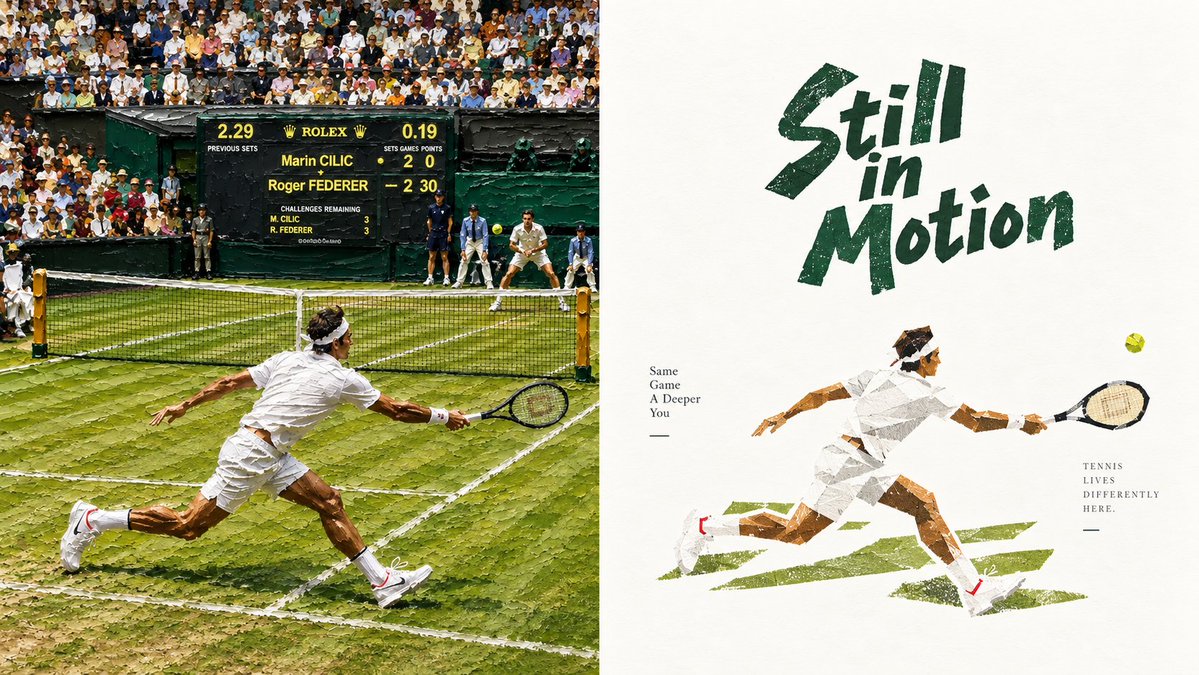
Wimbledon Motion Diptych
Goal: Create a two-panel editorial sports artwork about Roger Federer at Wimbledon, combining a rough painterly match scene with a minimalist poster illustration. Canvas: Wide horizontal 16:9 composition split exactly into 2 equal vertical panels.
Fields you can change: tennis player, headline text, left slogan, right slogan.
Full prompt
Goal: Create a two-panel editorial sports artwork about {argument name="tennis player" default="Roger Federer"} at Wimbledon, combining a rough painterly match scene with a minimalist poster illustration.
Canvas: Wide horizontal 16:9 composition split exactly into 2 equal vertical panels. Left panel is a dense, realistic, rough-brush illustration of a grass-court tennis match; right panel is a clean off-white poster with distressed typography and collage-like tennis illustration. No outer border.
Layout: Left panel occupies the left half and shows an action moment from behind the near player, lunging low across a worn green grass court toward the net. The far baseline has 1 opposing player in white preparing to return, with 2 ball kids or officials standing near the back wall. A large scoreboard sits high at center-left behind the court, with a packed audience filling the stands above it. Right panel occupies the right half with lots of negative space: large hand-painted green title at upper center-right, small slogan text at mid-left, a running tennis player illustration across the lower center, and a small vertical text block near the lower right.
Left panel subject details: Depict exactly 2 tennis players: 1 foreground player in all-white tennis outfit, white headband, white shoes with small red accents, stretched into a dramatic forehand reach with racket extended; 1 distant opponent in white near the far baseline. Include 1 yellow tennis ball visible near the far player. The court is Wimbledon-style grass with scuffed, patchy texture, white boundary lines, a black net with yellow posts, and dark green walls. Use a crowded stadium background with many tiny spectators in hats and summer clothing. The left panel should feel like a photo transformed into thick oil-paint strokes, with visible palette-knife texture and rough edges.
Scoreboard text: Include a black-and-green Rolex-style scoreboard with yellow lettering. It should show the names Marin CILIC and Roger FEDERER, with Federer leading; include readable fragments such as "ROLEX", "Marin CILIC", "Roger FEDERER", "PREVIOUS SETS", "SETS", "GAMES", "POINTS", and small challenge remaining lines, but do not worry about perfect numerical accuracy.
Right panel visual style: Minimalist off-white paper background with subtle grain. At the top, write {argument name="headline text" default="Still in Motion"} in large dark forest-green, rough dry-brush, slanted hand-lettering. The illustrated player below should match the foreground player from the left panel, drawn as a low-poly paper collage / torn-paper texture in white, tan, brown, gray, and green, sprinting to the right with a black racket and a small yellow tennis ball floating ahead. Add exactly 3 rough green brush-stroke court marks beneath the player.
Right panel text content: Add two small serif text blocks: on the left of the illustrated player, stacked lines reading {argument name="left slogan" default="Same Game A Deeper You"} with a short horizontal rule beneath; near the lower right, stacked lines reading {argument name="right slogan" default="TENNIS LIVES DIFFERENTLY HERE."} with a short horizontal rule beneath.
Color and mood: Wimbledon greens, white clothing, sunlit grass, dark scoreboard, warm crowd tones, and an elegant vintage sports-magazine mood. The overall finish should be rough, textured, slightly imperfect, artistic, and editorial rather than glossy.
Constraints: Use exactly 2 panels, exactly 2 tennis players, exactly 1 visible tennis ball in the left panel, exactly 1 visible tennis ball in the right panel, exactly 1 large scoreboard, exactly 3 green brush-stroke court marks in the right panel. Avoid logos other than the scoreboard-style Rolex reference, avoid watermarks, and keep the right panel spacious and uncluttered.