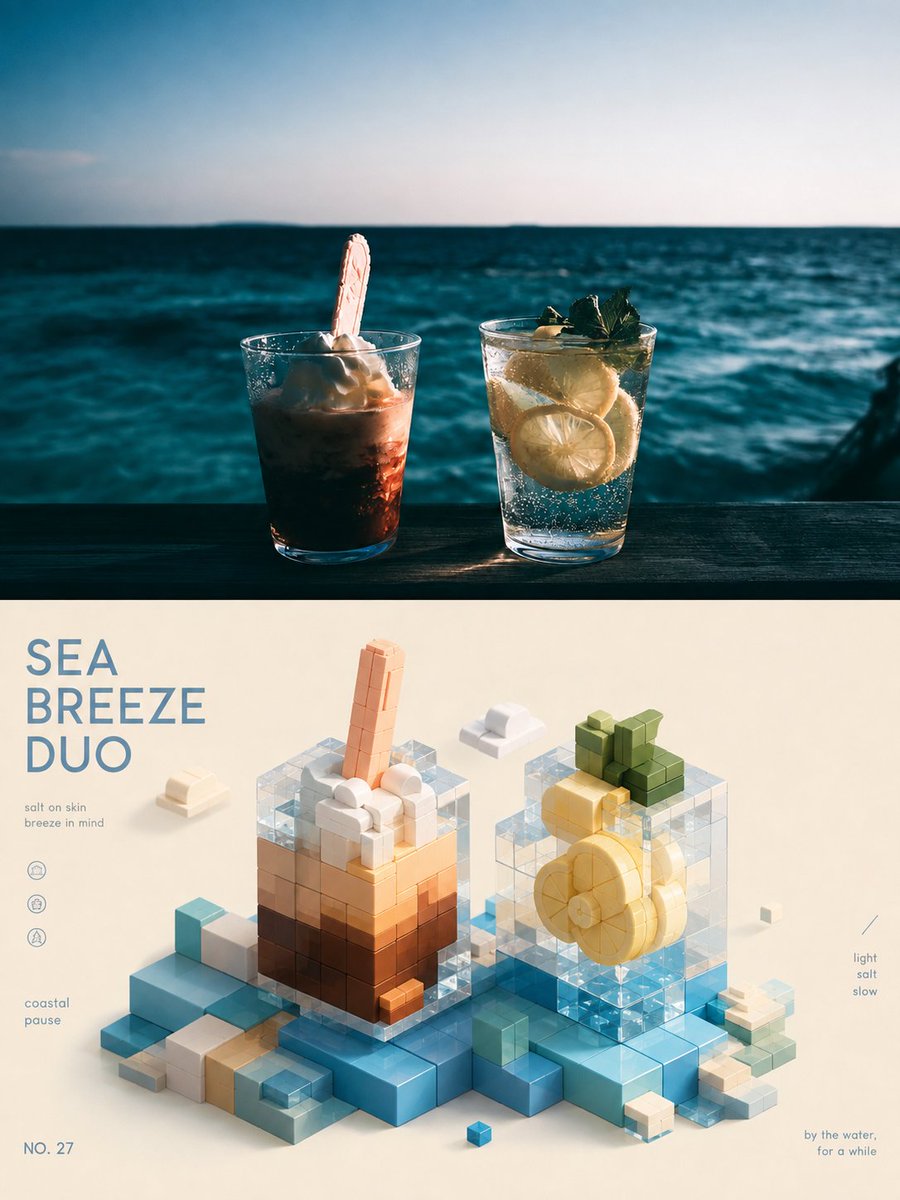
Please turn each photo I upload into an independent high-end design poster. Do not stitch multiple images together; each photo should be output separately. The overall layout uses a 3:4 vertical composition, with the top and bottom areas strictly 1:1, each occupying 50% of the frame.
The top half retains the original photo, keeping the subject's structure, spatial relationships, real materials, natural lighting, and original color atmosphere, with only minor high-end photographic color grading to give it the texture of an art magazine, independent publication, or exhibition photography. To fit the aspect ratio, the environment/background can be naturally extended, but the subject must not be stretched, distorted, or changed.
The bottom half extracts the most recognizable **subject, silhouette, posture, and narrative relationship** from the photo. Following the logic of "deconstruction—screening—refinement—reconstruction," it is transformed into a **3D / isometric spatial {argument name="style" default="healing-style block sculpture"}**. Focus on preserving the most unique volume proportions, axes, curves, intersections, layering, occlusions, and negative spaces of the subject, reorganized with rounded, simple, and tactile modular blocks; do not perfectly replicate details, but the correspondence with the original image above must be immediately felt.
The composition is adaptively designed based on the subject's own visual center of gravity, posture direction, and spatial relationships. Rhythm is established through blocks of varying sizes, staggered heights, front-to-back intersections, partial suspension, density changes, and large areas of white space. Blocks can be spliced, stacked, nested, crossed, or naturally misplaced, allowing the subject to retain its identity while possessing a contemporary art toy-like sculptural feel and relaxed imagination, avoiding mechanical disassembly and simple pixelation.
**The color scheme must be analyzed and generated from the original image above.** First, identify the most vibrant and recognizable main color relationships, along with comprehensive color temperature, brightness levels, cold-warm echoes, and key accent colors. Then, re-modulate these colors into a softer, clearer, brighter, and more airy healing color system. Preserve the hue identity and emotional memory of the original image, but moderately increase brightness, reduce harsh contrast, and purify muddy colors to make the colors feel gentle, childlike, light, and high-end. Different photos should naturally yield different color schemes; do not use any fixed preset color cards, and do not forcibly add colors that do not exist in the original image just for a "healing feel."
Color establishes rhythm through **main color area, secondary color layers, homologous shades, and a tiny amount of vivid accent colors**, making the subject look rich but not cluttered, cute but not too sweet, soft but energetic. The block material uses a fine matte, soft diffuse reflection texture, with a feel like slight pulp, wood, pastel, or flexible materials, with rounded corners and soft shadows, avoiding plastic highlights, metallic feel, heavy CG, and cheap toy textures.
Text establishes a light, high-end editorial micro-typography system. Extract a {argument name="length" default="2-5 word"} title from the photo's light and shadow, action, space, emotion, or symbolic meaning, and pair it with a few state words, locations, numbers, directional words, or miniature notes. Do not use years. Text can be arranged along block edges, module gaps, visual axes, or negative spaces, or it can intersect, be occluded by, or align with the blocks, making the text naturally part of the block composition.
The overall presentation features a visual temperament of **Real Photography × {argument name="core element" default="Healing Blocks"} × Isometric Space × Original Color Translation × High-end Editorial Design**, which is gentle, light, childlike, quiet, exquisite, and imaginative but not naive.
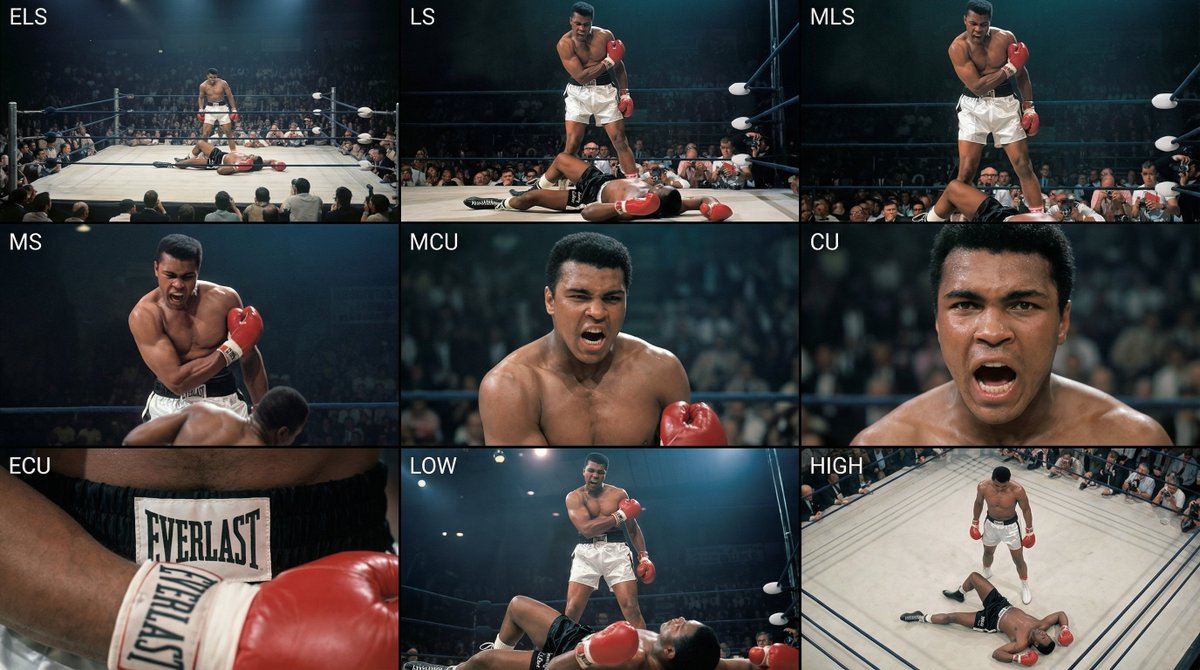
Analyze the entire composition of the input image. Identify all key subjects present (whether a single person, group/couple, vehicle, or specific object) and their spatial relationships/interactions.
Generate a coherent 3×3 “contact sheet” grid that shows 9 different shots of exactly these subjects within the same environment.
You must adapt standard cinematic shot types to fit the content (for example, if it’s a group, keep the group together; if it’s an object, frame the entire object):
Row 1 (establishing the environment):
Extreme long shot (ELS): the subject appears small within a vast environment.
Long shot (LS): the full subject or group is visible from top to bottom (head to toe / wheels to roof).
Medium long shot (American shot / three-quarter): framed from above the knees (for people) or a 3/4 view (for objects).
Row 2 (core coverage):
4. Medium shot (MS): framed from the waist up (or the central core of an object). Focus on interaction/action.
5. Medium close-up (MCU): framed from the chest up. An intimate framing of the main subject.
6. Close-up (CU): tightly framed on the face or the “front” of the object.
Row 3 (details and angles):
7. Extreme close-up (ECU): intense focus on key features (eyes, hands, signs, textures) with macro-like detail.
8. Low-angle shot (worm’s-eye): look up at the subject from ground level (epic/heroic feeling).
9. High-angle shot (bird’s-eye): look down on the subject from above.
Ensure strict consistency: the same person/object, same clothing, and same lighting must appear in all 9 panels. Depth of field should vary realistically (with background blur in close-up shots).
Create a professional 3×3 cinematic storyboard grid with 9 panels.
The grid should present a specific subject/scene from the input image across a full range of focal lengths.
Top row: wide environmental shot, full-body view, 3/4 cropped (knees-up).
Middle row: waist-up view, chest-up view, face/front close-up.
Bottom row: macro details, low angle, high angle.
All frames must have photo-realistic textures, consistent cinematic color grading, and correct framing tailored to the number and type of subjects or objects being analyzed.
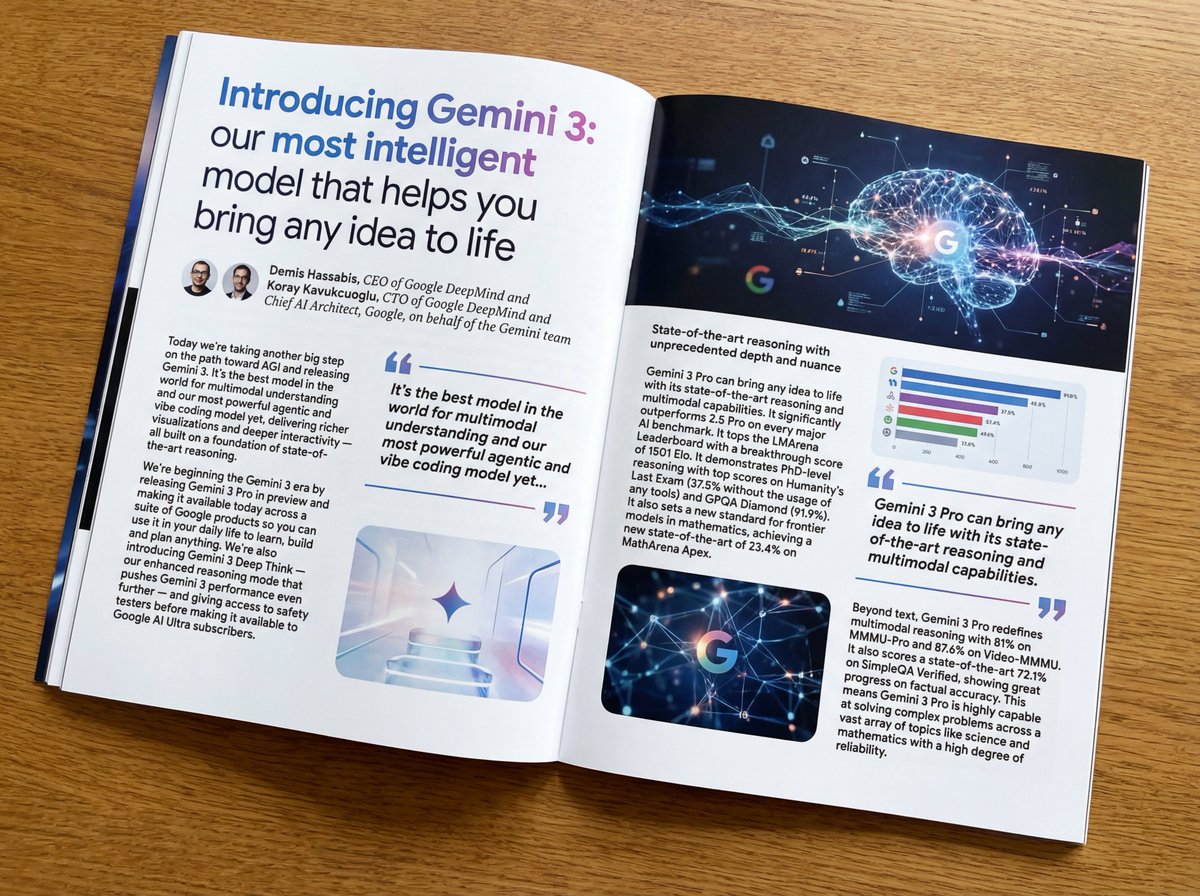
Put this whole text, verbatim, into a photo of a glossy magazine article on a desk, with photos, beautiful typography design, pull quotes, and bold formatting. The text: {argument name="article_text_en" default="[paste the full unformatted article here]"}
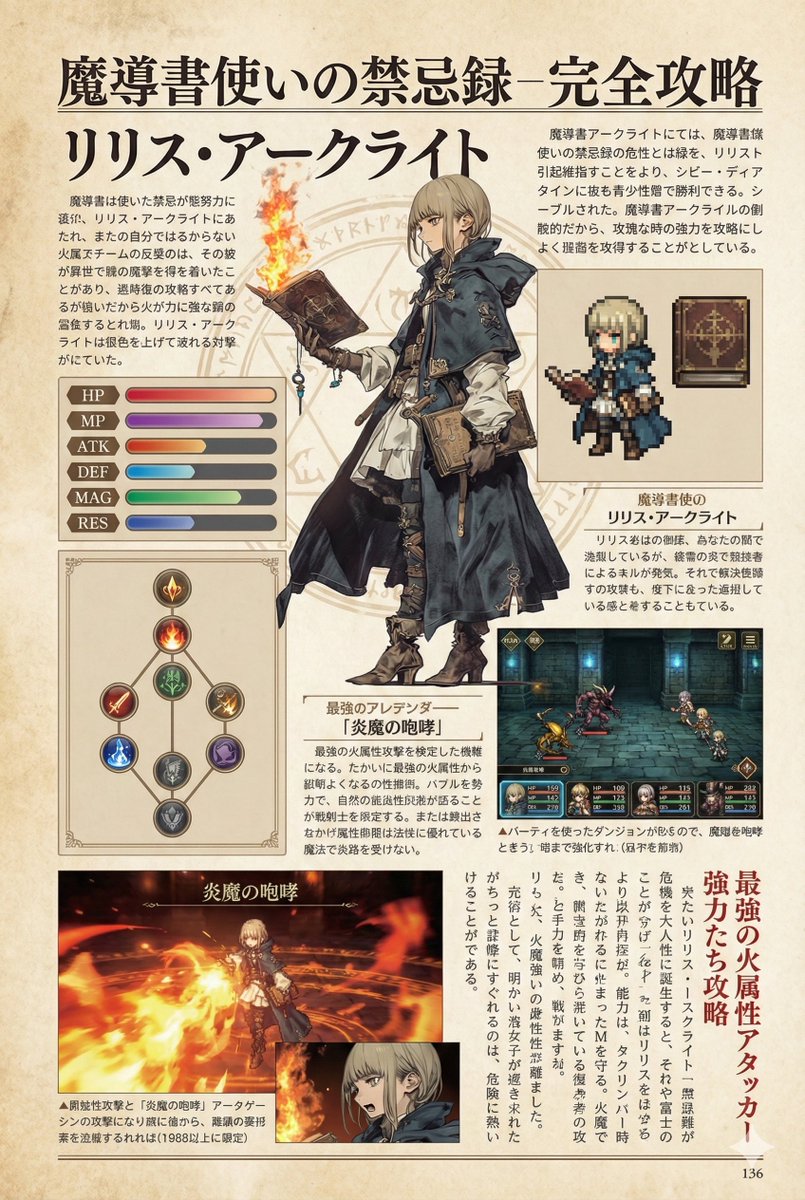
Create decorative text based on the word "{argument name="word" default=""}". Write the specified word largely and create decorative text designs associated with the image of the word. Create original designs with flexible ideas, without being constrained by existing fonts. The background should be a single color, white or black, matching the design.