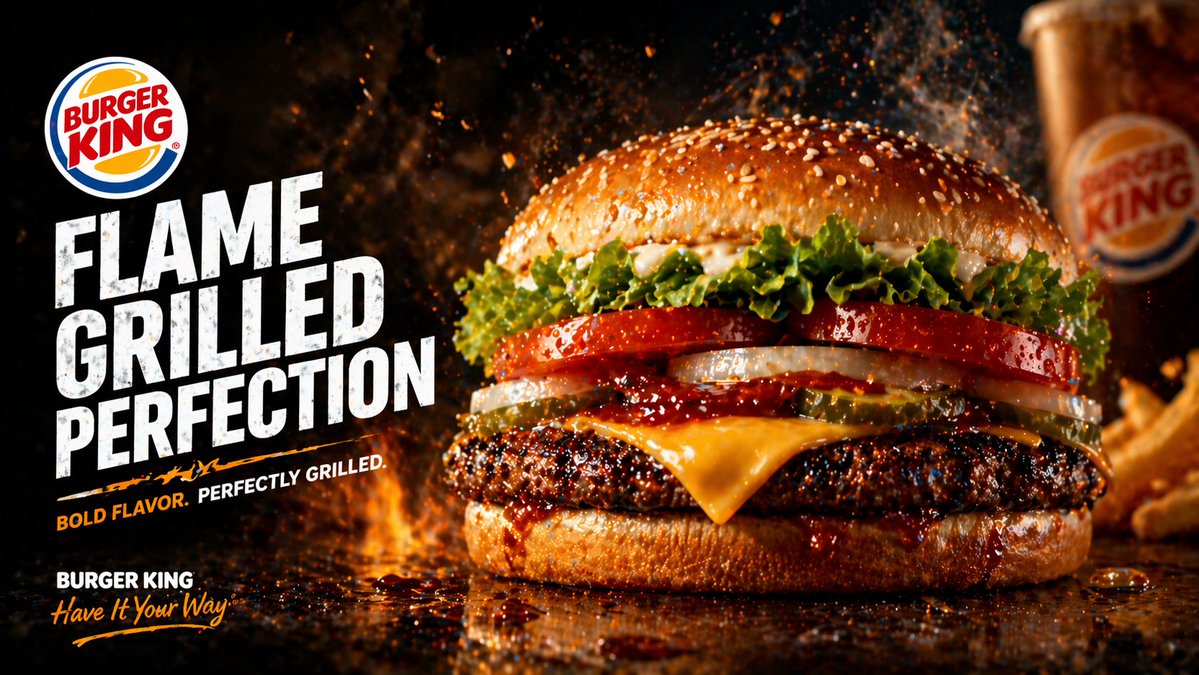
Create a dramatic fast-food advertising poster in a cinematic studio style for BURGER KING. Use a wide landscape composition with the hero burger dominating the right half of the frame and bold promotional typography stacked on the left.
Fields you can change: brand name, headline text, tagline text, slogan text.
Full prompt
Create a dramatic fast-food advertising poster in a cinematic studio style for {argument name="brand name" default="BURGER KING"}. Use a wide landscape composition with the hero burger dominating the right half of the frame and bold promotional typography stacked on the left. The background should be nearly black with fiery orange flames, glowing embers, smoke, and flying grease droplets to emphasize heat and flame-grilling. The burger should be an extreme close-up, shot at table level on a glossy dark reflective surface with sauce drips and scattered droplets. Show exactly 8 visible burger components from top to bottom: 1 sesame seed top bun, 1 layer of curly green leaf lettuce, 2 thick red tomato slices, 2 white onion rings, 3 pickle slices, 1 slice of melted yellow American cheese, 1 thick charred flame-grilled beef patty, and 1 glossy bottom bun with barbecue sauce dripping over the edge. Make the patty heavily textured with blackened grill-char detail and juicy highlights. Add sparks and steam rising around the burger. On the left side, place a circular fast-food logo near the upper-left corner, then huge distressed bold white block text in three stacked lines reading {argument name="headline text" default="FLAME GRILLED PERFECTION"}. Beneath it, add a short tagline in smaller uppercase text with an orange accent slash or underline, reading {argument name="tagline text" default="BOLD FLAVOR. PERFECTLY GRILLED."}. In the bottom-left corner, add the brand name again in white plus a handwritten script slogan in orange reading {argument name="slogan text" default="Have It Your Way"}. In the blurred background on the far right, include exactly 2 secondary food elements: 1 branded soda cup and 1 portion of fries, both out of focus. High contrast, rich warm tones, glossy food photography, ultra-detailed textures, realistic commercial lighting, shallow depth of field, premium restaurant poster aesthetic, print-ready ad composition.

Analyze the entire composition of the input image. Identify all key subjects present (whether a single person, group/couple, vehicle, or specific object) and their spatial relationships/interactions.
Generate a coherent 3×3 “contact sheet” grid that shows 9 different shots of exactly these subjects within the same environment.
You must adapt standard cinematic shot types to fit the content (for example, if it’s a group, keep the group together; if it’s an object, frame the entire object):
Row 1 (establishing the environment):
Extreme long shot (ELS): the subject appears small within a vast environment.
Long shot (LS): the full subject or group is visible from top to bottom (head to toe / wheels to roof).
Medium long shot (American shot / three-quarter): framed from above the knees (for people) or a 3/4 view (for objects).
Row 2 (core coverage):
4. Medium shot (MS): framed from the waist up (or the central core of an object). Focus on interaction/action.
5. Medium close-up (MCU): framed from the chest up. An intimate framing of the main subject.
6. Close-up (CU): tightly framed on the face or the “front” of the object.
Row 3 (details and angles):
7. Extreme close-up (ECU): intense focus on key features (eyes, hands, signs, textures) with macro-like detail.
8. Low-angle shot (worm’s-eye): look up at the subject from ground level (epic/heroic feeling).
9. High-angle shot (bird’s-eye): look down on the subject from above.
Ensure strict consistency: the same person/object, same clothing, and same lighting must appear in all 9 panels. Depth of field should vary realistically (with background blur in close-up shots).
Create a professional 3×3 cinematic storyboard grid with 9 panels.
The grid should present a specific subject/scene from the input image across a full range of focal lengths.
Top row: wide environmental shot, full-body view, 3/4 cropped (knees-up).
Middle row: waist-up view, chest-up view, face/front close-up.
Bottom row: macro details, low angle, high angle.
All frames must have photo-realistic textures, consistent cinematic color grading, and correct framing tailored to the number and type of subjects or objects being analyzed.
Put this whole text, verbatim, into a photo of a glossy magazine article on a desk, with photos, beautiful typography design, pull quotes, and bold formatting. The text: {argument name="article_text_en" default="[paste the full unformatted article here]"}
Create decorative text based on the word "{argument name="word" default=""}". Write the specified word largely and create decorative text designs associated with the image of the word. Create original designs with flexible ideas, without being constrained by existing fonts. The background should be a single color, white or black, matching the design.


