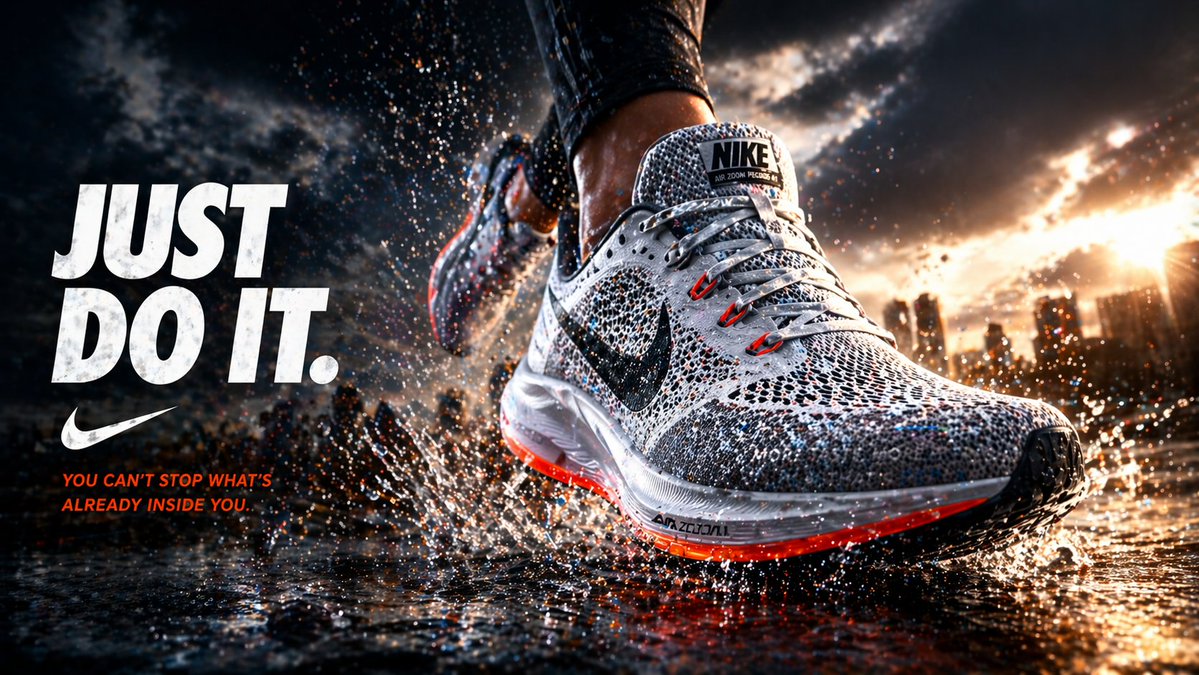
Create a cinematic sports advertising poster featuring a giant close-up running shoe in motion splashing through shallow water on a wet city street at sunset.
Fields you can change: headline text, tagline text, brand name, product type.
Full prompt
Create a cinematic sports advertising poster featuring a giant close-up running shoe in motion splashing through shallow water on a wet city street at sunset. The composition is a low-angle, ultra-dynamic action shot with 1 primary shoe dominating the right half of the frame and 1 secondary blurred shoe visible behind it, implying a runner mid-stride. The hero sneaker is a white and gray knit performance shoe with a black side swoosh-style logo, gray laces, small red lace-loop accents, a thick translucent cushioned sole, and a bright orange-red outsole glow along the bottom edge. Show the shoe covered in realistic water droplets and sharp texture detail, with explosive splash particles frozen around the sole. The runner wears dark athletic leggings, visible only from the lower legs down. Place a dramatic urban skyline in the distant background on the right, softly blurred, under stormy dark clouds breaking into warm golden sunlight near the horizon. Use intense contrast between cool blue-gray shadows and fiery orange highlights, with glossy reflections on the rain-soaked pavement. On the left side, add 3 text elements arranged vertically: a huge bold distressed white uppercase headline reading {argument name="headline text" default="JUST DO IT."}, beneath it 1 white swoosh-style brand mark, and below that a smaller uppercase orange motivational line reading {argument name="tagline text" default="YOU CAN'T STOP WHAT'S ALREADY INSIDE YOU."}. Include visible branding on the tongue label with {argument name="brand name" default="NIKE"}. Make it look like a premium high-impact commercial poster for {argument name="product type" default="running shoes"}, with hyperreal detail, dramatic lighting, shallow depth of field, motion energy, crisp typography, ad-photography polish, and a widescreen 16:9 layout.

Analyze the entire composition of the input image. Identify all key subjects present (whether a single person, group/couple, vehicle, or specific object) and their spatial relationships/interactions.
Generate a coherent 3×3 “contact sheet” grid that shows 9 different shots of exactly these subjects within the same environment.
You must adapt standard cinematic shot types to fit the content (for example, if it’s a group, keep the group together; if it’s an object, frame the entire object):
Row 1 (establishing the environment):
Extreme long shot (ELS): the subject appears small within a vast environment.
Long shot (LS): the full subject or group is visible from top to bottom (head to toe / wheels to roof).
Medium long shot (American shot / three-quarter): framed from above the knees (for people) or a 3/4 view (for objects).
Row 2 (core coverage):
4. Medium shot (MS): framed from the waist up (or the central core of an object). Focus on interaction/action.
5. Medium close-up (MCU): framed from the chest up. An intimate framing of the main subject.
6. Close-up (CU): tightly framed on the face or the “front” of the object.
Row 3 (details and angles):
7. Extreme close-up (ECU): intense focus on key features (eyes, hands, signs, textures) with macro-like detail.
8. Low-angle shot (worm’s-eye): look up at the subject from ground level (epic/heroic feeling).
9. High-angle shot (bird’s-eye): look down on the subject from above.
Ensure strict consistency: the same person/object, same clothing, and same lighting must appear in all 9 panels. Depth of field should vary realistically (with background blur in close-up shots).
Create a professional 3×3 cinematic storyboard grid with 9 panels.
The grid should present a specific subject/scene from the input image across a full range of focal lengths.
Top row: wide environmental shot, full-body view, 3/4 cropped (knees-up).
Middle row: waist-up view, chest-up view, face/front close-up.
Bottom row: macro details, low angle, high angle.
All frames must have photo-realistic textures, consistent cinematic color grading, and correct framing tailored to the number and type of subjects or objects being analyzed.
Put this whole text, verbatim, into a photo of a glossy magazine article on a desk, with photos, beautiful typography design, pull quotes, and bold formatting. The text: {argument name="article_text_en" default="[paste the full unformatted article here]"}
Create decorative text based on the word "{argument name="word" default=""}". Write the specified word largely and create decorative text designs associated with the image of the word. Create original designs with flexible ideas, without being constrained by existing fonts. The background should be a single color, white or black, matching the design.


