Editorial / Poster
Anime Gender Swap Before After Poster
Goal: Create a polished anime magazine-cover style “gender swap before/after” poster.
Fields you can change: hair color, before label, character name, stamp text, headline text.
Full prompt
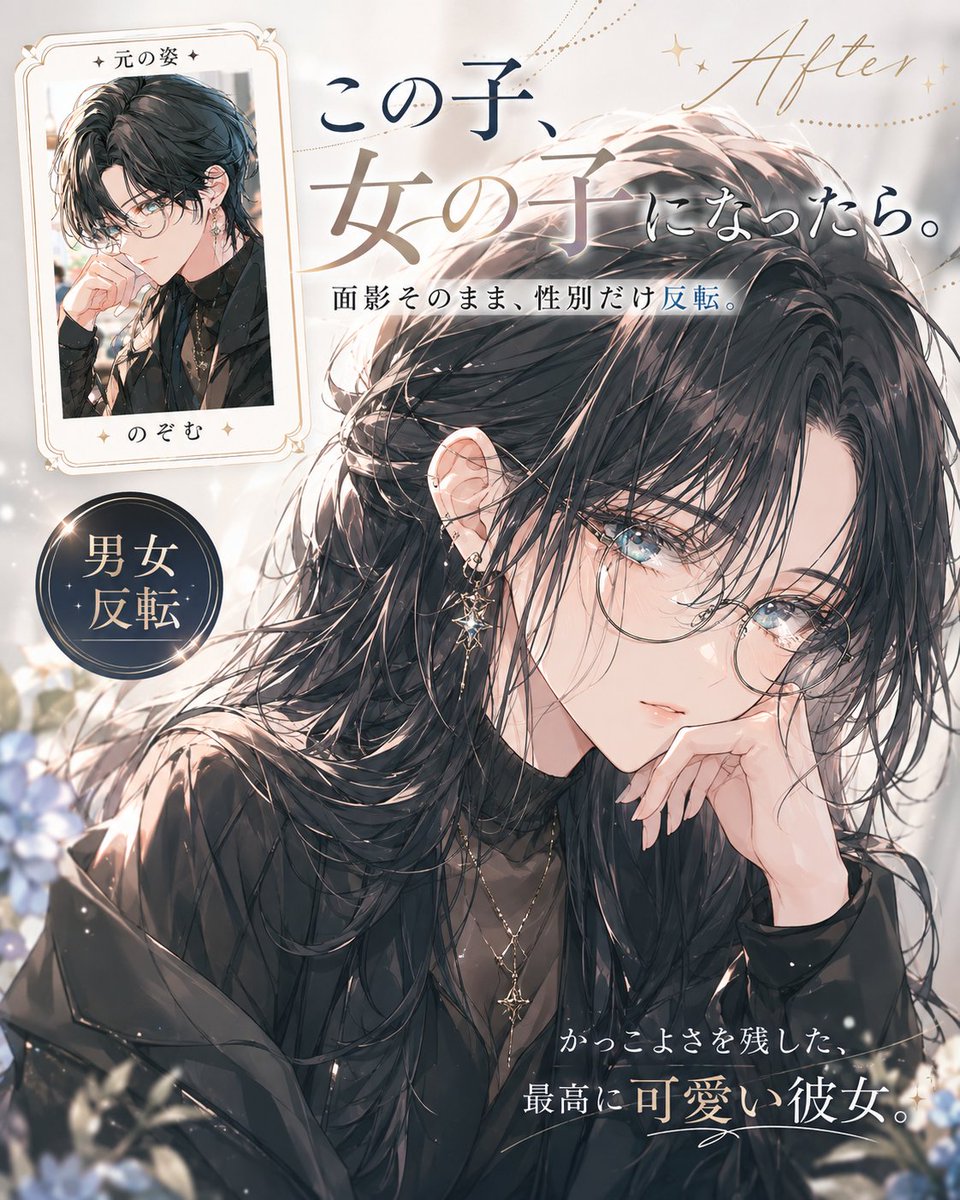
Goal: Create a polished anime magazine-cover style “gender swap before/after” poster. The main subject is the transformed After character: an extremely handsome teenage boy who preserves the soft facial resemblance of the original character, with {argument name="hair color" default="light ash-blonde"} tousled medium-short hair, sparkling blue eyes, pale luminous skin, a gentle open smile, and an elegant androgynous beauty. He wears a loose white shirt with rolled sleeves, a pale blue loosened necktie, blue suspenders, slim earrings, a delicate bracelet, and a blue belt with silver details. Pose him seated in a relaxed three-quarter view, leaning slightly forward with one hand near his cheek, looking directly at the viewer. Use airy spring lighting, soft bokeh flowers, floating white petals, translucent watercolor highlights, and crisp high-detail anime linework.
Canvas: Vertical 4:5 poster, light pastel blue and white palette, bright dreamy background, plenty of negative space on the left for typography, main After portrait large and dominant on the right and center.
Layout: Include exactly 1 small Before card in the upper-left corner and 1 large After portrait occupying most of the canvas. The Before card should have rounded corners, a thin blue border, and show a cute original girl with the same visual identity: ash-blonde wavy bob hair, blue eyes, white blouse, blue plaid skirt or blue ribbon accents, cheerful expression. Add a small top ribbon label on the card reading {argument name="before label" default="元の姿"} and a name under the mini portrait reading {argument name="character name" default="のぞむ"}. Add exactly 1 circular blue stamp near the lower-right of the poster reading {argument name="stamp text" default="男女\n反転"} with tiny sparkle marks.
Text content: Large elegant Japanese headline on the left, set in a mix of black and soft blue calligraphic serif type: {argument name="headline text" default="この子、\n男の子に\nなったら。"}. Under it, smaller Japanese subcopy: "面影そのまま、性別だけ反転。" Near the bottom, add a small caption: "可愛さを残した、最高にかっこいい彼。" Use refined magazine typography, with the key words in blue and the rest in dark ink.
Visual style: High-end shoujo anime illustration, glossy magazine cover composition, ethereal watercolor lighting, detailed hair strands, delicate jewelry, soft skin shading, blue-white color harmony, romantic and clean design. Keep all Japanese text legible and integrated into the layout. Avoid photorealism, clutter, extra characters, watermarks, or random additional text.



