Editorial / Poster
Japan Illustrated Travel Poster
Goal: Create a premium illustrated travel poster infographic for Japan, blending tourism advertising, map art, and editorial layout.
Fields you can change: country name, headline country text, Japanese quote, English quote.
Full prompt
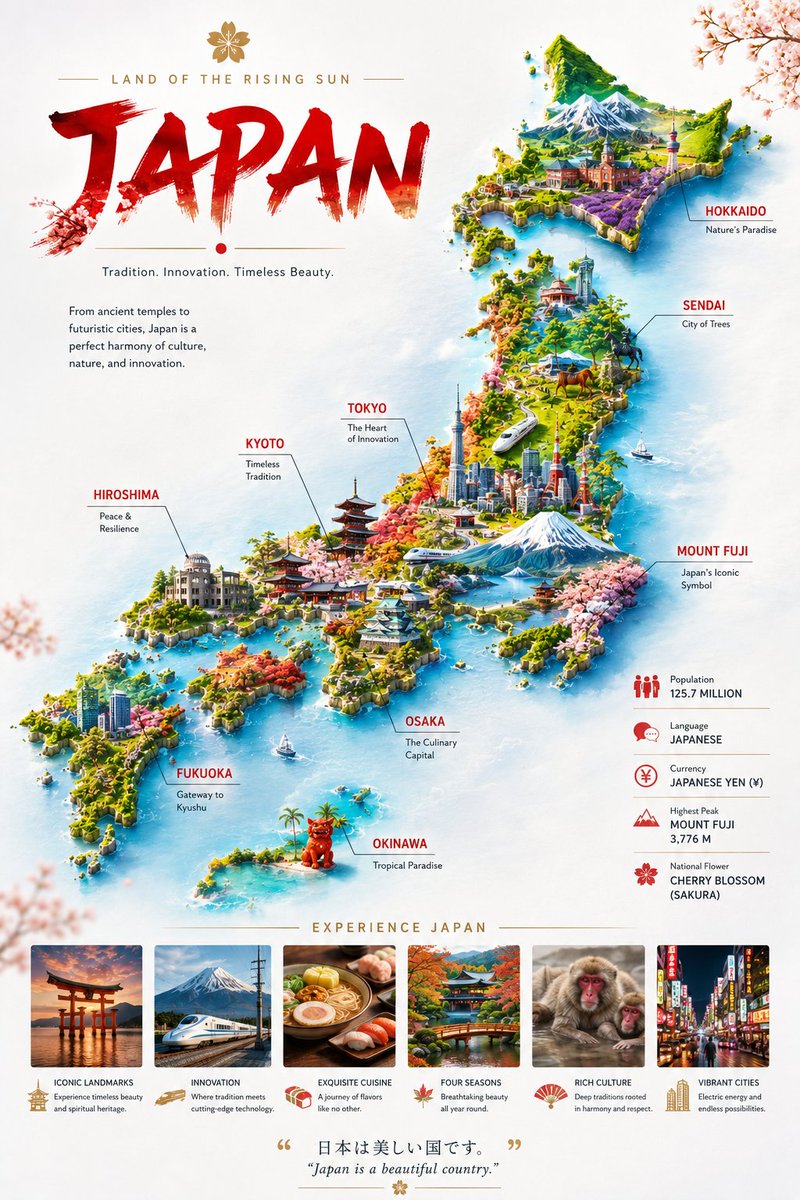
Goal: Create a premium illustrated travel poster infographic for {argument name="country name" default="Japan"}, blending tourism advertising, map art, and editorial layout.
Canvas: Vertical poster, 2:3 aspect ratio, bright white paper background with soft watercolor texture, airy margins, subtle pale blue ocean wash around the map, delicate cherry blossom branches fading in the top-right and lower-left corners.
Main layout: Left third contains the title block and introductory copy; right and center contain a detailed 3D isometric fantasy map of Japan made of lush green islands surrounded by turquoise water. The islands are not geographically exact but clearly form the Japanese archipelago from Hokkaido at top to Okinawa at bottom. Use miniature landmarks, cities, mountains, trains, boats, temples, forests, cherry blossoms, beaches, and urban skylines throughout.
Title block: At the top-left, place a small gold cherry blossom icon above the spaced uppercase subtitle “LAND OF THE RISING SUN” with thin gold horizontal lines on both sides. Below it, write the huge main title “{argument name="headline country text" default="JAPAN"}” in bold red expressive brush-calligraphy, with rough paint edges and slight orange-gold dry-brush texture near the bottom. Under the title, add a small red dot centered between thin gold lines, then the tagline “Tradition. Innovation. Timeless Beauty.” Add a short paragraph below: “From ancient temples to futuristic cities, Japan is a perfect harmony of culture, nature, and innovation.”
Map subject details: The illustrated map should show snowy mountains, a Mount Fuji-like peak, modern Tokyo skyscrapers, a red pagoda, Kyoto temples, Hiroshima Peace Memorial dome, bullet train tracks, coastal villages, sailboats, bridges, rice fields, lavender fields, tropical Okinawa water, and a small red guardian lion statue. Use vibrant greens, reds, pink cherry blossoms, aqua seas, white snow, and golden sunlight. Make the rendering highly detailed, colorful, polished, and slightly whimsical, like a high-end travel magazine infographic.
Map labels: Add exactly 9 red uppercase destination labels with fine gray leader lines and smaller black subtitles: 1) “HOKKAIDO” — “Nature’s Paradise”; 2) “SENDAI” — “City of Trees”; 3) “TOKYO” — “The Heart of Innovation”; 4) “MOUNT FUJI” — “Japan’s Iconic Symbol”; 5) “KYOTO” — “Timeless Tradition”; 6) “HIROSHIMA” — “Peace & Resilience”; 7) “OSAKA” — “The Culinary Capital”; 8) “FUKUOKA” — “Gateway to Kyushu”; 9) “OKINAWA” — “Tropical Paradise”.
Right-side facts panel: Place exactly 5 compact horizontal fact rows with red icons and thin divider lines: 1) Population icon, “Population” and “125.7 MILLION”; 2) speech bubbles icon, “Language” and “JAPANESE”; 3) yen coin icon, “Currency” and “JAPANESE YEN (¥)”; 4) mountain icon, “Highest Peak” and “MOUNT FUJI 3,776 M”; 5) cherry blossom icon, “National Flower” and “CHERRY BLOSSOM (SAKURA)”.
Bottom section: Center the gold heading “EXPERIENCE JAPAN” above exactly 6 rectangular photo-style cards in a row. Each card has a vivid image, a small gold/red icon, an uppercase title, and a short caption. The 6 cards are: 1) torii gate at sunset, title “ICONIC LANDMARKS”, caption “Experience timeless beauty and spiritual heritage.”; 2) bullet train with Mount Fuji, title “INNOVATION”, caption “Where tradition meets cutting-edge technology.”; 3) ramen and sushi, title “EXQUISITE CUISINE”, caption “A journey of flavors like no other.”; 4) autumn bridge and temple garden, title “FOUR SEASONS”, caption “Breathtaking beauty all year round.”; 5) snow monkeys in hot spring, title “RICH CULTURE”, caption “Deep traditions rooted in harmony and respect.”; 6) neon city street, title “VIBRANT CITIES”, caption “Electric energy and endless possibilities.”
Footer quote: At the bottom center, add gold quotation marks around Japanese text “{argument name="Japanese quote" default="日本は美しい国です。"}” and below it the English translation in italic serif text: “{argument name="English quote" default="Japan is a beautiful country."}” with a tiny gold floral ornament beneath.
Visual style: Luxurious travel-poster infographic, crisp readable typography, red and gold accent palette, photorealistic-miniature mixed with painterly digital illustration, clean editorial composition, high resolution, no watermark, no extra labels beyond the specified text.