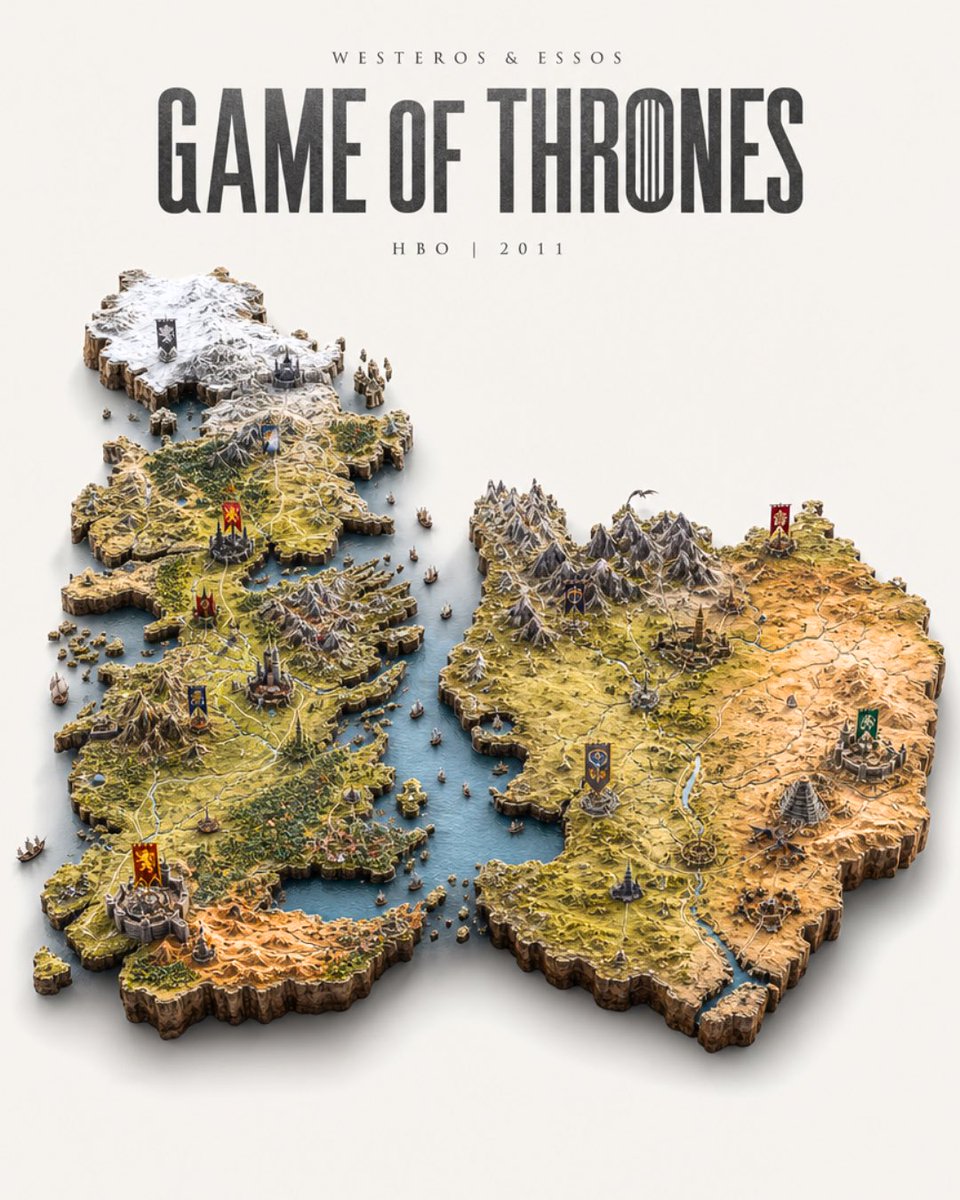
Editorial / Poster
Game of Thrones Isometric Map Diorama
Goal: Create an ultra-detailed photorealistic isometric miniature scale-model diorama map of the world from Game of Thrones, floating on a pure warm off-white studio background with a soft drop shadow beneath.
Fields you can change: TV show, world label, main title, subtitle.
Full prompt
Goal: Create an ultra-detailed photorealistic isometric miniature scale-model diorama map of the world from {argument name="TV show" default="Game of Thrones"}, floating on a pure warm off-white studio background with a soft drop shadow beneath.
Canvas: Vertical poster composition, 4:5 aspect ratio, centered diorama occupying the lower two-thirds and large title typography in the upper third. Use clean studio lighting, realistic shadows, shallow but readable depth, and a premium collectible tabletop model look.
Title text: At the top, set small spaced uppercase text reading {argument name="world label" default="WESTEROS & ESSOS"}. Below it, place a huge tall condensed serif/fantasy title reading {argument name="main title" default="GAME OF THRONES"}, dark charcoal with slightly weathered texture; make the O in THRONES resemble the Iron Throne vertical blade motif. Beneath the main title, add small spaced text reading {argument name="subtitle" default="HBO | 2011"}.
Map layout: Build two separate raised landmass miniatures divided by blue sea. On the left is Westeros, tall and narrow, with a snowy northern region at the top, a wall-like icy boundary, rugged green central lands, winding pale roads, mountain ridges, forests, lakes, castle miniatures, and a warmer southern desert region at the bottom. On the right is Essos, wider and more horizontal, with jagged central mountains, dry yellow-orange plains to the east, green-brown western terrain, rivers, roads, fortified cities, pyramids, towers, and ruins. Both continents have thick carved cliff edges like cutaway terrain, rocky brown sides, and tiny coastal islands.
Discrete elements to include: Use exactly 10 heraldic banner markers placed across the map: 6 on Westeros and 4 on Essos. Westeros banners: one black northern banner in the snowy top region, one yellow-and-blue banner in the upper central region, one red lion banner in the central region, one dark red banner near the central-west castle, one blue banner in the lower central region, and one red lion banner at the southern castle. Essos banners: one dark blue banner in the mountain region, one red banner in the far upper-right city, one green banner at the right-side city, and one blue-gold banner in the lower central city. Add exactly 24 tiny sailing ships and boats scattered in the surrounding seas and between the continents, all miniature scale and varied in size.
Visual style: Hyper-real miniature realism, isometric three-quarter top-down view, highly detailed terrain texture, tiny castles and settlements, crisp roads and rivers, muted fantasy-map colors, blue water, snow white north, ochre desert, mossy greens, rocky grays, and subtle atmospheric shadows. The diorama should feel like a handcrafted museum-quality prop or board-game map, not a flat illustration.
Constraints: No people, no modern objects, no watermark, no UI, no border frame. Keep all text legible and centered. The background must remain plain off-white with ample negative space around the title and floating map.



