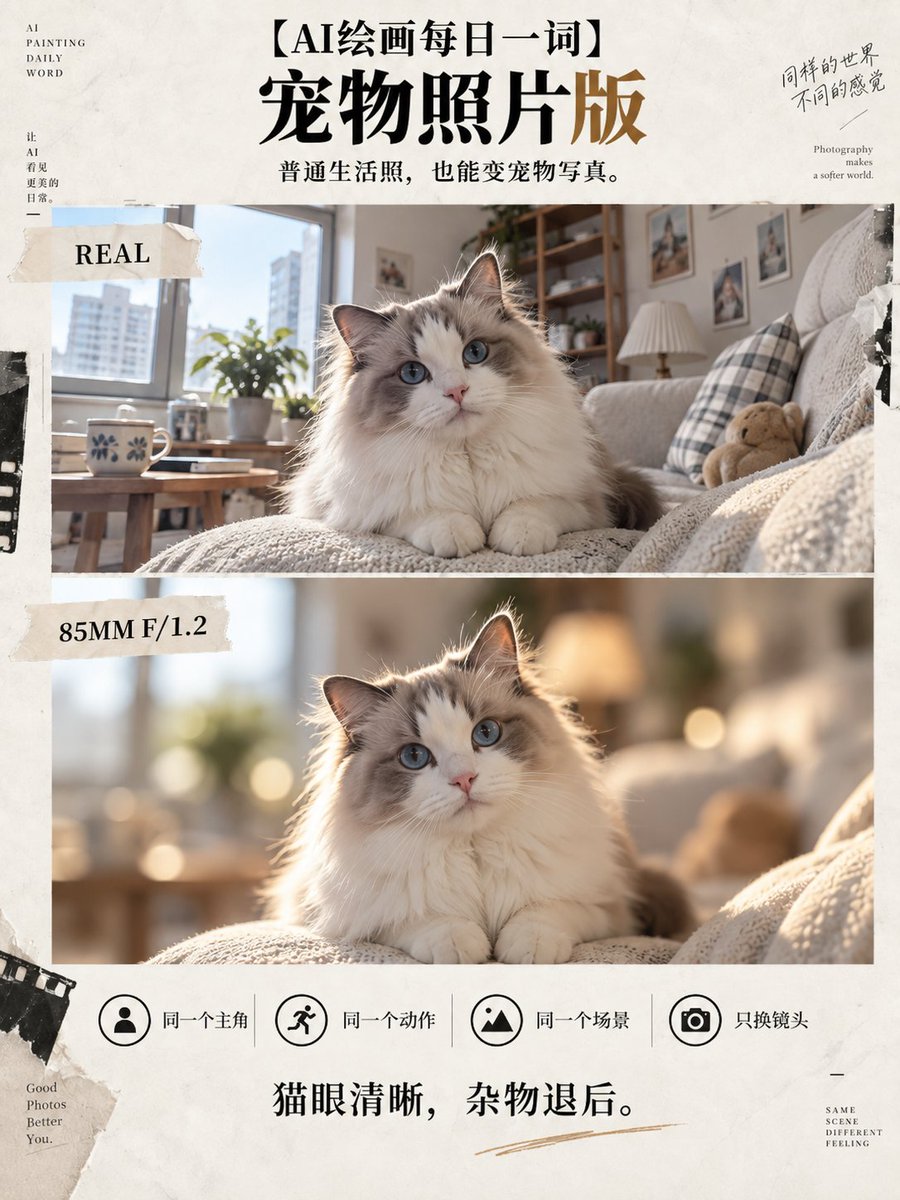
Based on the photo I uploaded, create a standalone 3:4 vertical 'Out-of-Focus Detached Twin' visual poster.
The image is strictly divided into two areas, upper and lower, with a height ratio of 1:1, each occupying 50%.
Upper and lower parts must maintain:
Same subject, same face, same action, same pose, same gaze direction, same subject position, same scene, same shooting angle, same compositional relationship.
Do not redesign the person.
Do not change the background.
Do not alter the photo content.
Upper Part | REAL
Fully preserve the original uploaded photo.
Maintain the texture of original mobile photography, digital camera, or life snapshots.
Retain all person, background, and environmental information.
Light exposure and color adjustments are allowed, but do not change the depth of field relationship.
Allow viewers to clearly see the original real state of the photo.
Lower Part | 85MM F/1.2
Strictly based on the same image as the upper part, re-simulate a professional full-frame wide-aperture portrait photography session.
Simulate:
85mm full-frame prime lens, f/1.2 aperture.
Subject's eyes, face, and main contours remain high-definition sharp.
Recalculate depth of field based on real spatial distances.
The focal plane where the subject is located is clear.
Environments before and after the subject gradually enter defocus status according to distance.
Close-range background retains some structure.
Mid-range background begins to soften.
Far-range background completely transforms into natural creamy out-of-focus (bokeh).
Background elements like:
Street lamps, car lights, shop windows, leaf reflections, metal reflections, sunlight highlights
Naturally transform into real optical bokeh of different sizes and blur levels.
The out-of-focus area must have real lens characteristics:
Soft circular light spots, slight cat-eye deformation at edges, highlight gradients, foreground/background depth layers, real spatial compression.
No artificial cutout feeling should appear at the edges of hair, shoulders, and clothes.
Natural transition is needed between hair strands and the out-of-focus area.
Retain slight lens breathing, chromatic aberration, grain, exposure errors, and real photographic defects.
The final effect must look like:
The same photographer did not move position, just swapped a regular phone for an 85mm F1.2 professional lens and took another shot.
Prohibited:
Whole-block background Gaussian blur.
Prohibit background becoming a mass of color without spatial hierarchy.
Prohibit cutting out the person and pasting onto a blurred background.
Prohibit face swapping.
Prohibit changing person's actions.
Prohibit adding non-existent buildings or scenery.
Prohibit illustration feel.
Prohibit excessive skin smoothing.
Prohibit plastic skin.
Prohibit AI studio photography feel.
Analyze the entire composition of the input image. Identify all key subjects present (whether a single person, group/couple, vehicle, or specific object) and their spatial relationships/interactions.
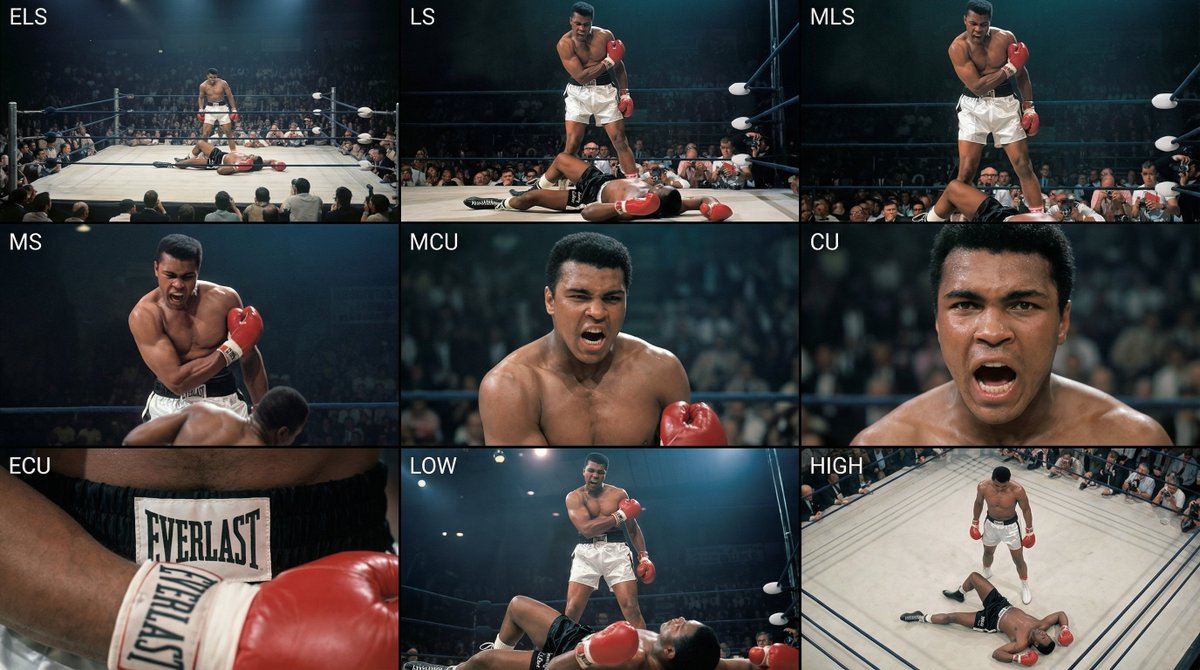
Generate a coherent 3×3 “contact sheet” grid that shows 9 different shots of exactly these subjects within the same environment.
You must adapt standard cinematic shot types to fit the content (for example, if it’s a group, keep the group together; if it’s an object, frame the entire object):
Row 1 (establishing the environment):
Extreme long shot (ELS): the subject appears small within a vast environment.
Long shot (LS): the full subject or group is visible from top to bottom (head to toe / wheels to roof).
Medium long shot (American shot / three-quarter): framed from above the knees (for people) or a 3/4 view (for objects).
Row 2 (core coverage):
4. Medium shot (MS): framed from the waist up (or the central core of an object). Focus on interaction/action.
5. Medium close-up (MCU): framed from the chest up. An intimate framing of the main subject.
6. Close-up (CU): tightly framed on the face or the “front” of the object.
Row 3 (details and angles):
7. Extreme close-up (ECU): intense focus on key features (eyes, hands, signs, textures) with macro-like detail.
8. Low-angle shot (worm’s-eye): look up at the subject from ground level (epic/heroic feeling).
9. High-angle shot (bird’s-eye): look down on the subject from above.
Ensure strict consistency: the same person/object, same clothing, and same lighting must appear in all 9 panels. Depth of field should vary realistically (with background blur in close-up shots).
Create a professional 3×3 cinematic storyboard grid with 9 panels.
The grid should present a specific subject/scene from the input image across a full range of focal lengths.
Top row: wide environmental shot, full-body view, 3/4 cropped (knees-up).
Middle row: waist-up view, chest-up view, face/front close-up.
Bottom row: macro details, low angle, high angle.
All frames must have photo-realistic textures, consistent cinematic color grading, and correct framing tailored to the number and type of subjects or objects being analyzed.
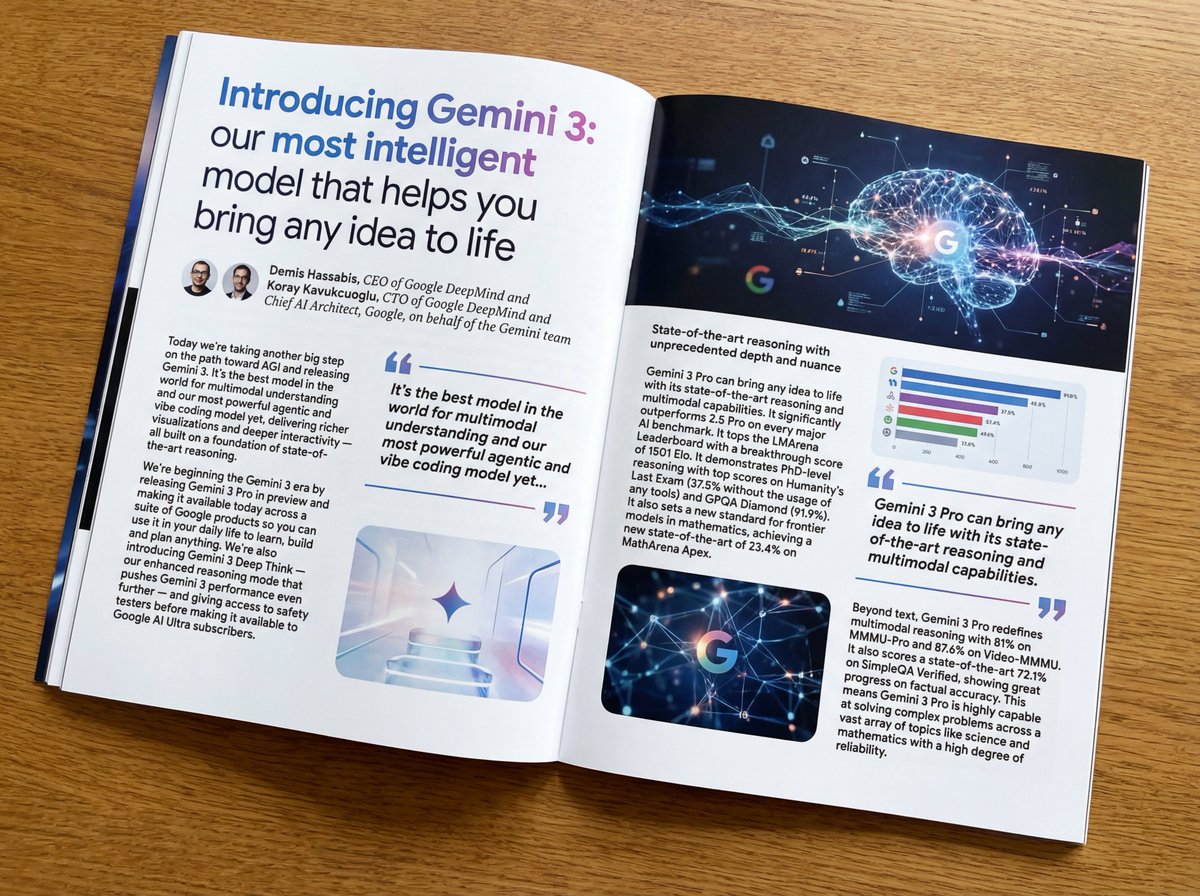
Put this whole text, verbatim, into a photo of a glossy magazine article on a desk, with photos, beautiful typography design, pull quotes, and bold formatting. The text: {argument name="article_text_en" default="[paste the full unformatted article here]"}
Create decorative text based on the word "{argument name="word" default=""}". Write the specified word largely and create decorative text designs associated with the image of the word. Create original designs with flexible ideas, without being constrained by existing fonts. The background should be a single color, white or black, matching the design.