Editorial / Poster
Oversized Lipstick Beauty Campaign
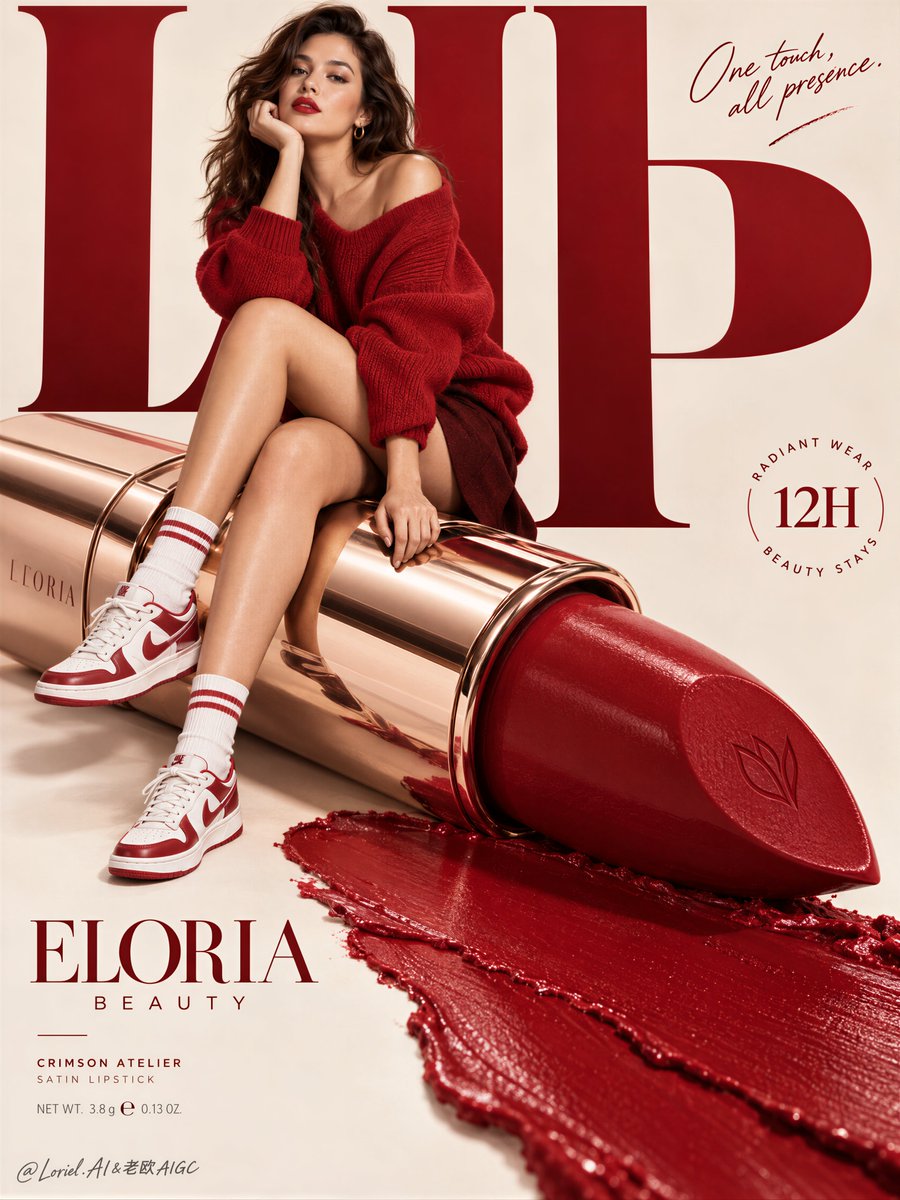
Create a premium beauty advertising poster for a fictional international cosmetics house named ELORIA BEAUTY, designed as a single vertically composed flagship campaign image where one oversized lipstick becomes both the hero product and the sculptural stage for the entire…
Full prompt
Create a premium beauty advertising poster for a fictional international cosmetics house named ELORIA BEAUTY, designed as a single vertically composed flagship campaign image where one oversized lipstick becomes both the hero product and the sculptural stage for the entire composition. The final image must merge Orbit, Transit, and Port into one unified key visual: instantly striking, materially luxurious, and curatorially reduced. It must feel like a Cannes-level beauty campaign, a collectible fashion-cosmetics poster, and a gallery-grade retail art print at once.
The absolute hero is the lipstick. Render one monumental luxury lipstick placed diagonally across the lower half of the frame, large enough to dominate the page like an industrial beauty sculpture. The lipstick bullet is a rich deep crimson-red with dense creamy pigment, velvety smooth surface, subtle pressure marks, and a premium satin-gloss finish. The tube casing is rose-gold metal with refined seam breaks, polished reflective edges, soft cosmetic-grade highlights, and realistic luxury manufacturing detail. A controlled lipstick smear extends from the bullet across the ground plane: thick, creamy, highly pigmented, with soft dragged ridges, tapered edges, and tactile cosmetic realism. The smear must feel luxurious and sensual, never messy, never paint-like, never bloody. The product must own the composition through scale, sharpness, and irresistible material presence.
A mature female model sits on the lipstick body with relaxed confidence and fashion-beauty precision. She wears a tonal red styling system that harmonizes with the lipstick world: an oversized crimson knit or sweatshirt, a minimal dark skirt or clean short silhouette, white socks, and premium white-red sneakers. Her pose feels effortless but exact: one leg bent, one leg extended, one arm resting, torso slightly turned, expression poised and aware. Anatomy must be realistic and elegant: correct head-neck-shoulder ratio, believable torso and hip structure, smooth thigh-to-knee transition, natural mature softness, realistic hands with five fingers, subtle skin texture, and no plastic smoothing. Her makeup is product-led and polished: precise red lips matching the lipstick shade, refined skin finish, soft eye definition, and no heavy cluttering glam. She supports the product narrative, but the lipstick must remain the dominant star.
The background is a clean cosmetic-paper neutral in warm ivory-beige with strong negative space. Behind the seated figure, build one monumental typographic block in giant architectural letters, such as "LIP" or "VELVET", rendered in the same red family as the lipstick but slightly deeper and more structural. These letters should rise like a graphic wall behind the model and product, partly framing the seated body and reinforcing the page geometry. They must feel integrated into the poster architecture, not floating. Keep the environment minimal so every visual decision points back to product, body, and word.
The Orbit layer: amplify the immediate seduction of the lipstick so the poster reads in one glance as color, confidence, and beauty impact. The Transit layer: make the layout feel modular and commercially extensible, as if this hero image belongs to a wider campaign system of shades, finishes, and fashion states. The Port layer: reduce all nonessential clutter, keep the space clean, let the oversized product, restrained model pose, and monumental lettering do most of the work. The result should feel globally premium, contemporary, and collectible.
Typography must be sparse, luxurious, and newly invented in English only. Use one handwritten or script-like line in the upper-right, such as "one touch, all presence" or another stronger beauty phrase. Near the right side of the lipstick, place one circular or radial claim element with very few words and a central performance anchor like "12H". In the lower-left, place the brand line "ELORIA beauty" in a refined editorial serif-sans pairing. Add only a few tiny product cues such as shade name, finish, or net weight. No dense copy, no retail overload, no promotional clutter. Typography must function as a graphic element and stay clear of the model’s face and the lipstick bullet.
Color hierarchy: 50% warm off-white and pale cosmetic beige negative space, 30% rich crimson and deep lipstick red, 15% rose-gold metallic casing and soft skin warmth, 5% white or charcoal micro-typography contrast. Lighting must be bright, controlled, and premium: soft frontal studio key, gentle fill, subtle specular sheen on the lipstick casing, creamy highlights on the bullet, clean grounding shadows beneath the product and model, and enough contrast to keep the red world vibrant but refined. No muddy red, no dead grey, no cheap glossy overkill.
Material semantics must be explicit and elevated: creamy bullet texture, metallic cosmetic packaging, knit fabric softness, smooth skin realism, sneaker leather and mesh detail, glossy lip finish, and premium paper-studio background. The final image should read as both a commercial product ad and a high-fashion beauty object.
Quality control and structured exclusions: photoreal only, correct female anatomy, realistic hands and five fingers, no extra fingers, no missing fingers, no fused fingers, no broken wrists, no distorted face, no warped lipstick geometry, no unrealistic smear texture, no cheap makeup styling, no unreadable typography, no random letters, no cluttered layout, no style drift, no AI slop, no real person names, no real brand names.