Editorial / Poster
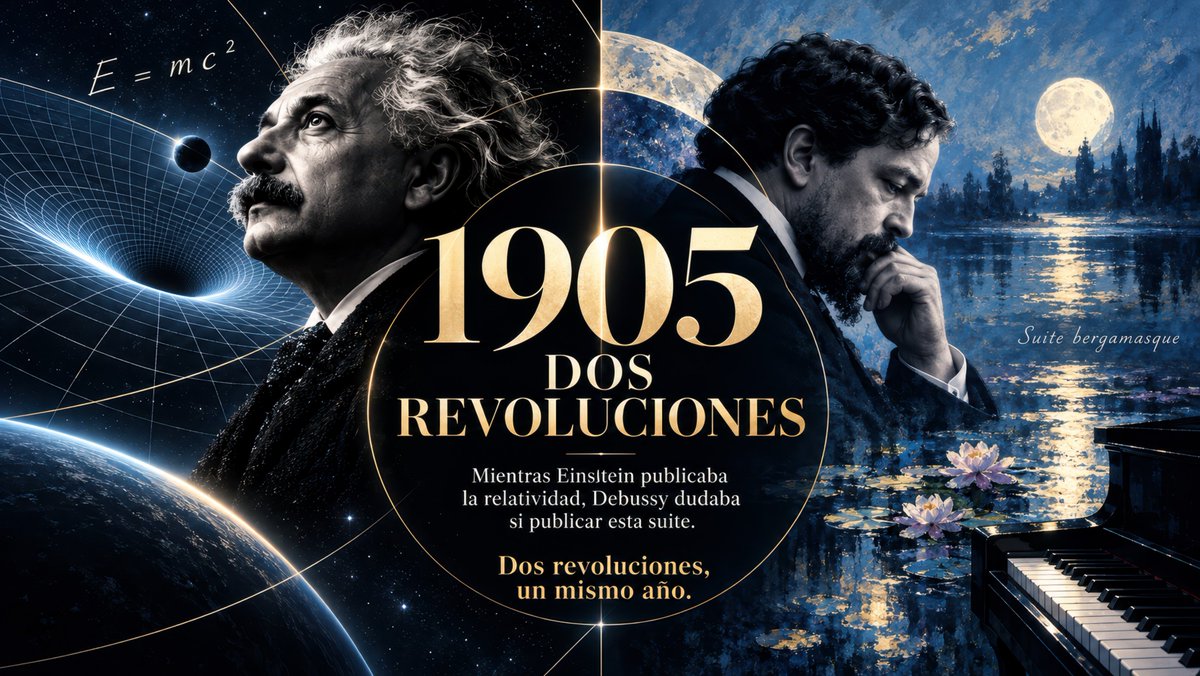
1905 Two Revolutions Poster
Goal: Create a cinematic widescreen historical poster about 1905, contrasting Albert Einstein's physics revolution with Claude Debussy's musical revolution in the same year.
Fields you can change: headline year.
Full prompt
Goal: Create a cinematic widescreen historical poster about {argument name="headline year" default="1905"}, contrasting Albert Einstein's physics revolution with Claude Debussy's musical revolution in the same year.
Canvas: 16:9 horizontal poster, dark midnight-blue and black palette with luminous gold typography, high-contrast dramatic lighting, photorealistic painterly collage style, elegant editorial design.
Layout: Split the image vertically into two thematic halves with a large central black circular medallion overlapping both sides. Thin glowing gold orbital lines and a subtle vertical gold divider connect the two worlds. The central medallion contains the main typography, with the year huge at the top and supporting Spanish text below.
Left half: A dramatic black-and-white portrait of Albert Einstein in profile facing upward to the left, wild gray hair, mustache, dark suit, contemplative expression. Behind him is deep space with stars, a curved Earth horizon at the bottom left, a warped spacetime grid funnel with a black hole-like depression, a small dark planet or eclipse near the grid, and handwritten equation text reading “E = mc²” near the upper left. Use cool blue highlights and fine scientific linework.
Right half: A moody portrait of Claude Debussy in profile facing down to the right, dark curly hair and beard, formal black suit, hand resting against chin in a thoughtful pose. Behind him is an impressionist moonlit lake landscape inspired by Clair de lune: full moon in the upper right, blue night sky, distant dark trees and castle-like silhouettes, shimmering reflections on water, lily pads and exactly 3 visible pink-white water lilies near the lower center-right. Place a glossy black grand piano in the lower right corner with visible white and black keys. Add small elegant script text on the right reading “Suite bergamasque”.
Central text content: In the black circular medallion, set large gold serif text: “{argument name="headline year" default="1905"}”. Beneath it, in stacked uppercase white/gold serif text: “DOS” and “REVOLUCIONES”. Below that, smaller white Spanish body text: “Mientras Einstein publicaba la relatividad, Debussy dudaba si publicar esta suite.” At the bottom, in warm gold serif text: “Dos revoluciones, un mismo año.”
Typography and style: Use luxurious classical serif lettering for the title, with subtle beveling and gold glow. Body text should be centered and readable. Blend science and music visually: left side precise cosmic geometry, right side painterly impressionist water and moonlight. Add fine film grain, realistic lighting, soft bloom, and museum-quality poster polish.
Constraints: Include exactly 2 main human figures: Einstein on the left and Debussy on the right. Include exactly 1 piano, exactly 1 central circular text medallion, exactly 1 equation “E = mc²”, exactly 1 phrase “Suite bergamasque”, and exactly 3 water lilies. Preserve all Spanish text exactly as specified. Do not add logos, watermarks, extra captions, or modern UI elements.