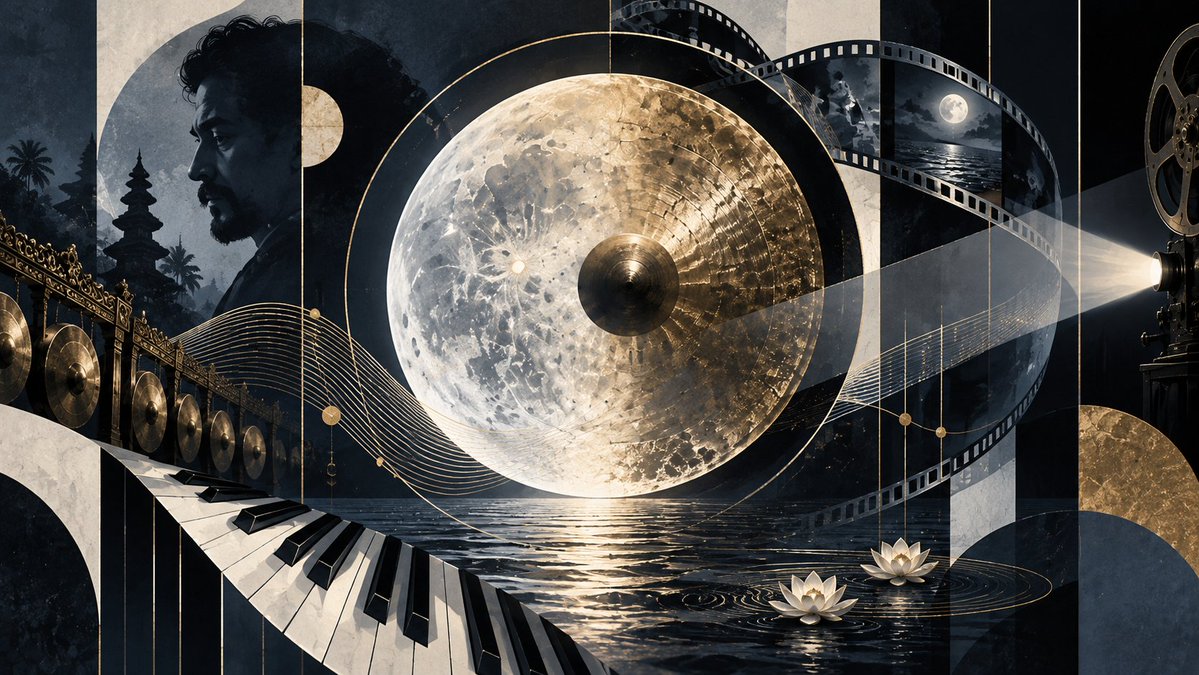
A cinematic, surreal digital collage in a dark palette of deep blues, blacks, and metallic golds.
Full prompt
A cinematic, surreal digital collage in a dark palette of deep blues, blacks, and metallic golds. The central focal point is a massive, hyper-realistic full moon that has been transformed into a golden Indonesian Gamelan Gong (gong ageng), featuring concentric rings and a textured, hammered metal surface. To the left, a monochrome profile portrait of Claude Debussy with curly hair and a beard fades into the background, superimposed over silhouettes of Balinese temple towers (meru) and palm trees. A row of small golden gongs hangs vertically on the far left edge. In the lower left foreground, a piano keyboard curves dynamically like a wave, merging into the dark water below. On the right side, strips of film reel wind through the composition, showing frames of night skies and oceans, leading to a vintage projector lens emitting a beam of light. At the bottom center, two white lotus flowers float on the rippling black water, reflecting the golden light of the moon-gong. Thin, elegant golden lines representing musical staves weave horizontally across the entire image, connecting the disparate elements.

Analyze the entire composition of the input image. Identify all key subjects present (whether a single person, group/couple, vehicle, or specific object) and their spatial relationships/interactions.
Generate a coherent 3×3 “contact sheet” grid that shows 9 different shots of exactly these subjects within the same environment.
You must adapt standard cinematic shot types to fit the content (for example, if it’s a group, keep the group together; if it’s an object, frame the entire object):
Row 1 (establishing the environment):
Extreme long shot (ELS): the subject appears small within a vast environment.
Long shot (LS): the full subject or group is visible from top to bottom (head to toe / wheels to roof).
Medium long shot (American shot / three-quarter): framed from above the knees (for people) or a 3/4 view (for objects).
Row 2 (core coverage):
4. Medium shot (MS): framed from the waist up (or the central core of an object). Focus on interaction/action.
5. Medium close-up (MCU): framed from the chest up. An intimate framing of the main subject.
6. Close-up (CU): tightly framed on the face or the “front” of the object.
Row 3 (details and angles):
7. Extreme close-up (ECU): intense focus on key features (eyes, hands, signs, textures) with macro-like detail.
8. Low-angle shot (worm’s-eye): look up at the subject from ground level (epic/heroic feeling).
9. High-angle shot (bird’s-eye): look down on the subject from above.
Ensure strict consistency: the same person/object, same clothing, and same lighting must appear in all 9 panels. Depth of field should vary realistically (with background blur in close-up shots).
Create a professional 3×3 cinematic storyboard grid with 9 panels.
The grid should present a specific subject/scene from the input image across a full range of focal lengths.
Top row: wide environmental shot, full-body view, 3/4 cropped (knees-up).
Middle row: waist-up view, chest-up view, face/front close-up.
Bottom row: macro details, low angle, high angle.
All frames must have photo-realistic textures, consistent cinematic color grading, and correct framing tailored to the number and type of subjects or objects being analyzed.
Put this whole text, verbatim, into a photo of a glossy magazine article on a desk, with photos, beautiful typography design, pull quotes, and bold formatting. The text: {argument name="article_text_en" default="[paste the full unformatted article here]"}
Create decorative text based on the word "{argument name="word" default=""}". Write the specified word largely and create decorative text designs associated with the image of the word. Create original designs with flexible ideas, without being constrained by existing fonts. The background should be a single color, white or black, matching the design.


