Create a premium 4:5 editorial art poster featuring an original character and a visually rich personal story. The upper section should be a highly realistic cinematic portrait of the character in a natural environment connected to their story.
Full prompt
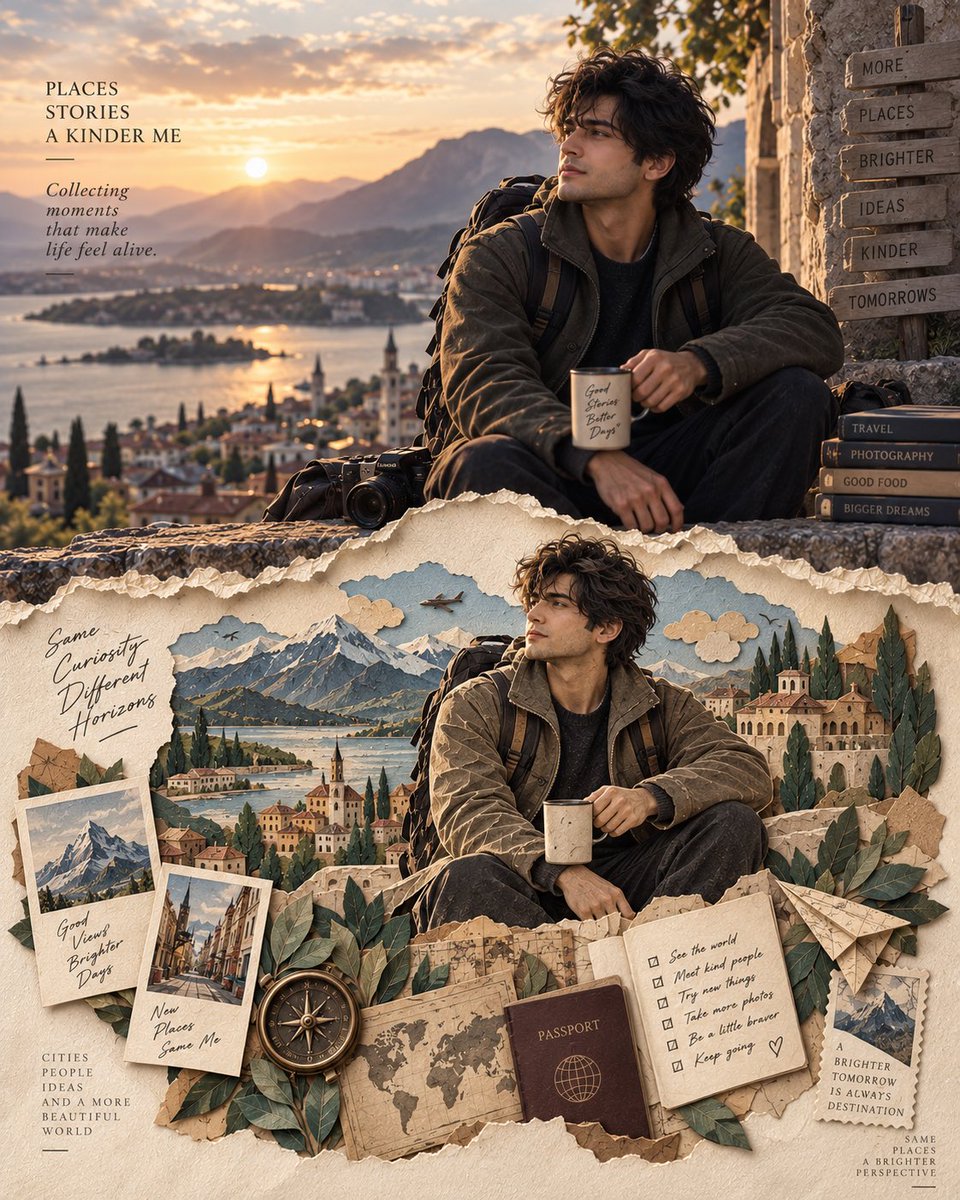
Create a premium 4:5 editorial art poster featuring an original character and a visually rich personal story.
The upper section should be a highly realistic cinematic portrait of the character in a natural environment connected to their story. Give the character a distinctive appearance, authentic expression, realistic skin texture, believable clothing, and carefully composed environmental details. The scene should feel like a frame from a sophisticated travel or lifestyle magazine.
Gradually transform the lower section of the same composition into an intricate handcrafted layered paper-cut artwork. Reinterpret the character, surroundings, landmarks, objects, and small narrative elements entirely through cut and sculpted paper. Use stacked paper layers, finely cut silhouettes, subtle embossing, folded and torn edges, tactile fibers, miniature details, and realistic depth created by delicate shadows.
Let the paper artwork visually continue elements from the photograph above, almost as if the real world is unfolding into a miniature handmade world. Include visual motifs connected to the character’s city, profession, passion, travels, or personal journey rather than simply copying the photographic scene.
Use a sophisticated palette of warm ivory, parchment, muted earth tones, dusty neutrals, and restrained accent colors, with visible paper grain and handcrafted imperfections. Add elegant editorial typography with a refined serif typeface, a short fictional name or title, and minimal supporting text.
Composition: sophisticated magazine cover aesthetic, strong visual hierarchy, generous negative space, balanced symmetry, premium art direction, subtle cinematic lighting, tactile realism, museum-quality paper craftsmanship.
The key visual idea is: a real cinematic moment evolving into a handcrafted paper memory.
No reference image, no copied composition. Create the character, environment, and narrative from scratch while maintaining a polished, recognizable visual identity throughout.
Analyze the entire composition of the input image. Identify all key subjects present (whether a single person, group/couple, vehicle, or specific object) and their spatial relationships/interactions.
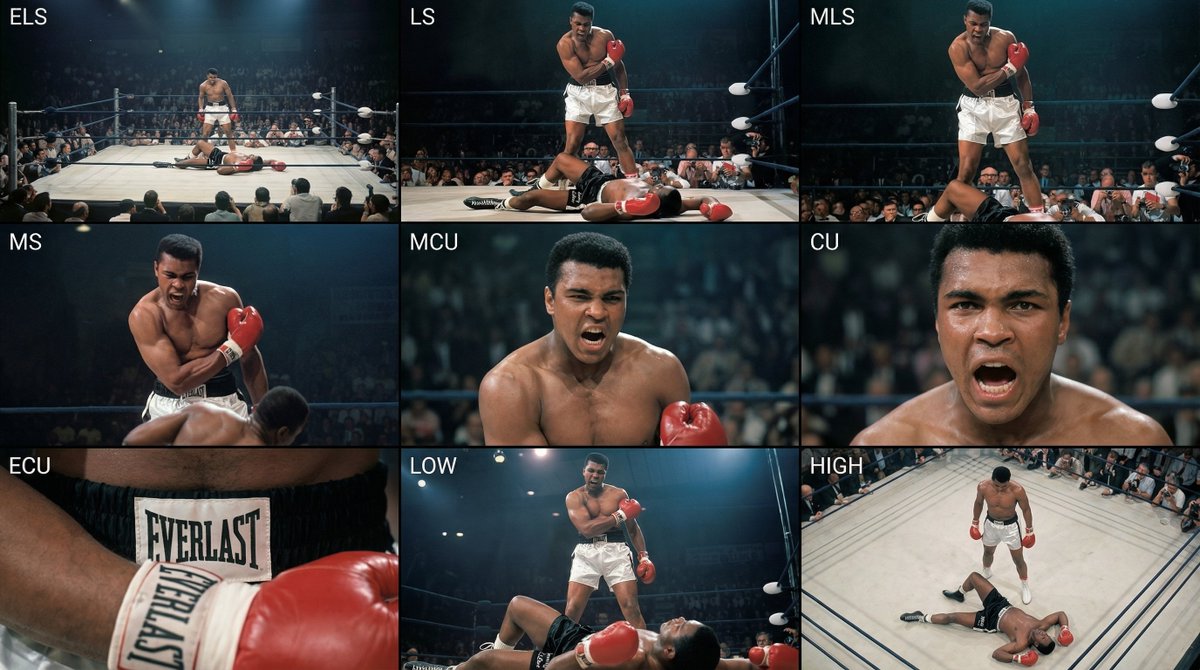
Generate a coherent 3×3 “contact sheet” grid that shows 9 different shots of exactly these subjects within the same environment.
You must adapt standard cinematic shot types to fit the content (for example, if it’s a group, keep the group together; if it’s an object, frame the entire object):
Row 1 (establishing the environment):
Extreme long shot (ELS): the subject appears small within a vast environment.
Long shot (LS): the full subject or group is visible from top to bottom (head to toe / wheels to roof).
Medium long shot (American shot / three-quarter): framed from above the knees (for people) or a 3/4 view (for objects).
Row 2 (core coverage):
4. Medium shot (MS): framed from the waist up (or the central core of an object). Focus on interaction/action.
5. Medium close-up (MCU): framed from the chest up. An intimate framing of the main subject.
6. Close-up (CU): tightly framed on the face or the “front” of the object.
Row 3 (details and angles):
7. Extreme close-up (ECU): intense focus on key features (eyes, hands, signs, textures) with macro-like detail.
8. Low-angle shot (worm’s-eye): look up at the subject from ground level (epic/heroic feeling).
9. High-angle shot (bird’s-eye): look down on the subject from above.
Ensure strict consistency: the same person/object, same clothing, and same lighting must appear in all 9 panels. Depth of field should vary realistically (with background blur in close-up shots).
Create a professional 3×3 cinematic storyboard grid with 9 panels.
The grid should present a specific subject/scene from the input image across a full range of focal lengths.
Top row: wide environmental shot, full-body view, 3/4 cropped (knees-up).
Middle row: waist-up view, chest-up view, face/front close-up.
Bottom row: macro details, low angle, high angle.
All frames must have photo-realistic textures, consistent cinematic color grading, and correct framing tailored to the number and type of subjects or objects being analyzed.
Put this whole text, verbatim, into a photo of a glossy magazine article on a desk, with photos, beautiful typography design, pull quotes, and bold formatting. The text: {argument name="article_text_en" default="[paste the full unformatted article here]"}
Create decorative text based on the word "{argument name="word" default=""}". Write the specified word largely and create decorative text designs associated with the image of the word. Create original designs with flexible ideas, without being constrained by existing fonts. The background should be a single color, white or black, matching the design.