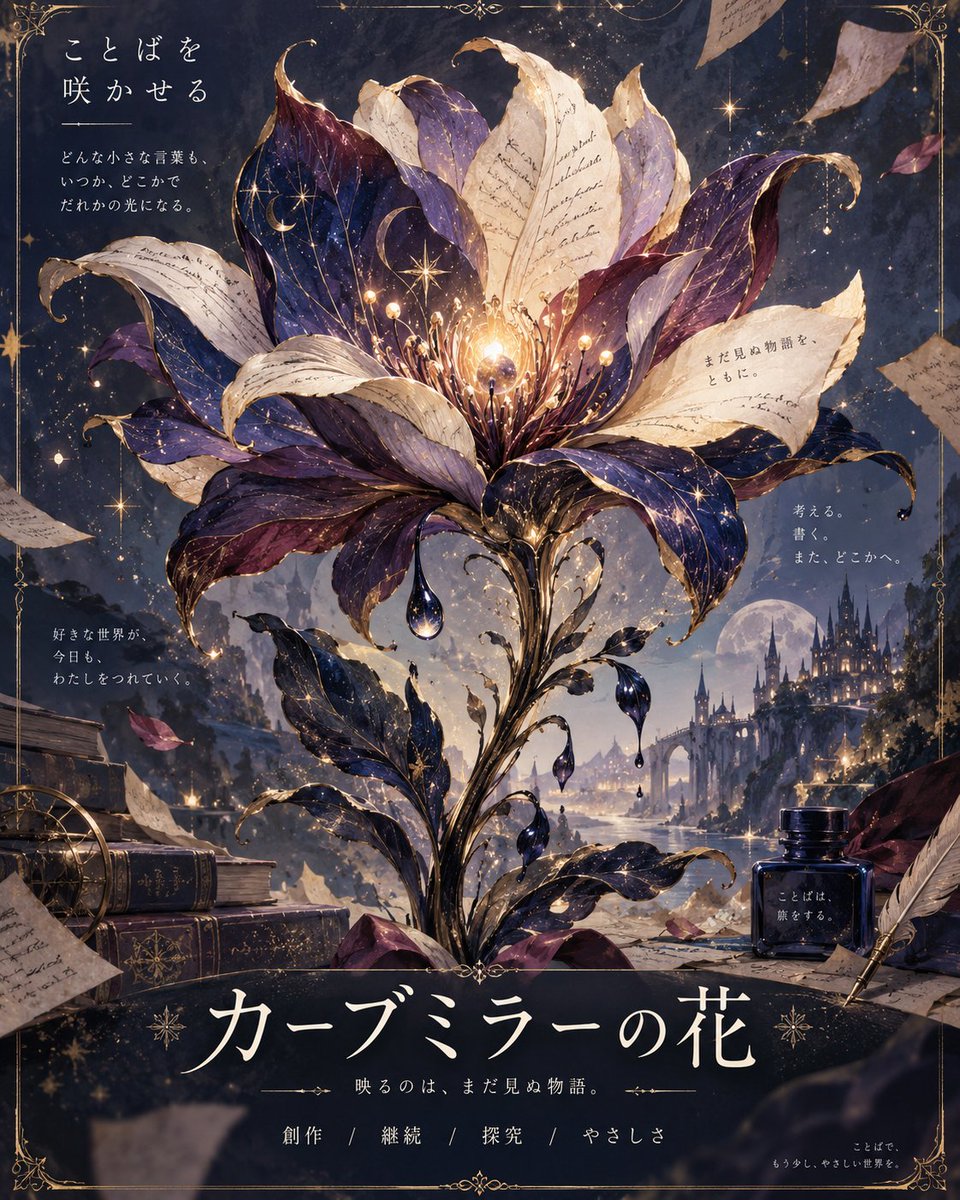
A vertical digital illustration in a fantasy art style featuring a large, magical flower blooming from a dark, starry background.
Full prompt
A vertical digital illustration in a fantasy art style featuring a large, magical flower blooming from a dark, starry background. The flower's petals are textured like old parchment paper with faint handwritten script and celestial motifs (stars, moons) in deep purple and blue tones. A glowing golden orb sits at the center of the bloom, emitting light rays and floating sparkles. Surrounding the flower are scattered pieces of torn paper, some with visible Japanese text fragments. In the lower left corner, there is a stack of antique books with gold-embossed spines and a brass compass. In the lower right corner, an ink bottle labeled 'ことばは、旅をする。' (Words travel.) sits next to a quill pen. The background shows a distant castle silhouette under a full moon, reflected on water below. At the top left, white Japanese text reads: 'ことばを咲かせる' (Make words bloom), followed by smaller text: 'どんな小さな言葉も、いつか、どこかで誰かの光になる。' (No matter how small the word, someday, somewhere, it becomes someone's light). On the right side, floating text reads: '考える。書く。また、どこかへ。' (Think. Write. Somewhere else again.). Near the bottom, large stylized white Japanese characters read: 'カーブミラーの花' (Curve Mirror Flower), with a subtitle: '映るのは、まだ見ぬ物語。' (What reflects is a story yet unseen). Below that, four keywords separated by slashes: '創作 / 継続 / 探究 / やさしさ' (Creation / Continuation / Exploration / Kindness). The overall color palette is rich with midnight blues, purples, golds, and cream whites, creating a mystical and literary atmosphere.

Analyze the entire composition of the input image. Identify all key subjects present (whether a single person, group/couple, vehicle, or specific object) and their spatial relationships/interactions.
Generate a coherent 3×3 “contact sheet” grid that shows 9 different shots of exactly these subjects within the same environment.
You must adapt standard cinematic shot types to fit the content (for example, if it’s a group, keep the group together; if it’s an object, frame the entire object):
Row 1 (establishing the environment):
Extreme long shot (ELS): the subject appears small within a vast environment.
Long shot (LS): the full subject or group is visible from top to bottom (head to toe / wheels to roof).
Medium long shot (American shot / three-quarter): framed from above the knees (for people) or a 3/4 view (for objects).
Row 2 (core coverage):
4. Medium shot (MS): framed from the waist up (or the central core of an object). Focus on interaction/action.
5. Medium close-up (MCU): framed from the chest up. An intimate framing of the main subject.
6. Close-up (CU): tightly framed on the face or the “front” of the object.
Row 3 (details and angles):
7. Extreme close-up (ECU): intense focus on key features (eyes, hands, signs, textures) with macro-like detail.
8. Low-angle shot (worm’s-eye): look up at the subject from ground level (epic/heroic feeling).
9. High-angle shot (bird’s-eye): look down on the subject from above.
Ensure strict consistency: the same person/object, same clothing, and same lighting must appear in all 9 panels. Depth of field should vary realistically (with background blur in close-up shots).
Create a professional 3×3 cinematic storyboard grid with 9 panels.
The grid should present a specific subject/scene from the input image across a full range of focal lengths.
Top row: wide environmental shot, full-body view, 3/4 cropped (knees-up).
Middle row: waist-up view, chest-up view, face/front close-up.
Bottom row: macro details, low angle, high angle.
All frames must have photo-realistic textures, consistent cinematic color grading, and correct framing tailored to the number and type of subjects or objects being analyzed.
Put this whole text, verbatim, into a photo of a glossy magazine article on a desk, with photos, beautiful typography design, pull quotes, and bold formatting. The text: {argument name="article_text_en" default="[paste the full unformatted article here]"}
Create decorative text based on the word "{argument name="word" default=""}". Write the specified word largely and create decorative text designs associated with the image of the word. Create original designs with flexible ideas, without being constrained by existing fonts. The background should be a single color, white or black, matching the design.


