Editorial / Poster
Monochrome Nike Puffer Blueprint Ad
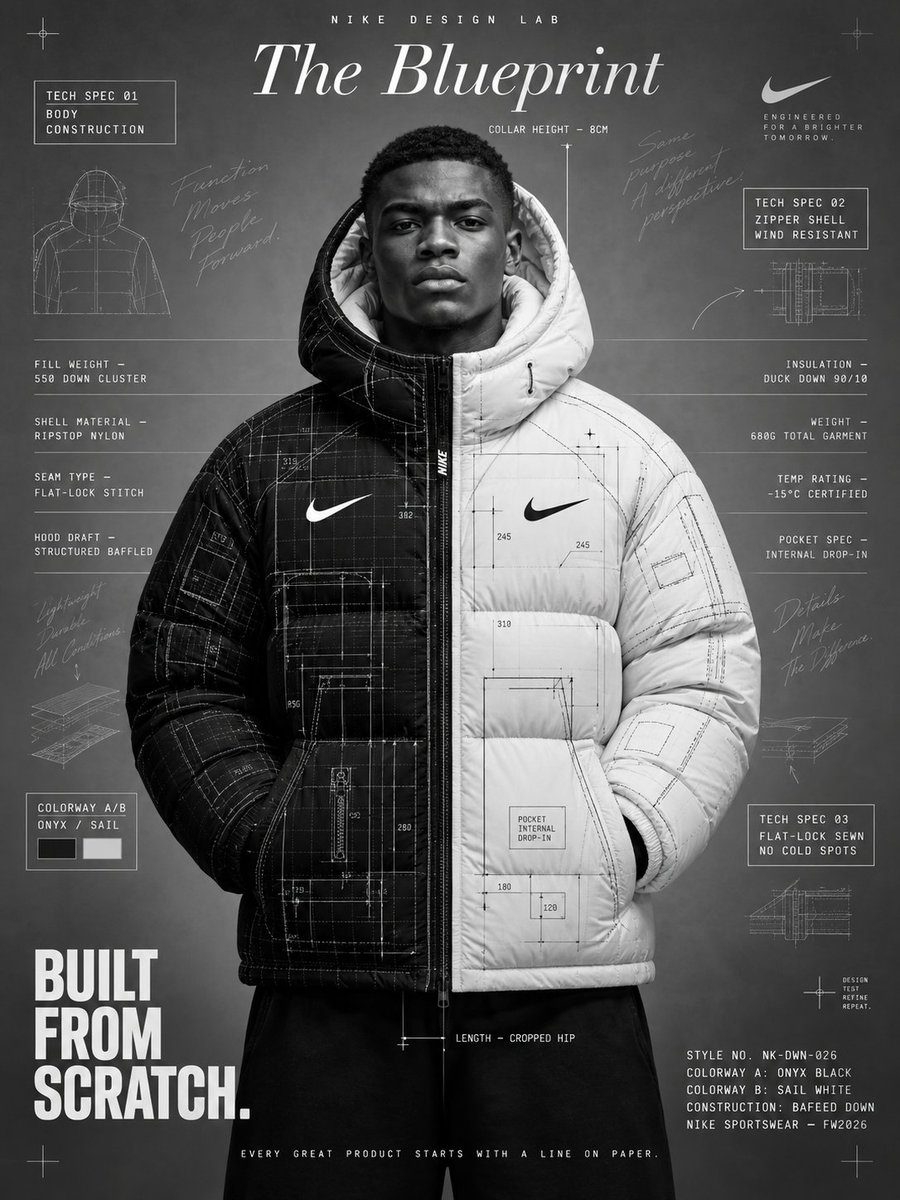
Create a premium high-concept Nike product advertisement poster, square 4:3 ratio, entirely monochrome black and white. “THE BLUEPRINT” — A designer’s technical deconstruction of the Nike down puffer jacket.
Full prompt
Create a premium high-concept Nike product advertisement poster, square 4:3 ratio, entirely monochrome black and white. “THE BLUEPRINT” — A designer’s technical deconstruction of the Nike down puffer jacket. The jacket is split perfectly in half vertically, revealing two colorways simultaneously. Technical garment construction blueprints are overlaid directly on the jacket fabric. Everything is desaturated — pure black, white, and gray.
Young male model, approximately early 20s. Short cropped hair, very clean face. Chiseled sharp jaw, high cheekbones. EXPRESSION: intense, direct, unwavering stare straight into camera lens. Zero emotion — stoic, powerful, commanding presence. Lips slightly pressed together, jaw set. Upper body shot — head, shoulders, torso visible down to approximately mid-waist. Face positioned upper-center of frame. Skin tones rendered in rich grayscale — deep contrast, cinematic black and white photography.
Nike oversized down puffer jacket, full zip center, hood attached and up, hood framing the head with interior visible as lighter cream tone. The jacket is divided exactly down the center vertical zip/seam into two perfectly mirrored halves.
Left half: jet black matte panel with white Nike swoosh logo, visible puffer quilting lines, fabric absorbing light.
Right half: off-white or cream panel with black Nike swoosh logo, visible quilting lines, fabric bright and slightly luminous.
The split is razor sharp and precise at the center zip, both halves identical in silhouette and construction.
Technical blueprint overlay printed directly on fabric. On black left half: fine white line drawings including grid overlay, garment pattern cutlines, seam lines, measurement boxes, hood arcs, pocket geometry, zipper sketch lines, quilting layout grid. On white right half: fine black line drawings including sleeve seam lines, panel joins, annotation boxes, measurement brackets, fill distribution zones, cuff detail insets. Thin annotation lines extend outward into the background architectural drawings.
Horizontal lines with small annotation text beside them such as:
“FILL WEIGHT — 550 DOWN CLUSTER”
“SHELL MATERIAL — RIPSTOP NYLON”
“SEAM TYPE — FLAT-LOCK STITCH”
“HOOD DRAFT — STRUCTURED BAFFLED”
Right-side dark text:
“INSULATION — DUCK DOWN 90/10”
“WEIGHT — 680G TOTAL GARMENT”
“TEMP RATING — -15°C CERTIFIED”
“POCKET SPEC — INTERNAL DROP-IN”
Vertical lines include top annotation:
“COLLAR HEIGHT — 8CM”
and bottom annotation:
“LENGTH — CROPPED HIP”
All annotation text in small, clean monospace technical font with precise hairline rules.
Around the jacket, faint handwritten notes scattered in gray tones, illegible cursive with arrows and circles, organic and spontaneous, fading toward the edges.
Background is clean neutral mid-gray, slightly darker at corners with subtle vignette. Pure studio environment with no visible distractions.
Top center: small spaced caps white “NIKE DESIGN LAB”
Above the tit



