Editorial / Poster
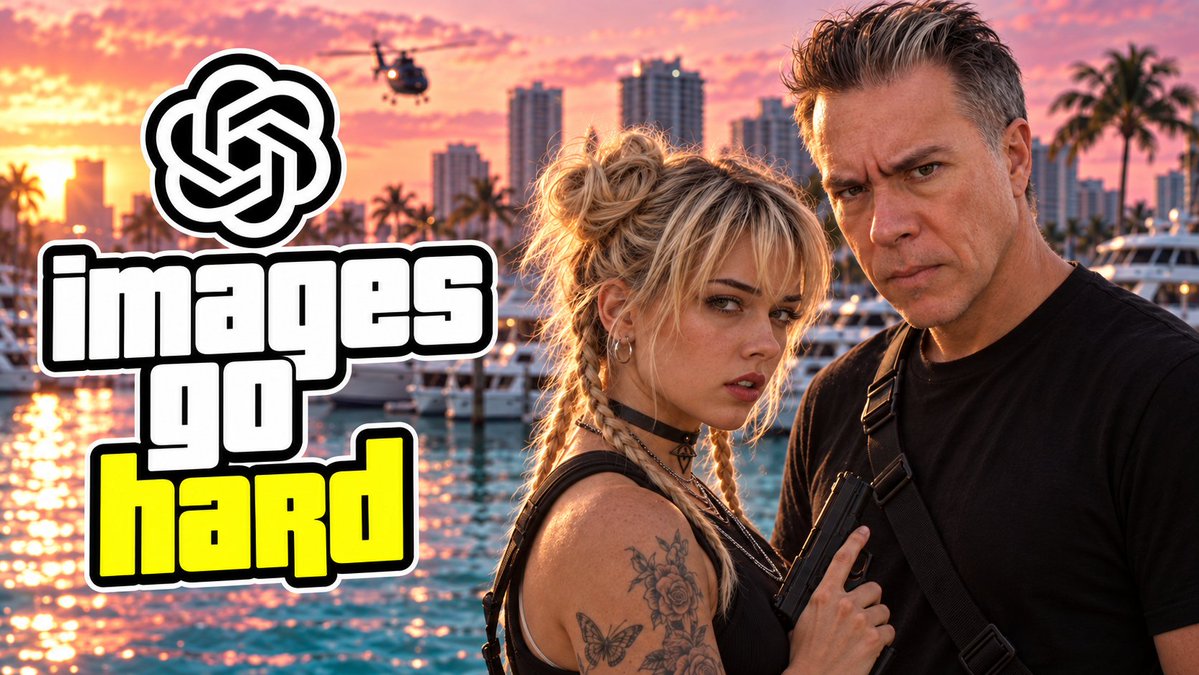
Images Go Hard Action Thumbnail
Goal: Create a cinematic YouTube-style thumbnail for an AI image generation announcement, combining action-movie realism with bold viral thumbnail typography. Canvas: 16:9 widescreen, high-resolution, sharp photorealistic composite with dramatic sunset lighting.
Fields you can change: female character hair style, male character appearance, headline text.
Full prompt
Goal: Create a cinematic YouTube-style thumbnail for an AI image generation announcement, combining action-movie realism with bold viral thumbnail typography.
Canvas: 16:9 widescreen, high-resolution, sharp photorealistic composite with dramatic sunset lighting. The scene is set at a luxury marina waterfront with orange-pink sky, reflective water, yachts, palm trees, a distant city skyline, and one small helicopter in the sky.
Layout: Split composition. The left 40% is dominated by large stacked text and the OpenAI knot logo; the right 60% features two intense action characters in the foreground. Keep the text large enough to read at thumbnail size, with thick black outlines and white outer stroke/drop shadow separating it from the background.
Text content: Use exactly 3 stacked text lines reading: “images” on top, “go” in the middle, and “hard” on the bottom. Make “images” and “go” white, and make “hard” bright neon yellow. Use a chunky rounded block font similar to bold gaming/YouTube thumbnail lettering.
Logo: Place exactly 1 OpenAI-style knot logo above the word “images” on the upper left. It should be black and white, sticker-like, with a thick white border and dark outline.
Subject details: Include exactly 2 foreground people. Character 1 is a young punk action woman, {argument name="female character hair style" default="messy blonde hair in braided pigtails with loose bangs"}, wearing a black sleeveless tactical top, black choker, layered necklaces, hoop earrings, and visible tattoos on her shoulder and upper arm, including floral and butterfly designs. She looks directly at the camera with a fierce, slightly open-mouthed expression and holds a black pistol close to her chest. Character 2 is a stern middle-aged action man, {argument name="male character appearance" default="short salt-and-pepper hair, strong jaw, black T-shirt, tactical shoulder strap"}, standing close behind her and looking directly at the viewer with an intense suspicious expression.
Visual style: Hyperrealistic cinematic photography, glossy Hollywood action poster energy, warm golden-hour rim light, high contrast, shallow depth of field on the background, detailed skin texture, dramatic reflections on the water, vivid saturated colors.
Customizable text: The visible headline should read {argument name="headline text" default="images go hard"}. Keep the same 3-line stacked layout even if customized.
Constraints: Do not add extra people, extra logos, or extra text. Keep the gun visible but not firing. No gore, no watermark, no UI frame.



