Diagram / Infographic
Snow Leopard Encyclopedia Card Prompt
Full prompt
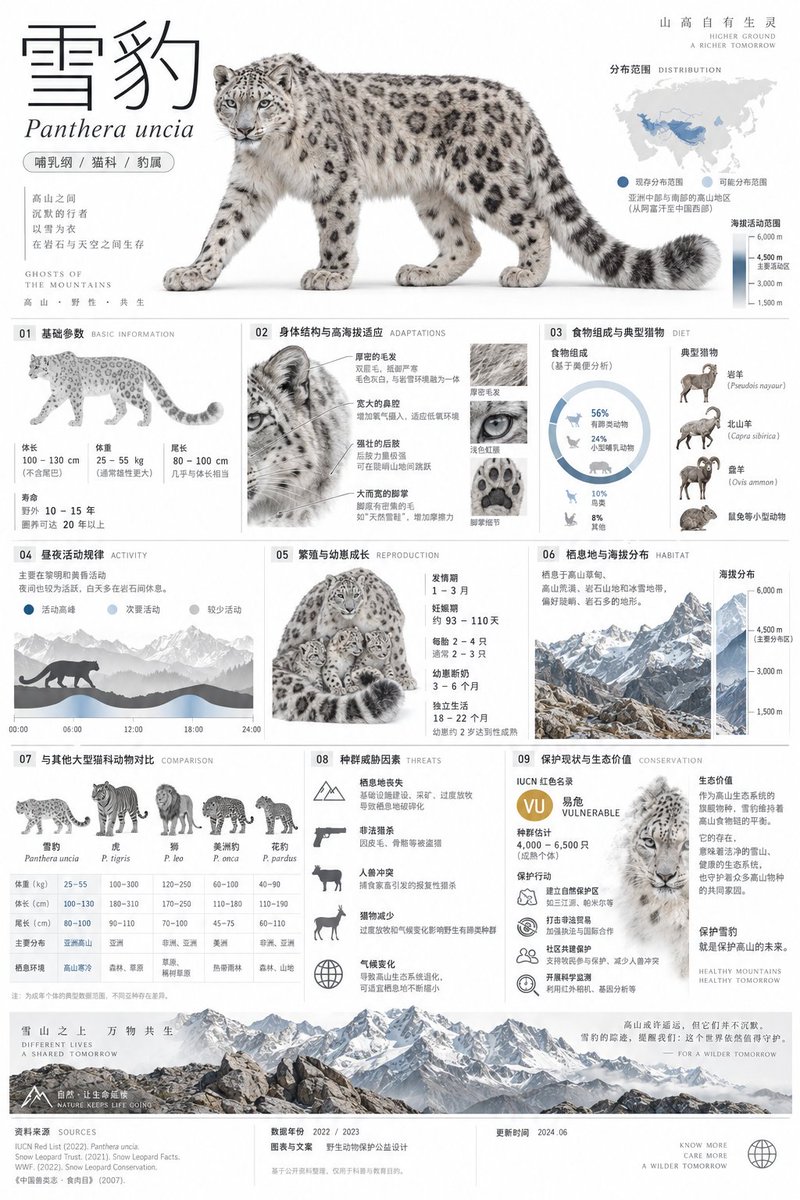
A 2:3 vertical minimalist art style snow leopard encyclopedia info card, museum exhibit level visual quality, adopting Swiss International Style and premium natural history atlas language. Top ~30%: Adult snow leopard cutout studio-style full-body side close-up on pure white background, realistically retaining grey-white fur, black ring patterns, thick long tail, wide paws and facial details, not anthropomorphic; paired with super-large thin-line title "Snow Leopard", small italic "Panthera uncia", capsule tags "Mammalia/Felidae/Panthera", Asia distribution mini-map and altitude activity range axis.
Middle ~60%: Based on 12-column and 8pt grid, clearly arranging nine major modules - basic parameters of body length, weight, tail length and lifespan; body structure and high-altitude adaptation features; food composition and typical prey; diurnal/nocturnal activity patterns; breeding cycle and cub growth; habitat types and altitude distribution; comparison with other large felids; population threat factors; conservation status, actions and ecological value. Charts use outline proportion diagrams, footprint size charts, altitude distribution maps, prey network graphs and concise timelines.
Bottom ~10% marks conservation status, data year, source and update time. Main colors glacier grey, snow white, rock brown and graphite black, with minor cold blue accents; Source Han Sans Light, DIN and Roboto Mono, 2pt linear icons, 0.5pt light dividers, large whitespace. All biological data must be accurate and verifiable, no fabricated population numbers, no exaggerated descriptions, Chinese clearly readable, no garbled text.
View original prompt
一张 2:3 竖版的极简艺术风雪豹百科信息卡,博物馆展品级视觉品质,采用瑞士国际主义与高级自然历史图鉴语言。顶部约 30%:纯白背景上的成年雪豹去背景工作室式全身侧面特写,真实保留灰白毛发、黑色环状斑纹、粗长尾巴、宽大脚掌与面部细节,不拟人化;配超大细线标题“雪豹”、小号斜体“Panthera uncia”、胶囊标签“哺乳纲/猫科/豹属”、亚洲分布小地图与海拔活动范围轴。 中部约 60%:基于 12 列与 8pt 网格,清晰排列九大模块——体长、体重、尾长与寿命基础参数;身体结构与高海拔适应特征;食物组成与典型猎物;昼夜活动规律;繁殖周期与幼崽成长;栖息地类型与海拔分布;雪豹与其他大型猫科动物对比;种群威胁因素;保护等级、保护行动与生态价值。图表采用轮廓比例图、足迹尺寸图、海拔分布图、猎物网络图和简洁时间轴。 底部约 10% 标注保护等级、数据年份、资料来源与更新时间。主色取冰川灰、雪白、岩石褐与石墨黑,少量冷蓝强调;思源黑体 Light、DIN 与 Roboto Mono,2pt 线性图标,0.5pt 淡分割线,大面积留白。所有生物数据必须准确可核验,不虚构种群数字,不使用夸张描述,中文清晰可读,无乱码。