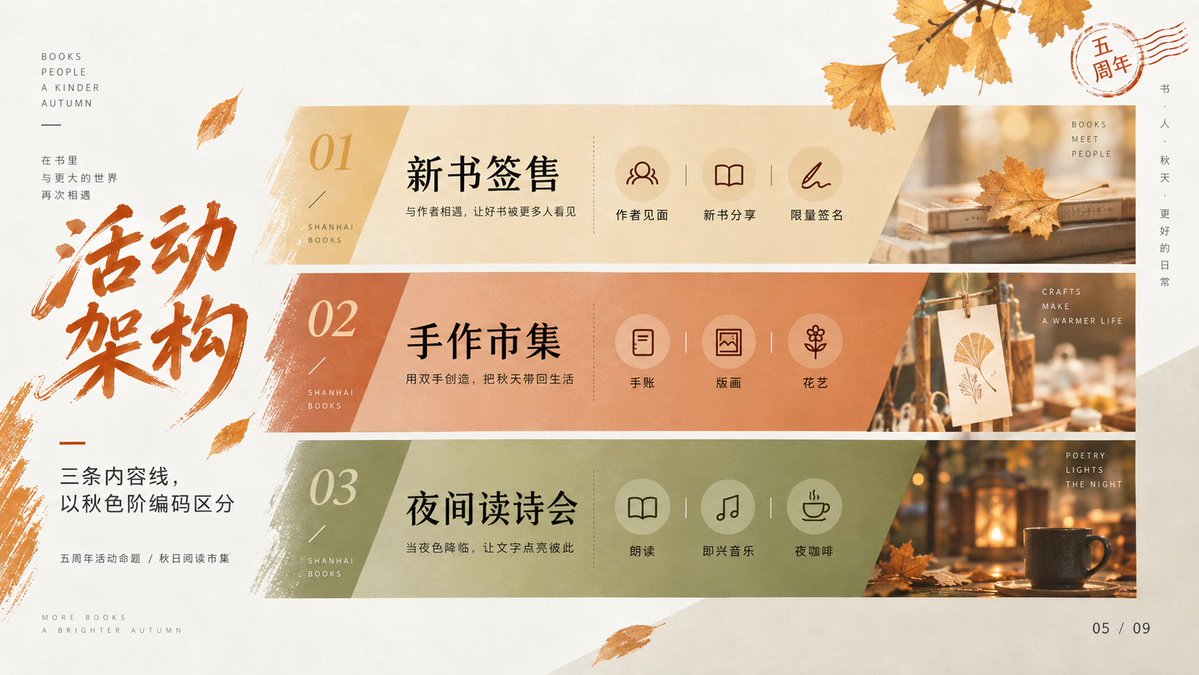
Create a high-resolution, professional presentation slide (16:9 aspect ratio) with an 'Autumnal Literary' aesthetic. The background is a clean off-white paper texture. **Visual Elements:** 1.
Full prompt
Create a high-resolution, professional presentation slide (16:9 aspect ratio) with an 'Autumnal Literary' aesthetic. The background is a clean off-white paper texture.
**Visual Elements:**
1. **Main Typography:** Large, expressive Chinese calligraphy in the center-left reading "把秋天装进书店" (Put Autumn into the Bookstore). The font style should be rough brush strokes in a burnt orange/terracotta color.
2. **Geometric Shapes:** A large diagonal block of solid burnt orange cutting across the right side of the canvas from top-right to bottom-center.
3. **Photography:** In the upper right corner, overlay a realistic photo of golden ginkgo leaves on a branch against a white wall, casting soft shadows. This image should blend naturally with the orange geometric shape.
4. **Stamp Element:** A red circular stamp graphic in the top right corner containing the text "五周年" (5th Anniversary).
5. **Secondary Text:** Below the main calligraphy, include smaller black sans-serif text: "山海秋集" and "独立书店五周年企划路演". Further down, add small grey text: "五周年活动命题 / 秋日阅读市集".
6. **Decorative Details:** Add scattered single autumn leaves floating around the text. Include vertical English text on the far left edge: "BOOKS PEOPLE A KINDER AUTUMN". Include vertical Chinese text on the far right edge: "书 · 人 · 秋天 · 更好的日常". Bottom right corner has page number "01 / 09".

Analyze the entire composition of the input image. Identify all key subjects present (whether a single person, group/couple, vehicle, or specific object) and their spatial relationships/interactions.
Generate a coherent 3×3 “contact sheet” grid that shows 9 different shots of exactly these subjects within the same environment.
You must adapt standard cinematic shot types to fit the content (for example, if it’s a group, keep the group together; if it’s an object, frame the entire object):
Row 1 (establishing the environment):
Extreme long shot (ELS): the subject appears small within a vast environment.
Long shot (LS): the full subject or group is visible from top to bottom (head to toe / wheels to roof).
Medium long shot (American shot / three-quarter): framed from above the knees (for people) or a 3/4 view (for objects).
Row 2 (core coverage):
4. Medium shot (MS): framed from the waist up (or the central core of an object). Focus on interaction/action.
5. Medium close-up (MCU): framed from the chest up. An intimate framing of the main subject.
6. Close-up (CU): tightly framed on the face or the “front” of the object.
Row 3 (details and angles):
7. Extreme close-up (ECU): intense focus on key features (eyes, hands, signs, textures) with macro-like detail.
8. Low-angle shot (worm’s-eye): look up at the subject from ground level (epic/heroic feeling).
9. High-angle shot (bird’s-eye): look down on the subject from above.
Ensure strict consistency: the same person/object, same clothing, and same lighting must appear in all 9 panels. Depth of field should vary realistically (with background blur in close-up shots).
Create a professional 3×3 cinematic storyboard grid with 9 panels.
The grid should present a specific subject/scene from the input image across a full range of focal lengths.
Top row: wide environmental shot, full-body view, 3/4 cropped (knees-up).
Middle row: waist-up view, chest-up view, face/front close-up.
Bottom row: macro details, low angle, high angle.
All frames must have photo-realistic textures, consistent cinematic color grading, and correct framing tailored to the number and type of subjects or objects being analyzed.
Put this whole text, verbatim, into a photo of a glossy magazine article on a desk, with photos, beautiful typography design, pull quotes, and bold formatting. The text: {argument name="article_text_en" default="[paste the full unformatted article here]"}
Create decorative text based on the word "{argument name="word" default=""}". Write the specified word largely and create decorative text designs associated with the image of the word. Create original designs with flexible ideas, without being constrained by existing fonts. The background should be a single color, white or black, matching the design.


