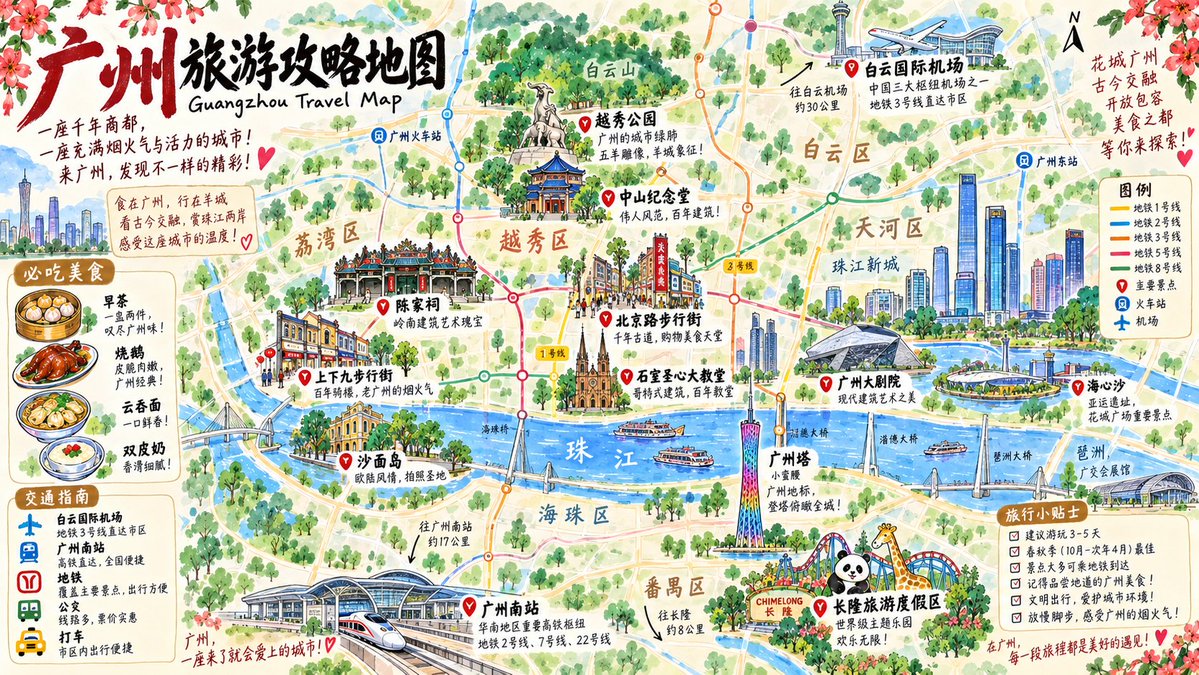
Editorial / Poster
Hand-Painted Guangzhou Travel Map
Goal: Create a hand-painted watercolor travel guide map for Guangzhou, combining a tourist map, illustrated landmarks, food recommendations, transport tips, and friendly handwritten annotations.
Fields you can change: city name, promotional note, accent color.
Full prompt
Goal: Create a hand-painted watercolor travel guide map for {argument name="city name" default="Guangzhou"}, combining a tourist map, illustrated landmarks, food recommendations, transport tips, and friendly handwritten annotations.
Canvas: Wide horizontal 16:9 poster, bright cream paper background, soft watercolor texture, lively red flower branches in the top-left and top-right corners, dense but readable illustrated-map composition.
Main title: Large expressive Chinese brush-calligraphy title at top left reading “广州旅游攻略地图”, with a smaller English subtitle underneath: “Guangzhou Travel Map”. Add warm handwritten intro copy below the title in Chinese, with red heart accents, describing Guangzhou as a thousand-year commercial capital, a city full of fireworks-like everyday life and vitality.
Map layout: Show the Pearl River running horizontally through the lower middle in bright blue watercolor, with boats, bridges, and district labels. Draw green parks, pale streets, metro lines, route dots, trees, small neighborhoods, and landmark icons across the map. Label exactly 7 district/area names in large soft Chinese characters: Liwan District, Yuexiu District, Baiyun District, Tianhe District, Haizhu District, Panyu District, and the Pearl River. Add a north arrow at the upper right.
Landmark pins and illustrated attractions: Use red location pins with labels and short handwritten notes. Include exactly 15 featured place labels: 1) Guangzhou Railway Station, 2) Yuexiu Park, 3) Sun Yat-sen Memorial Hall, 4) Baiyun International Airport, 5) Guangzhou East Station, 6) Chen Clan Ancestral Hall, 7) Shangxiajiu Pedestrian Street, 8) Beijing Road Pedestrian Street, 9) Sacred Heart Cathedral, 10) Shamian Island, 11) Guangzhou South Station, 12) Guangzhou Opera House, 13) Canton Tower, 14) Haixinsha, 15) Chimelong Tourist Resort. Illustrate the landmarks as cute miniature watercolor icons, including the Five Rams statue, traditional Lingnan architecture, cathedral spires, a high-speed train station and train, Canton Tower in rainbow colors, modern skyscrapers in Zhujiang New Town, an opera house, bridges, boats, and Chimelong animals with a panda and giraffe beside a roller coaster.
Left sidebar: Create a rounded cream note panel titled “must-eat food” in Chinese. Include exactly 4 food items with circular plate illustrations and short notes: morning tea dim sum, roast goose, wonton noodles, and double-skin milk. Below it, create a second rounded panel titled “transport guide” in Chinese. Include exactly 5 transport icons with labels: airplane for Baiyun International Airport, train for Guangzhou Station, metro, bus, and taxi.
Right sidebar: Create a small legend box titled “legend” in Chinese. Include exactly 7 legend entries: metro line 1, metro line 2, metro line 3, metro line 5, metro line 8, main attraction, railway station, and airport; use colored route strokes and matching simple icons. At the lower right, add a rounded “travel tips” note box with exactly 6 checklist items in Chinese, including suggestions for a 3–5 day trip, best seasons, planning attractions and transit, remembering local food, noticing opening hours, and slowing down to enjoy Guangzhou.
Visual style: Whimsical Guangzhou hand-drawn travel-map illustration, watercolor and ink, soft pastel greens and blues, warm reds, cream note cards, handwritten Chinese labels, playful tourist-guide mood, lively but clean composition, high detail, no photorealism.
Customizable text emphasis: Include a short handwritten promotional note on the right saying {argument name="promotional note" default="Flower City Guangzhou, an ancient and open city of culture, food and scenery waiting for you to explore!"}. Use {argument name="accent color" default="deep red"} for title brush lettering, hearts, and pin accents.
Constraints: Preserve the wide poster map layout, keep all listed counts exact, use Chinese for the visible title and map labels where specified, keep English only for the subtitle “Guangzhou Travel Map”, avoid extra logos or watermarks, and do not add unrelated cities.



